

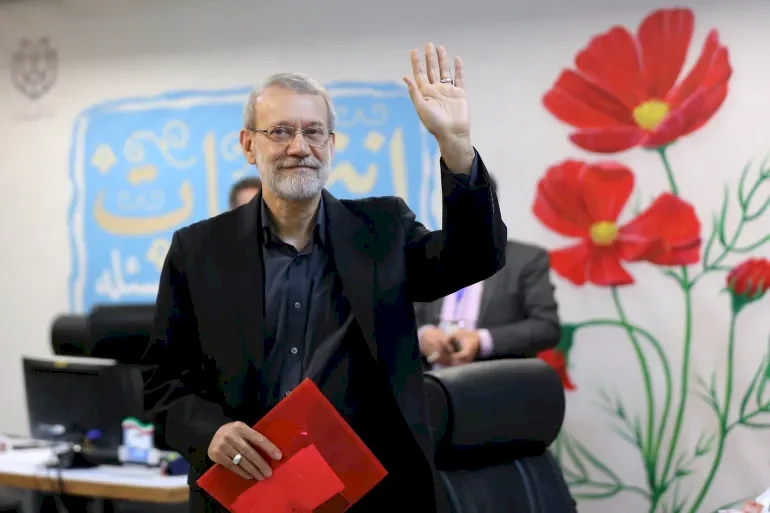
Analysts: The Assassination of Larijani May Strengthen the Military's Grip on Iran
SadaNews - The New York Times quoted several analysts saying that the assassination of the Iranian Supreme National Security Council Chairman, Ali Larijani, in an Israeli airstrike on Tuesday, may pave the way for the Iranian military to tighten its grip on the country's ruling system which is facing an American-Israeli war.
The newspaper stated that Larijani was a bridge between the hardline factions within the military establishment and the more moderate political groups in the ruling apparatus of the country. He effectively became Iran's leader after the initial Israeli airstrikes resulted in the deaths of high-ranking officials, including Supreme Leader Ali Khamenei.
The report indicated that Larijani, described as a seasoned conservative politician, enjoyed the trust of Ali Khamenei, and his responsibilities had steadily expanded over the past few months, playing a coordinating role with allies and neighboring countries.
The newspaper quoted a high-ranking Iranian official, who requested anonymity, stating that Larijani's assassination caused deep shock and raised concerns that Israeli assassinations would continue until the elimination of all members of the Iranian leadership and the downfall of the Islamic Republic.
In a statement to The New York Times, a member of the Revolutionary Guard, who asked not to be named, said that the assassination of Larijani and Basij Force Commander Gholam Reza Soleimani could strengthen the hardliners and consolidate their grip on power in the country.
Militarization of the Regime
Regarding the repercussions of this assassination, Hamid Reza Azizi, an expert on Iranian security affairs at the German Institute for International and Security Affairs, stated that this operation means further militarization of the regime in Iran.
Azizi noted in his conversation with The New York Times that with Larijani's departure, the balance had tipped entirely in favor of the military elite, making it difficult to envision how they could propose new ideas to end the war waged by the U.S. and Israel against Iran.
For his part, Ali Alfoneh, a senior researcher at the Arab Gulf States Institute in Washington, stated that Larijani's assassination would accelerate what he termed the "hardening of the regime" and entrench the Revolutionary Guard's influence.
From an Iranian perspective, Hafez Salehi, a conservative political analyst close to the government, described Larijani as the most important and effective link between the security and political leadership in Iran.
Salehi wrote on social media that Larijani's assassination might reduce the chances of reaching a political solution to end the war.
 Follow the latest Sada News via Google News
High-level sources reveal to SadaNews: Washington seeks to hold a Gaza Reconstruction Conf...

Will the election of Khalil al-Hayya change Hamas's approach and path?!

Iraqji Reveals Details of the Attack on the Iranian Supreme Leader's Headquarters

صراع على إرث خامنئي وسط غياب مجتبى.. والمتشددون يتهمون قادة إيران بـ«الانقلاب»

The European Union Reiterates Its Call for Israel to Refrain from Expanding Settlements in...

"Mamdani Berlin".. The German Left Bets on a Politician of Turkish Descent to Lead the Cap...

Hebrew Channel: Kushner Pushing to Enhance Communication Between the United States and the...
