

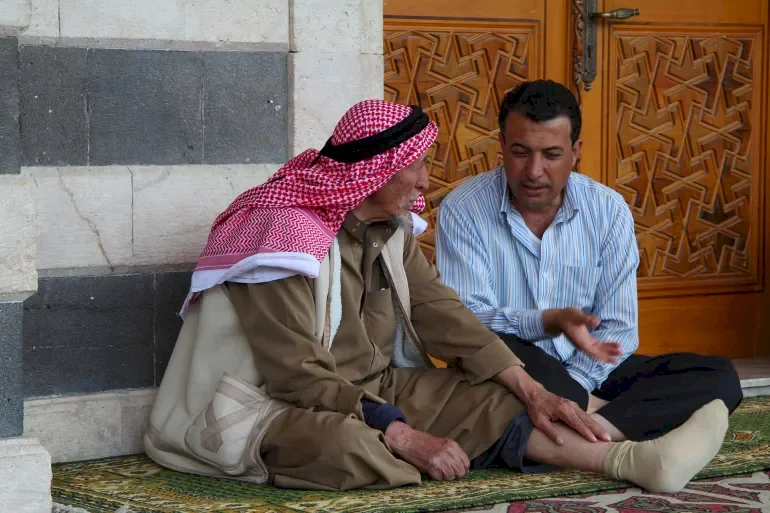
Tarawih, Sustenance, and New Friendships: Stories of Men Beginning with a Prayer and Ending with Lifelong Relationships
SadaNews - In the midst of the closely lined rows for the Tarawih prayer, mosques do not just offer a space for worship and communion with God, but they also transform into vibrant social spaces filled with life and golden opportunities, away from the noise of cafes and the clamor of the internet.
This is confirmed by a study from Cornell University, which highlighted the important role that places of worship play in creating a fertile social environment that contributes to the formation of friendships and building new and strong bonds.
Not Just a Place of Worship
Egyptian lawyer Hussein Mansour is accustomed to gathering with family members at his mother's house in the Ghamra area where he grew up, before leaving it after marriage, like many of his friends who have been separated by living and work locations. Nevertheless, there remains one space that astonishingly reunites old friends.
He says: "The Tarawih prayer on the first day of Ramadan is an official appointment to meet all my friends, neighbors, and acquaintances with whom I have good relationships, and I only see some of them once a year. Everyone comes to break the fast with their families, we pray the Tarawih, then we go out for a little walk and relive our memories."
He continues: "Perhaps this is the only way to see childhood friends for sure without excuses or distractions. The same applies to my current residence, where I meet friends and neighbors whom the pressures of life prevent us from meeting, but we simply and regularly gather next to each other in the mosque daily."
Throughout Islamic history, the mosque has evolved from a mere place of worship to a multifunctional social institution. In an Indonesian study titled "The Mosque as a Center of Civilization," researchers noted that the mosque in the early Islamic community was a center for worship, education, judicial matters, conflict resolution, public affairs management, and community organization. Although some of these political and administrative roles have diminished over time, its religious and social role remains strongly present.
Support Networks Quietly Grow Between the Rows
Egyptian writer Mohamed El-Danasouri is keen to pray at the same mosque in Gharbia Governorate every year, a connection he shares with others. He tells Al Jazeera Net: "Unconsciously, a special bond has developed among us; I miss one of them if they are absent for a night, and I was surprised to find that they missed me when I was absent due to my illness."
He elaborates: "For example, my ophthalmologist had a purely professional relationship, but I was surprised to find him praying next to me every night, which turned into a friendship and mutual inquiry about our conditions and work, with a commitment to pray side by side in the front row. The same happened with others; conversations began during breaks or while waiting for prayer, and the relationships deepened to become real friendships that carry a special reassurance and a safe space, free from conflicts and anxiety, in a strong spiritual atmosphere."
Social support is described as one of the most significant benefits provided by regular attendance at the mosque. In a 2013 American study titled "Emotional Support Inside the Mosque Among Young American Muslims," researchers concluded with key findings:
The more one attends the mosque and participates in its activities, the greater the social support.
Women receive more emotional support than men.
More educated individuals tend to rely less on support networks within the mosque.
Commitment to regular attendance is associated with decreased levels of conflict and negative interactions among worshippers.
From a Passing Peace to a Meaningful Relationship
Dr. Mustafa El-Farmawy does not consider himself a socially outgoing person by nature. The university professor and one of the pioneers of animation in Egypt often finds it difficult to start conversations in gatherings; however, he has many friends and stories within the mosque. He tells Al Jazeera Net: "We gather in good company, I really love to connect with them because our bond is only love and obedience to God Almighty. It resembles what happens during Umrah and Hajj; we show compassion, get to know one another, take care of each other’s interests, and pray in absentia for those who are ill or have passed away among us."
El-Farmawy never imagined that his prayers in the mosque would lead to mutual benefits later on. He recounts: "There was an engineer friend who prayed with me, who knew that I was an animation director, and also knew that the mosque’s sheikh wanted a work to teach children how to perform ablution and pray. That’s how we got acquainted, and a connection formed between us as well as a certain type of work, which subsequently led to another professional collaboration. The unexpected twist came when I wanted to rent an apartment; I was surprised to find that the father of the tenant was a righteous man who prayed with me in the mosque, which made me feel reassured about the decision and agree immediately."
A human journey often begins with a passing peace in the mosque, which social studies describe as an "ideal environment and a bridge to new friendships." There, men and women - each in their own space - exchange common interests that may extend to professional aspects, where a prayer companion becomes a professional advisor or practical supporter. Although this may happen in any other social space, it often occurs within the mosque on the basis of the moral commitment and honesty imposed by the sanctity of the place.
Boundaries of Healthy Relationships Inside the Mosque
Despite all these positives, the world inside the mosque is not a "utopia" free from faults. French sociologist Émile Durkheim warns, in his book "The Elementary Forms of Religious Life," about the necessity of having clear boundaries to ensure that relationships remain within a healthy framework inside places of worship, considering them moral communities that require commitment to behavioral rules that preserve their sanctity and reduce negative interactions, the most prominent of which are:
Excessive criticism and disputes over space, voice, or formal details.
Burdening demands that may lead to psychological pressures on worshippers.
Exclusionary views towards certain groups, such as children, adolescents, or young girls.
Discrimination in treatment between men and women in accessing services or resources.
Critical or aggressive behavior towards some unintentional mistakes.
 Follow the latest Sada News via Google News
After Deschamps' Departure... Zinedine Zidane Tops the Candidates to Lead France

Mbappe Surpasses Messi and Becomes the All-Time Top Scorer in the World Cup

England Defeats France and Achieves Largest World Cup Achievement Since 1966

Messi Refused to Play for Spain and Missed 3 World Cups

Publishers Sue Google for Allegedly Using Books to Train Artificial Intelligence

Google Expands Capabilities of Google Search Console to Support Social Media Accounts

The Mediterranean Table... An Ancient Diet Revealing Its New Secrets for Health and Longev...
