

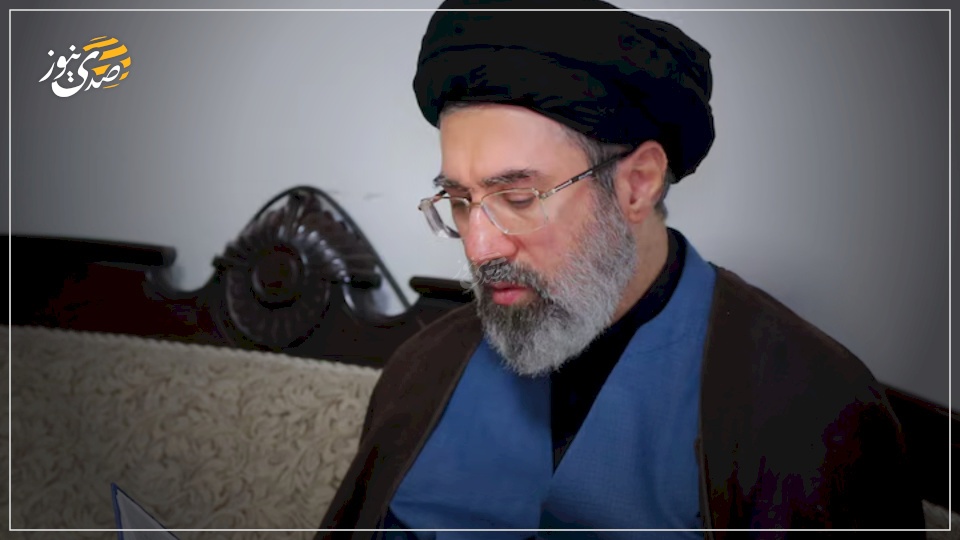
Analysis: Iran Challenges Trump and Prefers Confrontation by Choosing Mojtaba Khamenei as New Supreme Leader
SadaNews - The Iranian leadership has chosen confrontation over compromise by appointing Mojtaba Khamenei as the new Supreme Leader, succeeding his father, Ali Khamenei, in a move that regional officials interpret as a direct insult to U.S. President Donald Trump, who stated that the son is an "unacceptable" option.
The appointment of Mojtaba by the Assembly of Experts solidifies the dominance of the conservative faction in Tehran, a gamble that could reshape Iran's war with the United States and Israel, affecting regions beyond the local borders.
Alex Vatanka, a researcher at the Middle East Institute, noted that "Mojtaba taking power replicates the same scenario."
He added, "This is a significant insult to the United States, to carry out an operation of this magnitude and risk so much only to end up replacing an 86-year-old man with his hardline son."
The Supreme Leader represents absolute authority within Iran's complex system, having the final say on foreign policy and Iran’s nuclear program, as well as directing the elected president and parliament.
Mojtaba Khamenei’s Selection Means Confrontation and Resilience
Analysts argue that Mojtaba’s selection, as a cleric from the conservative faction whose wife, mother, and other family members were killed in U.S.-Israeli raids, sends an unequivocal message that the Iranian leadership rejects any possibility of concessions to maintain the regime, seeing no way forward but confrontation, revenge, and resilience.
Informed sources indicate that Mojtaba will face external pressures due to escalating conflict and internal pressures from dissatisfied citizens, but it is expected he will act quickly to solidify his power.
This is likely to mean expanding the power of the Revolutionary Guard, tightening internal surveillance, and comprehensive repression to crush opposition.
A regional official close to Tehran told Reuters, "The world will miss the era of his father... Mojtaba will have no choice but to display an iron fist... even if the war ends, there will be severe internal repression."
Iran witnesses these developments after months of rising internal unrest that has already weakened the Iranian regime before the war, described as the bloodiest turmoil since the Islamic Revolution in 1979.
Iran is suffering from a deteriorating economy, rising inflation, currency collapse, and increasing poverty rates, alongside intensified repression that has fueled public anger and increased protests; pressures expected to worsen under wartime rule.
Expectations About the Region’s Future Under Mojtaba Khamenei
An Iranian source familiar with the ground situation stated that tough days await Iran under Mojtaba, marked by increased internal surveillance and mounting pressures domestically, alongside a more hostile and aggressive stance externally.
Paul Salem, a researcher at the Middle East Institute, believes Mojtaba is not the qualified figure to pave the way for a deal with the United States or to hold a pivotal diplomatic role.
He stated, "None of the currently rising figures will be able to make concessions; this is a hardline choice made in a difficult moment."
In the view of Iran's religious faction, which many of its followers describe the United States as "the Great Satan," the death of Khamenei, the highest religious authority in the Iranian republic, has elevated him to a status of "martyrdom."
Adherents of this faction have depicted the late leader as a hero, comparing him to Imam Hussein, a symbol of sacrifice and resistance against oppression in Shiite doctrine.
Former U.S. diplomat and Iranian affairs specialist Alan Ayers stated that "Mojtaba is worse and more hardline than his father."
He added that he is the Revolutionary Guard's preferred candidate, and that he will face many acts of revenge.
This choice carries risks, as Israel has vowed to target any successor to Khamenei, while Trump stated that the war will not end until the military leadership and ruling elite in Iran are eliminated.
The New Leader Has Long Opposed Reformists
Mojtaba, 56, is a mid-ranking cleric with extensive influence and has long opposed reformist groups calling for engagement with the West. His close relationships with senior clerics and the Iranian Revolutionary Guard, which dominates Iran's security forces and economy, give him wide influence in the country's political and security institutions.
Mojtaba gained considerable influence during his father's reign as a prominent figure close to the security apparatus and the massive business empire controlled by that apparatus. Analysts have noted that he also built influence behind the scenes as his father's "gatekeeper," the man through whom all files pass, effectively serving as a "mini-Supreme Leader."
His selection comes amid the escalation of the U.S.-Israeli war against Iran, with joint strikes targeting fuel depots and other sites inside Iran, while Iran launched missile and drone attacks on Gulf countries, thereby expanding the conflict's scope.
Mojtaba received his education from conservative clerics in the Qom seminary, the center of Shia jurisprudence study in Iran, and holds the religious title "Hojjat al-Islam."
The U.S. Treasury Department imposed sanctions on Mojtaba in 2019, stating that he is formally the representative of the Supreme Leader despite never holding any elected or official government position.
A Gulf source familiar with the trends of regional governments commented on Mojtaba’s appointment, stating, "This sends a message to Trump and Washington that Iran will not back down and will continue to fight until the end."
Salem, from the Middle East Institute, likened Iran's path to that of Iraq under Saddam Hussein after 1991, or Syria under Bashar al-Assad after 2012, two regimes that withstood war and isolation for years but gradually lost control.
Salem stated, "They (the Iranians) are increasing their wager on the hardline approach. The internal situation is catastrophic and significantly destabilizing."
 Follow the latest Sada News via Google News
Jordanian Army Intercepts 4 Iranian Missiles and 4 Drones

Death of a Moroccan Man During His Arrest in Italy Sparks Calls for Investigation

Due to Trump's Sanctions.. Canada Cancels Joint Ceremony with the US for Bridge Opening

Trump: We will make great progress with Beirut.. Aoun: It is time for Lebanon to be stable

The Lebanese Army Deploys in the South and Comes Under Gunfire; Israel Clarifies

Bezhkian: Directives from the Leader to End the State of No War, No Peace

Meeting Between Aoun and Trump Expected Alongside 'Experimental Areas'
