

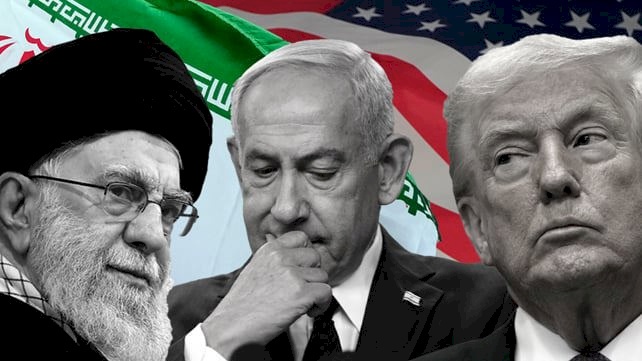
The Secret Call Between Trump and Netanyahu: The Spark of War on Iran
SadaNews - The behind-the-scenes of the war waged by the United States and Israel against Iran continues to unfold, with its reach expanding and transforming into a wide regional conflict.
On the Monday before the war began, Israeli Prime Minister Benjamin Netanyahu informed U.S. President Donald Trump of critical information, notably that Iranian Supreme Leader Ali Khamenei and his senior advisers were about to meet in one location in Tehran on Saturday morning.
According to three sources familiar with the conversation, Netanyahu told Trump and his team that they could all be killed in a single devastating airstrike.
The telephone call on February 23, held from the White House situation room and not previously disclosed, was a pivotal moment that ignited the war on Iran, as Netanyahu and Trump found in Khamenei and his inner circle "tempting targets they did not want to miss."
Trump was already inclined to strike Iran before learning about the intelligence regarding Khamenei's meeting, but Netanyahu's call hastened his decision.
The call was part of months of intense coordination between Trump and Netanyahu, who met twice and spoke on the phone 15 times in the two months leading up to the war, according to U.S. and Israeli officials.
The United States and Israel had considered launching a strike a week before Saturday, according to Axios, but postponed it for intelligence and operational reasons, including bad weather.
An initial examination conducted by the CIA at Trump's direction confirmed the information gathered by the Israeli military intelligence about Khamenei, and preparations accelerated after Trump informed Netanyahu he would consider moving forward, but he had to first deliver the State of the Union address the following night.
U.S. officials said Trump decided not to overly focus on Iran during his speech, so as not to alarm Khamenei and push him to hide before the strike was executed.
By Thursday, the CIA had fully confirmed that "these individuals would all be together."
On the same day, U.S. envoy Steve Whitehouse and Jared Kushner, Trump's son-in-law, called Trump from Geneva after hours of talks with Iranian officials, informing him of a firm decision that negotiations had reached a dead end, reinforcing the President's conviction to launch military action, and at 3:38 PM EST on Friday, he made his final decision.
Eleven hours later, bombs began to fall on Tehran, killing Khamenei and marking the start of the war.
According to Axios, Trump viewed Netanyahu as a close partner and was completely open to hearing his advice on Iran, but he was also determined to exhaust all diplomatic means first.
An American official stated: "One side was negotiating, while the other was laying military plans in partnership with Israel. Trump was constantly assessing both matters."
Under pressure from critics for suggesting that Israel had dragged the U.S. into the operation, U.S. Secretary of State Marco Rubio insisted on Tuesday that this operation "had to happen anyway," and that it was simply a matter of "timing."
He told reporters in the Capitol: "This weekend presented a unique opportunity to take joint action against this threat. We wanted to maximize success."
The original plan called for a strike in late March or early April, to give the U.S. administration time to build public support, and an American official told Axios that Netanyahu pushed to accelerate the attack.
Another American official added that Netanyahu began "inciting and warning that opposition leaders hiding in safe houses were at risk of being killed by the regime."
The expedited timeline put the U.S. administration in a difficult position, as instead of spending weeks building popular arguments for war, the White House found itself justifying the strikes after the bombs had fallen.
The official said: "We did not optimally set the conditions beforehand because the opportunity arose very quickly."
Another official acknowledged inconsistencies in messaging between Rubio and the White House, which began promoting the war after the attack, not before it.
Due to the surprise nature of Trump's and Netanyahu's attack on Saturday, many Americans were completely taken aback and stuck in their locations, prompting the U.S. State Department to launch an emergency evacuation campaign for over 1,500 citizens who requested assistance to leave the region.
When asked on Tuesday why there was no evacuation plan, Trump responded, "Well, because everything happened very quickly."
Meanwhile, Israeli Ambassador to Washington, Yair Leitner, refrained from commenting on the details of the February 23 call but denied that Netanyahu was "inciting" or raised the threat of Iranian opposition leaders as a reason to accelerate the actions.
Leitner told Axios: "Over the past year, we have worked more closely than ever with our partners in the United States regarding Iran, and we completely agree on the threat it poses to Israel, the U.S., and the free world."
The ambassador added: "Anyone who knows Trump understands that he is a strong leader who cannot be directed."
Trump also rejected any suggestion that Netanyahu was the one who made the final decision, stating in a remark on Tuesday: "We were negotiating with those extremists, and I felt that they would start the attack. I was completely convinced of that. In fact, maybe Israel drove us to take a decisive stance."
 Follow the latest Sada News via Google News
High-level sources reveal to SadaNews: Washington seeks to hold a Gaza Reconstruction Conf...

Iraqji Reveals Details of the Attack on the Iranian Supreme Leader's Headquarters

صراع على إرث خامنئي وسط غياب مجتبى.. والمتشددون يتهمون قادة إيران بـ«الانقلاب»

The European Union Reiterates Its Call for Israel to Refrain from Expanding Settlements in...

"Mamdani Berlin".. The German Left Bets on a Politician of Turkish Descent to Lead the Cap...

Hebrew Channel: Kushner Pushing to Enhance Communication Between the United States and the...

SadaNews Report: Israeli Elections with a Settlement Flavor!
