

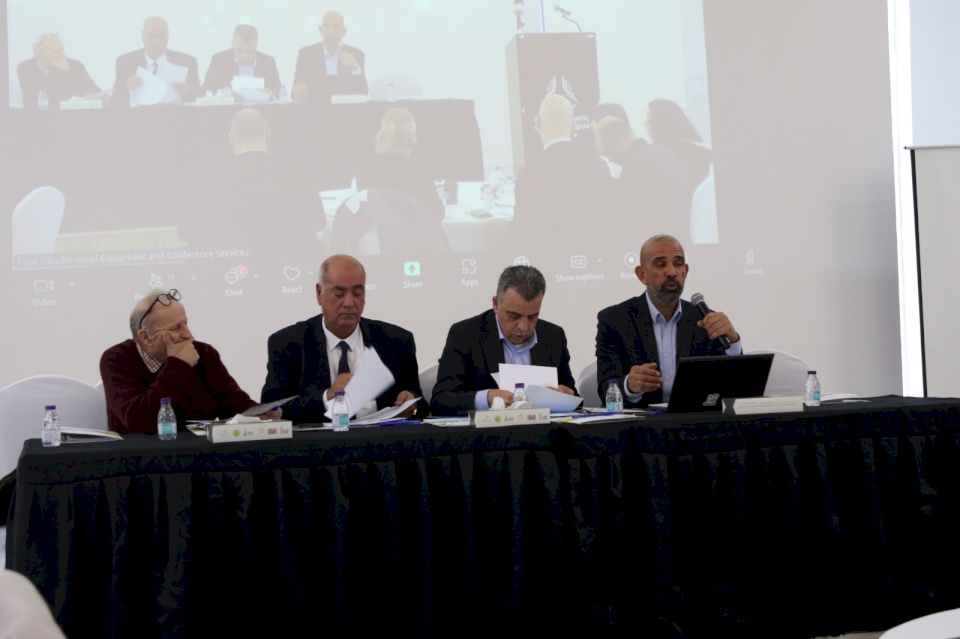
The Conference of the Palestinian Network of NGOs and UNDP Confirms Strengthening Partnership and National Unity to Support Resilience in the Face of Genocide
SadaNews - The conference organized by the Palestinian Network of NGOs in partnership with the United Nations Development Programme (UNDP) recommended that participants, including representatives from the government and civil institutions, emphasize the importance of strengthening existing partnerships and enhancing mutual relations based on a program that prioritizes supporting citizens’ resilience amidst the challenges and threats targeting the entire Palestinian existence, in accordance with the principle of mutual responsibility and commitment. The conference also highlighted the need for Palestinian unity in all areas of presence due to the seriousness of the current situation amid the genocide and occupation policies in the occupied Palestinian territory. It called for support for the steadfastness in the West Bank, Gaza Strip, and Jerusalem, along with adopting a principle of integration in humanitarian and development work across various sectors, regardless of the targeted institution or sector. Participants were urged to view networking and coalition-building as a strategic option that should be developed to ensure fair representation sectorally, professionally, and geographically. Additionally, the proposal emphasized the need to develop existing forms of cooperation and to view differences as a source of strength for the community that requires investment and a transformation into a challenge to renew positive energies and constructive work for the broader public. The conference also recommended that, regarding the donor community, financial support and project assistance should be accompanied by political support, enabling the Palestinian people to achieve their right to self-determination and sovereignty over their land, water, borders, and resources. Humanitarian aid should not replace support for political issues. Furthermore, the conference stressed the importance of prioritizing the issues of Palestinian women amid crises and humanitarian disasters in Gaza, focusing on supporting widows, young women, and orphans through small and micro-projects. At the same time, more attention should be given to the agriculture sector and increasing the ministry’s budget from the public budget, especially following the cessation of support by some donor agencies for livestock feed amid rising risks to the agricultural and livestock sectors. Regarding persons with disabilities, the conference recommended working towards their integration in donor programs and civil institutions, enhancing all forms of support and development programs. It also emphasized increasing the effectiveness and depth of programs based on principles that reduce administrative costs and deepen best practices in civil work while collecting successful experiences and building upon them to achieve the desired results in the spirit of genuine civil work that reflects its values and long heritage.
The conference was inaugurated yesterday morning with a welcoming speech by the Executive Director of the network, Amjad Al-Shawa, via a remote video communication system from Gaza, where he reviewed the catastrophic humanitarian situation in Gaza due to the ongoing open genocide and the continued unjust blockade, along with the prevention of humanitarian aid. Al-Shawa stressed the importance of Palestinian unity to face current dangers, pointing to the state of resilience and the role of civil society, which is the first responder to what is happening. According to Al-Shawa, more than 240 martyrs from civil institution workers have fallen, alongside the destruction of more than 80% of institutions in the sector, in addition to international institutions, the latest being what occurred at the "UNRWA" headquarters in Sheikh Jarrah. He confirmed that these challenges necessitate strengthening cooperation and joint coordination between all governmental, civil, and private sector parties, considering it an essential pillar in confronting the occupation. Despite this, civil institutions have maintained their operations and opened what remains of their premises as shelters and relief centers.
On behalf of the network, he sent a message from under the rubble and tents, urging everyone to work towards achieving unity and restoring roles, calling for the technocratic committee to manage Gaza to fulfill its role, with its first priority being to work towards a comprehensive and permanent cessation of aggression using all possible means to support the resilience of the people after thwarting the plan of the forced displacement of the people of Gaza in a path leading to the realization of national rights. He also called for localizing the relationship with the donor community and continuing to provide support for Palestinian civil work, especially in targeted areas, and reviewed the partnership linking the network with the UNDP that enabled the network to activate many sectors, develop its membership, institutionalize sectoral work and various programs, in addition to advocacy campaigns, including with the Coordination Council for Civil Work that includes various coalitions and institutions.
For his part, Yako Seelyers, the special representative of the director-general of the UNDP, emphasized the importance of partnership and cooperation, noting the conditions in which work operates in the occupied Palestinian territories. He is working to mobilize and provide support from donor governments for civil institutions and develop their projects in various fields, including enhancing the relationship between civil and governmental work, expanding consultations and meetings, working together, and finding solutions to problems faced by the Palestinian community in a creative manner, and organizing work, showcasing the importance of the relationship with the network amidst significant challenges, expressing his readiness to work in Gaza and the West Bank including Jerusalem and to continue providing all forms of support and cooperation.
The conference included the presentation of several working papers during two discussion sessions. The first session, titled "Government Sector Trends to Enhance the Participation of NGOs in Consultations for Developing National and Sectoral Policies," featured Mahmoud Attaya, Deputy Minister of Planning, who called for the continuation and expansion of partnerships between the government and civil society due to its significant impact on enhancing and responding to the government’s national priorities and bridging the gap in trust-building between partners and citizens. He reviewed developmental plans during successive governments and the strategies aimed at ensuring the presence of civil society in them while developing initiatives within advisory councils and various sectors, emphasizing the importance of dialogue, partnership, direct dynamic interaction, and delivering a unified message to the donor community and various international stakeholders. He called for directing assistance to achieve the highest degrees of benefit through national working groups and international institutions, as agreed upon in the 2017 plan, referring to the success of the dialogue which is a responsibility not just of one party but a shared commitment from all sides.
For his part, Refaat Sabah, a member of the Coordination Committee of the network and director of the Teacher Creativity Association, in his paper titled "NGOs Towards Building a Comprehensive Model for Relations Between Different Sectors in Facing Challenges," emphasized the importance of creating a sustainable and integrated partnership among various sectors, describing NGOs as having a fundamental role and not merely serving as intermediaries between society and government. He called for finding an agreed-upon mechanism to manage crises and expanding coordination in the face of the violation of Palestinian society and attempts to dismantle its social structure by the occupation. Regarding the donor community, he stressed the importance of implementing joint programs instead of different executing entities, creating a fundamental transformation in values and policies that protect the values and rights of the Palestinian community and achieve justice.
Majdi Abu Zeid, representing the UNDP, confirmed in his paper regarding "The Role of Donors in Enhancing the Enabling Environment for NGOs" the impact of enhancing the enabling environment for civil work, particularly under current circumstances. He emphasized that supporting Palestinian society is not merely a developmental priority but a necessity for governance and maintaining the elements of life. He focused on building the institutional capacities of civil society in advocacy and various fields, which is of great importance. The UNDP prioritizes activating the Coordination Council for Civil Work, which recently convened in Jericho to unify positions and formulate a unified vision to confront the challenges, highlighting the importance of working groups to overcome obstacles, especially sectoral working groups, and the nomination of grassroots working groups to increase their role.
The second session included significant topics under the title of partnership in various sectors with sectoral models. It featured Minister of Women's Affairs, Mona Khalili, who considered that partnership with civil institutions is a fundamental lever for empowering women and strengthening the resilience of the Palestinian community. She emphasized the role of economic empowerment for women amid Israeli aggression and its deep social and economic impacts. In light of this suffering, partnership is a national necessity imposed by the nature of the phase. She presented the vision of the Ministry of Women and the strategic partnership it has with women’s institutions in the formulation and implementation of policies within the field of civil work that is close to citizens’ lives in various communities. She called on donors to align interventions with national priorities to prevent the dispersion of efforts and transition from short-term programs to medium-term and sustainability.
Minister of Agriculture, Professor Zarq Salimiah, warned of a catastrophe facing Palestinian society amid challenges, as Palestinian land is in the primary target area. He called for protecting it and supporting agricultural projects due to their significance in bolstering the resilience of the people, protecting water resources, and building crucial pillars including sustainability and food security while integrating work among all components to protect existence. He urged investment in providing support for agricultural projects and livestock, stressing the need for donors to direct support for the agricultural sector through the ministry and partner civil institutions and deliver relief support, especially in rural areas and villages, prioritizing olive trees, sheep, field crops, water, and all other fields. He emphasized that any support could contribute to sustaining life by providing fertilizers, feed, pesticides, and seeds to achieve the goal of supporting farmers within the limited resources available, as the ministry’s budget does not exceed 1% of the authority’s general budget.
Dr. Abdul Rahman Al-Tamimi, Director of the Palestinian Hydrologists Group, chaired the first session, calling for breaking the ready-made shells in dialogue grounded in facts to try to forecast the future amid the situation that defines our fate at the height of the battle of awareness. The second session was led by Lawyer Alaa Badarna, legal advisor to the Center for Defending Freedoms and coordinator of the protection sector in the network, starting from the network’s understanding of the importance of dialogue, meeting, partnership, and joint action in an environment characterized by significant changes and fluctuations. It was followed by comments from Haneen Zidan, Director of the Rural Women Development Association, and Monjed Abu Jish, Director of Palestinian Agricultural Relief. The conference, which opened with the Palestinian national anthem and a minute of silence for the souls of the martyrs, witnessed many important interventions from representatives of subnational institutions and women’s institutions, stressing the importance of mobilizing collective action and providing a cooperative work environment among all sectors and components while re-examining everyone’s role in civil society based on the principles of transparency, governance, integrity, and good governance, amid calls to harness all capabilities for pioneering collective work and opening dialogue with all sectors. Project coordinator Heda Al-Saqa moderated the conference, with the recommendations being read by the Director of the Jerusalem Legal Aid Center, Issam Al-Aroori, who confirmed the lengthy path of civil work linked to the issues of the Palestinian public and marginalized groups and supporting resilience in the face of Israeli occupation.
 Follow the latest Sada News via Google News
Sheikh Meets with Representatives of Civil Society Institutions, Praising Their Role as a...

Ministry of Education Sets Friday for Announcing High School Results

مركز كارتر يصدر تقريره النهائي بشأن الانتخابات البلدية في الأراضي الفلسطينية المحتلة التي...

Al-Sharqawi from Geneva: Protecting the special status of Jerusalem requires greater coord...

Lt. General Al-Natsha Undergoes Lengthy Interrogation at Moskobiya Regarding His Represent...

The Occupation Demolishes a House in the Town of Sa'ir near Hebron

Sheikh Offers Condolences for the Martyrdom of Citizens in Deir Jareer
