

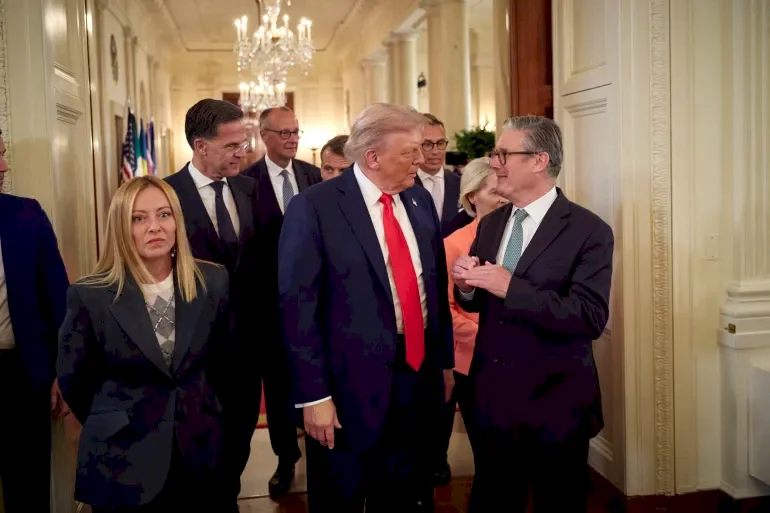
The Washington Post: Trump's Team Attacked Europe for a Whole Year, Now Seeks Its Support in the War
SadaNews - The Washington Post reported that the administration of U.S. President Donald Trump, which has downplayed the importance of European allies over the past year, is now in need of their political and logistical support for military operations conducted by Washington in coordination with Israel to weaken the Iranian regime.
Although the United States has not officially requested European countries to participate in the attack on Tehran, it seeks to use air bases and logistical infrastructure in Europe to facilitate its military operations, placing European capitals in a sensitive political position.
The newspaper pointed out that European leaders have attempted to maintain a cautious distance from the American attack since the beginning of the crisis, yet at the same time they have begun taking defensive military steps in the region, such as sending military reinforcements to the Middle East to protect their bases, citizens, and economic interests, especially with rising oil prices and the potential for a new wave of refugees towards Europe.
Some countries, such as Britain and France, have allowed the use of their bases to support American operations under specific conditions, while other countries, most notably Spain, have refused to engage in this support, angering Trump, who hinted at punitive measures against Madrid, saying, "It took us 3 or 4 days to determine where we could land. We are very surprised."
The article highlights the state of division within Europe regarding how to deal with the crisis, with positions ranging from cautious support for the United States as in Germany, to a public rejection of the war as in Spain, while most European leaders try to adopt a balanced stance that avoids confrontation with Washington while maintaining a semblance of political neutrality.
Increasing Concerns
Director of the Institute of International Affairs in Rome, Nathalie Tocci, expressed that this balance makes European leaders "half inside the war and half outside of it," disregarding their declared values and leaning towards supporting a U.S. President they cannot effectively influence.
This disparity reflects the fragility of transatlantic relations, especially amidst European criticisms of the lack of prior U.S. coordination with allies before launching the attack.
Italian Defense Minister Guido Crosetto stated before Parliament that the war in Iran began "without the world's knowledge" and was not a decision "in which anyone participated," adding that it is "outside the bounds of international law."
"Our missile depots are fully ready"
However, European fears are growing regarding the ramifications of the war, not only on the stability of the Middle East, as the newspaper states, but also on Europe's own security, alongside concerns about escalating geopolitical tensions and the conflict spilling over to other international powers.
In this context, analysts believe that the European continent finds itself once again facing the dilemma of participating in a U.S.-led conflict in the Middle East, a choice that remains unpopular with European public opinion following the bitter experiences in Iraq and Afghanistan.
Ultimately, the article portrays a divided and hesitant European continent, trying to balance its security commitments with the United States against its fears of being drawn into a new war, which could have long-term political, economic, and security repercussions.
Source: Washington Post
 Follow the latest Sada News via Google News
In a Rapid Pace.. The Occupation Builds a Huge Earth Barrier Inside Gaza

Meeting Between Aoun and Trump Expected Alongside 'Experimental Areas'

Gaza Health Warns of Collapse of Oncology Services Due to Depletion of Treatments and Susp...

The Occupation Demolishes a House in the Town of Sa'ir near Hebron

Israel Reveals Details of Secret Iranian Nuclear Facility in Mount Fas

A Mother, Her Child, and Her Three Daughters Martyred in Israeli Shelling on Gaza City

US Military Ends Latest Round of Strikes on Iran
