

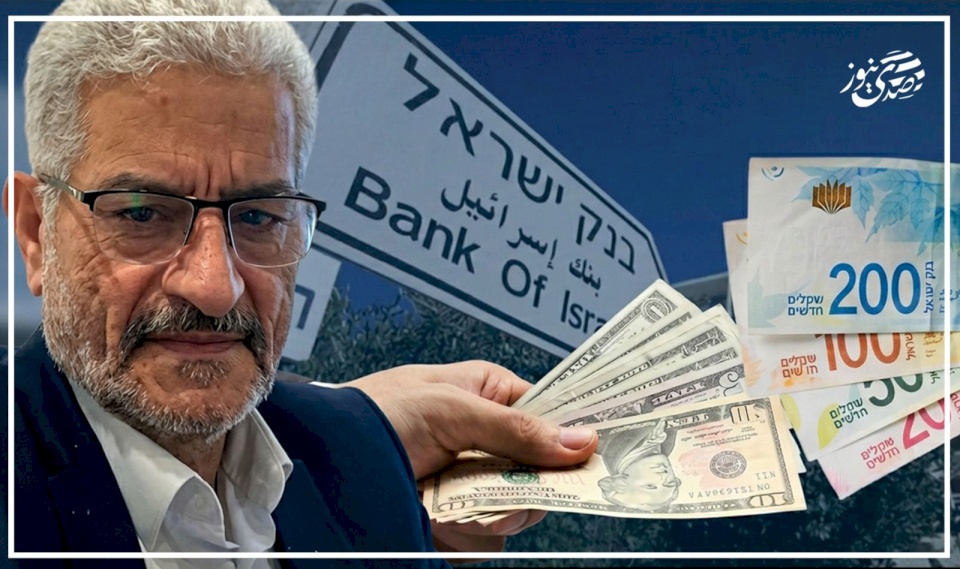
Several Reasons Drive the Shekel Down Against the Dollar.. When Will the Exchange Rate Exceed 3 Shekels?
Exclusive to "SadaNews" - The question is no longer "if" but "when"; several political and economic reasons have intertwined and are now pushing the shekel down against the dollar, and we are now just a short distance away from the dollar's exchange rate surpassing the 3 shekel barrier.
Banking and finance expert Muhammad Salama tells "SadaNews" that the current data indicates that the dollar's exchange rate against the shekel should range between 2.90 shekels and 3.10 shekels. He explains that the technical analysis map for measuring price volatility or the bilateral relationship between the two currencies suggests that the movement between the lowest and highest price may reach a range of 1700 points, noting that the market cannot move for three weeks below this margin.
He adds, "The natural average for measuring the level of volatility over a medium period, that is, between three to five months, is less than a range of 1700 points. Therefore, Salama predicts that the dollar's exchange rate will remain around this point (2.90 to 3.10 shekels) in the coming period, with an appetite for additional increases based on new developments.”
He continues, "The dollar's exchange rate against the shekel, based on the current data, should not drop below (2.85-2.88 shekels), while the possible higher price is the range of 3.10 shekels for the dollar, with a possibility of building a technical base that would encourage further increases.” He points out that the current technical analysis indicates that if the dollar's exchange rate remains stable against the shekel at the 3 shekels barrier for two consecutive days, it would form a base for further increases. He adds, "If the exchange rate closes for two consecutive days above 3 shekels, it will have reached a point that is difficult to descend from again for a long time, as the dynamics of pressure have begun to gather points leading the price upwards, and it will be difficult to return below previous exchange levels, as this price gains greater confidence and support and opens the appetite for increases.” He believes that the recent drop in the exchange rate to 2.80 shekels reflected reaching a saturation phase in the strength of the shekel, as the Israeli economy could not withstand this level of shekel strength, and technically it had reached a saturation point that the market rebounded from. This was not a corrective step; previously, the exchange rate rose from 2.80 shekels to 2.98 shekels, which was a corrective step, but the exchange rate has dropped again and is currently experiencing a natural rise, not corrective, due to several factors.
He states, "Technical analysis indicates the beginning of a rising phase for the dollar against the shekel, which may be slow but is nearly continuous; volatility will remain a characteristic but the general direction is upward.”
He adds, "Exchange levels could reach 2.98 shekels within days, and within a week it may try to reach 3 shekels,” indicating that the phase of reaching an exchange rate for the dollar that exceeds 3 shekels is approaching. He continues, "News regarding the shekel's decline will come in succession.”
Regarding the factors driving the shekel down against the dollar, Salama states that the primary reason enforcing a reduction in the shekel's strength against the dollar is the continued strategic risks according to Israeli readings despite the agreement reached between the United States and Iran aimed at ending the war.
He explains that part of the shekel's strength was based on expert expectations that the end of the war would contribute to mitigating strategic security risks facing "Israel." However, this did not happen; rather, the opposite occurred despite the Iranian-American agreement. He points out that the agreement sent signals within "Israel" about a decline in its standing before the United States, as most of the agreement's provisions do not favor "Israel." He notes that a significant portion of the shekel's strength in the preceding period relied on pricing operations regarding the elimination of geopolitical risks following this war, but as this has not been achieved, the markets will reevaluate the exchange rate, leading to a reduction in the shekel's strength.
He states, "When analyzing the factors that reduce the strength of the shekel, the most important point currently is the geopolitical ambiguity surrounding the agreement and the future of American-Israeli relations," indicating that the markets have also absorbed the matter of a change in the Israeli elections with the opposition's advantage, providing signals about the near end of Benjamin Netanyahu's government, in addition to the existence of internal conflicts within Israeli society that is heading towards igniting sharp social disagreements such as recruitment issues and others.
The second reason pushing the dollar up against the shekel is the ambiguous policy pursued by the US Federal Reserve, which has provided indications about its intentions to stabilize or raise interest rates in the upcoming period, rather than lowering them.
He adds, "The US Federal Reserve had been providing indications regarding its monetary direction; in the case of an intention to raise interest rates or lower them, it usually gave hints to prepare the economic environment for a financial policy decision. However, it no longer seems to want this, as the markets are affected by those indications to the extent that when interest rates are raised or lowered, the markets have already absorbed those previous hints.
He continues, "The Fed no longer wants to base its decision on prior indications," noting that this reduces the Fed's transparency and increases ambiguity in the markets due to the lack of clarity in monetary policy and the imposition of uncertainty.” He adds that the beneficiary of this situation is the US dollar, as investors are rushing towards the strong currency. He states, "The dollar does not belong only to the United States; about 58% of the cash reserves held by central banks worldwide are in dollars, which is deemed the world's primary currency.”
Salama concludes with two reasons related to the US Federal Reserve's policy that have led to the dollar's value increase. The first is the Fed's discussion about the value of inflation, as it sees this stage as dismissing any lowering of interest rates while keeping the possibility of raising them later. The second relates to the increasing level of ambiguity regarding monetary policy, which raises the risk premium.
Among the factors driving the shekel down, are the Bank of Israel's tendencies to lower interest rates, as lowering interest rates leads to a reduction in the cost of local Israeli bonds, meaning the borrowing cost. Credit rating agencies prioritize the cost of borrowing for the state in their decisions; when the state's risks are high, it means increased credit risks, which implies that the cost of borrowing is high. He adds, "Currently we are living in a period of interest rate cuts, which reduces financing costs, and the end point of the war has dissipated according to Israeli desires, and the interest rate risk premium has not risen but has not fallen to a certain level as dictated by the new data.”
 Follow the latest Sada News via Google News
Soaring Oil Prices Burn the Pockets of the Palestinian Citizen "The Poor"

Millions of Dollars in Losses.. "SadaNews" Reveals Shocking Figures for Traders from Pales...

The Problem of Shekel Overcrowding Worsens.. Fuel Station Owners Threatened with Closure o...

The Palestinian Economy at a Crossroads: 4 Files Awaiting Resolution

Several Reasons Drive the Shekel Down Against the Dollar.. When Will the Exchange Rate Exc...

Currency Exchange Rates Against the Shekel on Sunday (June 21)

Exchange Rates of Currencies Against the Shekel (June 20)
