

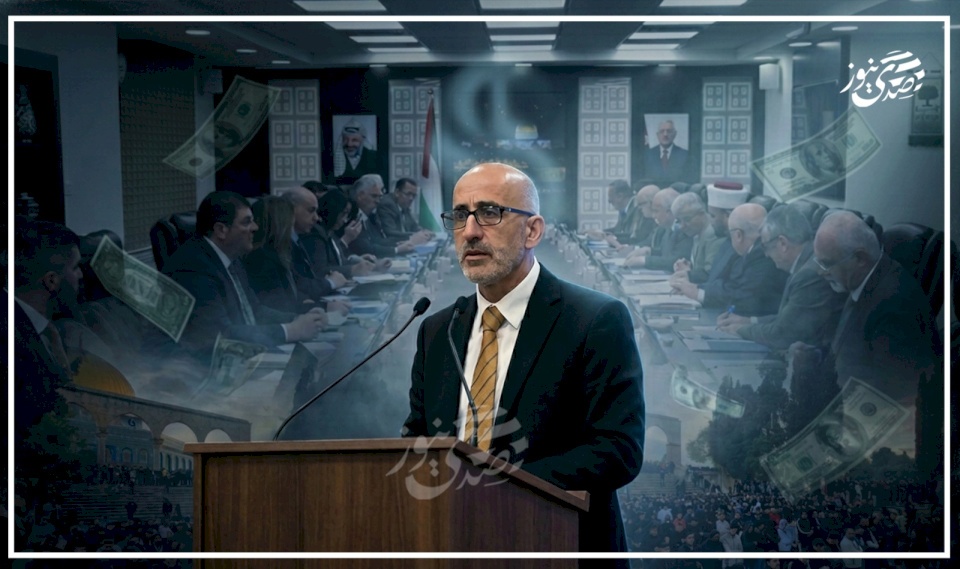
After "Earth Solutions" Ended.. Can the Government Arrange a Salary Percentage Before the Eid?
Exclusive SadaNews: The financial margin for the Palestinian National Authority diminishes month after month as "Israel" continues to withhold all clearance tax funds for the tenth consecutive month, which constitutes about 68% of the total revenues. Last month, Minister of Finance and Planning Dr. Steefan Salama held a press conference to showcase the depth of the financial crisis that the National Authority is experiencing, which he described as an "existential crisis," indicating that the authority managed to provide the 60% in the last payment with a "near miracle" without revealing the sources of the funds, which SadaNews learned were based on local revenues and bank facilities guaranteed by local bodies.
When SadaNews posed a direct question to the minister about whether the current crisis would push the National Authority to deviate from the usual expenditure rate in recent months, which reached 60% with a minimum of 2000 shekels, the minister did not provide a definitive answer, merely stating that the Ministry of Finance and Planning would disburse according to what is available to them.
Dr. Steefan Salama, who was preparing the employees and public for the worst based on the available financial data, stating "Earth Solutions have ended," referring to the exhaustion of local tools, simultaneously declared the ministry's inability to continue the usual expenditure rate, which the government has adhered to throughout recent months, explaining that to disburse 60% of the salary with a minimum of 2000 shekels, approximately 720 million shekels need to be secured, which is a nearly impossible task amidst the continued withholding of clearance funds, and no prospect for foreign aid before mid this year, in addition to declining local revenues which do not exceed 350-400 million shekels monthly, amidst obligations of the National Authority towards banks to service public debt amounting to about 300 million shekels monthly.
As the end of the holy month of Ramadan approaches and Eid al-Fitr arrives, public sector employees numbering about (172) thousand are wondering about the timing and percentage of salary disbursement amidst a significant government shortfall.
SadaNews learned from an informed source that the situation this month is considered the worst ever since the establishment of the Palestinian National Authority in 1994, noting that the timing and percentage of salary disbursement have not yet been finalized, but he confirmed that the percentage will surely be lower than in previous months; the Ministry of Finance cannot provide the usual disbursement percentage based on the current data.
The source pointed out that the situation would become clearer over the next week, but he confirmed that the data is bad as local revenues were below expectations, indicating that the hope was that consumer activity during the month of Ramadan would be high, which would have boosted local revenues, but that did not happen due to the decline in citizens' purchasing power, in addition to the outbreak of war on Iran and the imposition of more closures and checkpoints affecting commercial movement and local tax returns. The source predicted that the National Authority would try once again to seek facilities from the banking sector, but downplayed the likelihood of success in this step, given the government's inability to provide guarantees.
The source emphasized that the situation would not be fully clear until the end of next week, but the current data is not positive and imposes a complex reality that will push the government towards difficult options, including attempting to arrange a percentage of the salary (40-50% for example), or disbursing a portion of the salary while the government commits to paying a second installment after the holiday (for example, disbursing 30% before the holiday and the same after some time after the holiday), or disbursing a fixed amount to all employees (2000-2500 shekels for example).
It was noted that all options remain on the table and have not been decided yet, pending what revenues will be available, but he excluded that the government would succeed in providing the disbursement percentage in recent months.
It is worth noting that Israel has completely halted transferring clearance funds for nearly (10) months in an attempt to dry up clearance funds and push for a financial collapse, noting that it had not transferred more than a third since the events of October 7, 2023, after imposing additional deductions on clearance funds related to salaries of public employees in the Gaza Strip estimated at about 272 million shekels monthly.
Numbers from the Ministry of Finance and Planning revealed that the government's debt and accumulated obligations to various categories reached about 47.4 billion shekels by the end of 2025. Meanwhile, the monthly salary bill is about one billion and fifty million shekels while Israel is withholding about (16) billion shekels from clearance funds, which are being dried up through compensation lawsuits raised by settlers in Israeli courts. The Minister of Finance and Planning previously indicated that the number of lawsuits filed against the National Authority in Israeli courts reached (475), with compensation estimated at about (65) billion shekels, meaning that the amount of compensation could reach about four times the value of the withheld clearance funds.
 Follow the latest Sada News via Google News
Soaring Oil Prices Burn the Pockets of the Palestinian Citizen "The Poor"

Millions of Dollars in Losses.. "SadaNews" Reveals Shocking Figures for Traders from Pales...

The Problem of Shekel Overcrowding Worsens.. Fuel Station Owners Threatened with Closure o...

The Palestinian Economy at a Crossroads: 4 Files Awaiting Resolution
Fuel Crisis in the West Bank: Supply Disruption or Liquidity Shortage?

Government Contact Center Issues Clarifying Statement Regarding the Establishment of a Gov...

Exchange Rates of Currencies Against the Shekel Today, Wednesday (July 22)..
