

The Most Significant Interventions Implemented by the Palestinian Government Last Week
SadaNews - The Government Contact Center issued a report highlighting the most important developmental and reform interventions implemented by the government today, Sunday, during the past week as follows:
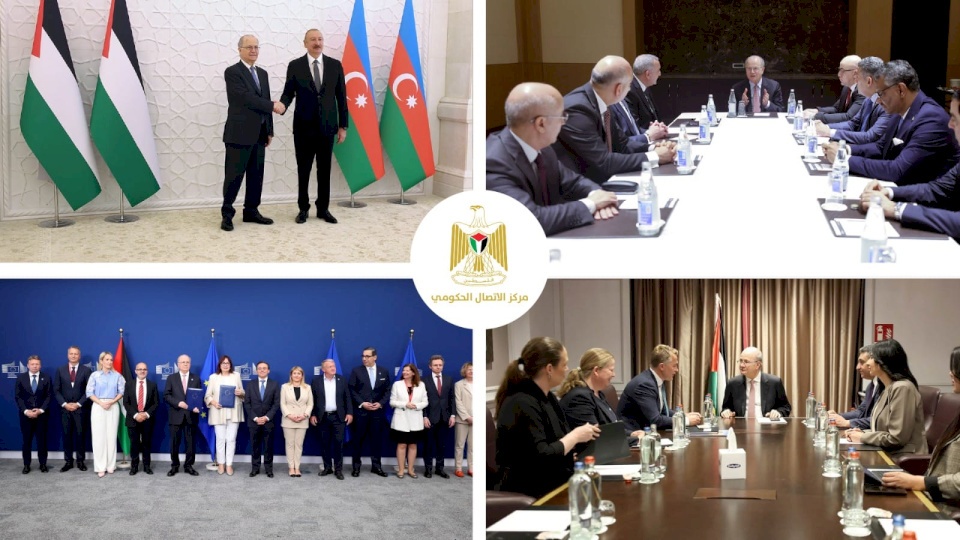
Prime Minister Mohammad Mustafa chaired the second ministerial meeting of the Donor Group in Brussels with the EU Commissioner for Mediterranean Affairs, attended by representatives from 65 countries and international institutions. He called on them to enhance political and financial support, fund the emergency budget, accelerate the reconstruction of Gaza, and support an independent Palestinian customs system. The meeting concluded with international pledges to support our people in the Gaza Strip with about one billion dollars.
Mustafa also discussed political developments with the EU High Representative and several European officials, demanding the release of clearance funds, the opening of Gaza crossings, and the enhancement of relief and reconstruction efforts, emphasizing the central role of the UN Relief and Works Agency (UNRWA).
The Ministry of Social Development implemented a package of social and humanitarian interventions in the West Bank and Gaza Strip, which included providing food and non-food assistance to 1,984 families in the West Bank worth 261,145 shekels, executing 25,000 food and non-food interventions in Gaza, and distributing 900 cups of drinking water in Gaza.
It also executed 89 interventions for the protection of women in the West Bank and 6,332 in Gaza, 133 interventions in the childhood file and 42 in the youth file in the West Bank, in addition to 40 interventions for child protection in Gaza. A total of 171 orphans in the West Bank benefited from the ministry's services, compared to 605 interventions dedicated to orphans in Gaza, alongside 43 interventions for persons with disabilities, 36 for the elderly, 101 health insurance services, 23 interventions in the daycare file, 18 interventions for economic empowerment, and 56 initiatives to support charitable associations and community work, enhancing the social protection system for the most needy groups.
The Minister of Agriculture announced the start of disbursing the second installment of the agricultural assistance program valued at 2.2 million shekels to support 52 agricultural projects in the West Bank.
He also conducted a tour in Jenin that included signing two agreements to establish two agricultural parks on 30 dunams in partnership with the Jenin Municipality, inaugurating a water reservoir in Kafr A'ari with a capacity of 1,000 m³, inspecting projects in Ya'bad, Burqin, Kafr Ra'ai, and 'Arraba, and visiting the factories of spring cucumbers, Tank, Kanaan, and Al-Hafid. He discussed with Al-Azhar University/Gaza the rehabilitation of the Faculty of Agriculture and Veterinary Medicine and with the South African ambassador the expansion of agricultural partnership and building on the success of the Initiative Project. The national campaign for vaccinating and tagging livestock against foot-and-mouth disease exceeded 97,000 heads in the Massafer Yatta and northern Jordan Valley regions.
The ministry conducted field visits and projects in 'Aqabah in partnership with "We Effect" and "ARIJ" under the "LIFT-Palestine" program. It also distributed 14,274 seedlings to 61 farmers in Taffouh, supported by "Diakonia," and 110 agricultural kits to 110 beneficiaries in the central Jordan Valley in partnership with ARIJ and funded by the Central Manonot Committee. It provided 4 hydroponic units and 3 biogas digesters to 7 farmers in Kafr Al-Lubad, Ballah, and Anabta in partnership with ARIJ and Save the Children.
In Tulkarem, agricultural equipment for fish feed production was received as part of the "SANET" project. In Hebron, farm school supplies were provided to 27 beneficiaries in Sa'ir and Beit 'Ola, which included 150 barrels and 1,000 sacks of fertilizer, seeds and seedlings were distributed to 90 farmers in Al-Dahariyya in partnership with the Land Research Center, Krek, and Al-Dahariyya Municipality. Training was conducted for 40 beneficiaries in Dhneiba on the production of bee wax creams, and Um Safa was supported with 14 bales of straw and 14 water tanks. A tour for 20 breeders was organized to a sewerage treatment plant in Jericho in cooperation with "EcoPeace Middle East," and 240 bales of alfalfa were distributed to 200 beneficiaries in Idna in partnership with "ESDC" and funded by Oxfam.
Moreover, irrigation networks were delivered to 30 farmers in Mithlon in partnership with "GIZ" and funded by German cooperation. The minister received the village council of Beit Al-Roush Al-Fouqa to follow up on the agricultural water pond project and provided agricultural supplies to 29 farmers in Iskaqa and Farqa, and to Beit 'Ola farmers funded by "UNDP," while an agreement was signed to pave agricultural roads in Tamoun in the Tubas Governorate.
The Ministry of Education and Higher Education launched a summer school program in approximately 600 schools to compensate for educational loss, summer incubators for school media, organized the "Land and Identity" art exhibition, concluded the Palestine "PalSTEM" Olympics, conducted a field tour in the Hebron Education Directorate, and organized a support visit to the Al-Raf'iya School in Yatta, announcing the dates for employment interviews for educational, vocational, and support positions for the 2026-2027 academic year.
The minister followed up with the Korean team on the implementation of the National Center for Artificial Intelligence and Emerging Technologies project until 2031, and discussed with the head of the Supreme Judicial Council the enhancement of a safe educational environment and raising awareness of juvenile justice.
The ministry also announced the names of candidates for Romania scholarships, opened registration for the comprehensive practical exam, and the Student Loan Fund announced the completion of sorting loan applications. The ministry organized three training sessions for teaching staff members and launched the second conference for resilience and challenge for Tawjihi students, inviting students and parents to rely on the ministry as an official reference before joining any higher education institution inside or outside the homeland.
The Energy and Natural Resources Authority worked on developing the infrastructure for the electricity and renewable energy sector, as it discussed the development of the ‘Aorta electricity network and its transformation from low pressure to medium pressure to enhance network efficiency and improve service quality and meet increasing demand, while stressing the continuation of implementing infrastructure projects in villages and towns threatened with confiscation to strengthen citizens’ resilience.
It agreed to include the municipality of Carmel in the "Sunshine Palestine" program by establishing a solar energy station with a capacity of 1 megawatt and providing the school and health center with solar energy systems to ensure the sustainability of services and lower the electricity bill.
In Nablus, a provisional license with a capacity of 500 kilowatts was granted to Nur Al-Din Joudah for renewable energy to establish a solar project in Talouza, which will benefit about 170 families as part of efforts to enhance investment in renewable energy and reduce dependence on imported energy sources.
The Ministry of Transport and Communications launched the "E-Kroka" electronic system for managing traffic accidents and discussed the regulation of the motorcycle, electric bicycles, and scooters sectors. It also confirmed the continuation of the free licensing campaign for agricultural tractors and conducted the first tractor licensing exams for 30 farmers in Yatta, continuing its monitoring campaigns on vehicles and inspection center visits.
On the engineering side, the ministry studied 6 plans for new road construction, 13 plans for road amendments and investment projects, 26 technical files, and 9 plans for new sites, in addition to studying the structural plans for Kafr Aqab and Wadi Al-Far'a. It received 20 complaints, accepted 14, closed 9, while 92 complaints remain under processing.
Additionally, 14,204 vehicle movements and 10,800 driver movements were recorded. A total of 1,516 property transfers were completed, 738 plates were issued, 316 initial registrations were completed, 204 distinctive numbers, and 16 transactions for engineering equipment were carried out. In terms of qualifications, 2,215 theoretical tests and 1,423 practical tests were conducted, resulting in the accreditation of 683 new drivers. The business sector was supported with the issuance of 333 operating licenses and the completion of transactions for 20 transportation companies.
The Ministry of Interior and its institutions executed a series of interventions to enhance public safety and security, including a tour by the Minister of Interior in Hebron Governorate to assess the readiness of security institutions and their plans, enhance coordination among agencies and law enforcement, and discuss cooperation with the municipalities of Hebron and Dura.
The minister also chaired a meeting of the Economic Security Team to discuss enhancing the protection of public funds, stopping violations of water lines and public and government lands, combating economic crimes, and the ministry approved measures to regulate tourism facilities and enhance public safety, including restricting licensed and unlicensed establishments and tightening supervision and taking legal actions against violators.
The police arrested 1,241 wanted individuals, including 9 serious offenders, executed 3,834 judicial warrants, and 56 drug control missions, and followed up on 274 criminal incidents.
Civil defense executed 290 firefighting missions and 81 rescue missions, issued 229 permits for facilities and crafts, inspected and licensed 275 elevators, and carried out 854 public safety rounds. Customs control monitored 73 tax and customs evasion cases and market monitoring, and destroyed 6.68 tons of violating goods.
The Civil Affairs Commission continued to implement humanitarian interventions in the West Bank governorates, including organizing visits to the Ibrahimi Mosque in Hebron and opening Shuhada Street, empowering farmers, releasing citizens and crews, and bringing in foodstuffs.
In Jenin, the Jalama station was reopened, electrical and water networks were maintained, and the entrances to Zbuba were opened. In Nablus, the establishment of a fence around the gas station in Deir Sharaf was enabled, and in Salfit, entrances to Qarawat Bani Hassan, Deir Balout, and Ravafat were opened, along with maintaining electricity and releasing citizens, and extinguishing fires.
In Qalqilya, maintenance of roads and lands took place, empowering farmers, and entering seedlings and fodder; and in Jerusalem, the rehabilitation of the Biddu tunnel, maintenance of electricity in Al-Eizariya, coordinating funerals, and extinguishing fires. In Jericho and the Jordan Valley, the repair of electricity lines in Al-Auja was done. In Tubas, water was restored to Al-Buqia and water lines were maintained in the eastern part of Aatouf.
The Ministry of Public Works and Housing paved 600 meters of the Jifna–Birzeit road with funding from the Arab Bank for Economic Development in Africa and the Islamic Development Bank management, and continued work on reconstructing the Al-Masafah–Khalat Al-Mia–Yatta road, and rehabilitating Amman Street in Jericho and Wadi Al-Badhan–Al-Far'a road (phase one).
In Nablus, and the road linking the Suleiman Pools–Artas in Bethlehem, and it expanded and leveled the Kfirat–Al-Arqa Hashemite road in Jenin, 2 km long with ministry machinery, and completed 29 projects for main and connecting roads, and supervised 5 building projects in Ramallah, Al-Bireh, and Hebron with a total area of 3,936 m², surveyed damages to homes demolished by the occupation in Qalqilya, and prepared for a meeting to raise traffic safety at the Biddu tunnel. The ministry conducted tests for the Aboon–Rawabi–Atara road to complete the design of its rehabilitation, prepared to launch a tender for the rehabilitation of the Um Al-Sharayet–Rafat road funded by Arab and Islamic funds under Islamic Development Bank management, and completed the design of phase two of the Al-Far'a–Al-Badhan road in Nablus.
It also opened tenders for sewage networks west of Jenin, and the construction of the main management and service building at Nablus Vocational and Technical University (phase one), and the expansion of the Bureen Basic School for Boys in Nablus. In Gaza, it began implementing the "Ahmad Al-Amir" shelter center east of Hamad City in Khan Yunis, covering over 25 dunums in partnership with the United Nations Development Program and the Palestinian Housing Council, and completed the survey of 33,018 residential buildings and 160,680 housing units in various governorates of the sector.
The Minister of Local Government inaugurated the development and operation project of the Salfit Municipality Park, with funding of 375,000 shekels from the Dutch Municipalities Union and with contributions from the municipality and a private company. He also assessed the Tel Al-Hawa area in Nablus and reviewed the road rehabilitation and water network project executed at a cost of 880,000 shekels. He met with local authorities in Salfit Governorate to discuss its developmental needs.
He discussed the needs of the joint services councils for solid waste management in northern and northwestern Jerusalem, Ramallah, and Al-Bireh, confirming the allocation of funding to expand the monitored landfill in Beit 'Anan and provide local authorities with waste containers, in addition to following up on the challenges facing waste collection crews due to occupation practices.
The Minister of Foreign Affairs and Expatriates held a series of diplomatic meetings with international entities, where she met with a delegation from the ruling authority headed by the president of the institution and the former president of Ireland, and included the former prime minister of New Zealand, emphasizing the importance of intensifying international efforts to raise the Palestinian voice, applying international law, ending the genocide war on Gaza, releasing the withheld Palestinian clearance funds, and halting the measures to Judaize Jerusalem and the settlement expansion.
She also gave an interview to Palestine TV about the role of diplomatic work in building alliances and mobilizing political and humanitarian support. During her visit to Nablus Governorate, she met with the governor and the administration of An-Najah National University, and participated in a dialogue meeting with students and academics, emphasizing continued international efforts to confront settler terrorism.
The Ministry of Tourism and Antiquities announced the continued reception of visitors at the archaeological site of Solomon Pools and Bal'a tunnel within programs to introduce tourism and archaeological sites, organize cultural and awareness tours in Bethlehem, Al-Eizariya, and Nablus, alongside inspecting the sites in Al-Ubeidiya, following up on the development of the Ain Al-Salman site, holding a workshop to inventory and register heritage buildings in Al-Bireh, and signing a cooperation agreement with the Antiquities Rescue Center at the Institute of Material Culture History of the Russian Academy of Sciences to enhance the protection of antiquities, scientific research, and exchange of experiences and implementation of joint programs.
The Ministry of Labor, in cooperation with the Sharek Youth Forum and with the support of the European Union, launched the "Generation of Crafts" campaign in Jericho to encourage youth to acquire skills that meet the labor market's needs. In Gaza, the Palestinian Employment Fund implemented interventions to support economic recovery, including signing 8 new contracts under the "Path towards Economic Resilience" project, bringing the cumulative total to 610 contracts, collecting and transporting 8,000 m³ of solid waste, and continuing to support companies and workers under the Business Recovery Initiative, alongside preparing to launch the "Training for Recovery" project to develop vocational training programs.
The ministry also conducted monitoring and protection work for workers, involving 59 inspection visits of 46 facilities, targeting 147 workers, taking 20 legal actions, receiving 15 complaints and 29 consultations, and conducting 7 awareness meetings, in addition to safety and occupational health visits that included 34 facilities and 454 workers, recording 16 violations and investigating 7 workplace injuries.
The Ministry of National Economy, during this week, implemented interventions to enhance economic cooperation and support the private sector and green economy, through discussions of cooperation with "BMZ" and "GIZ," and participation in a conference specialized in delivery technology and e-commerce, alongside following up on providing the ministry's services with high quality within a decentralized system, maintaining consumer rights, and ensuring their benefit from services, especially concerning quotas.
The Consumer Protection teams conducted 85 inspection rounds covering 498 commercial establishments, to ensure market safety and protect consumer rights, capturing 712 kg of violating materials and destroying 28 tons of unfit materials, and processing 22 complaints and referring 3 violators to the prosecution. In facilitating traders' work, the ministry accomplished the registration of 51 new companies and 572 company transactions, issued 87 import licenses and 20 foreign trade transaction cards and 25 certificates of origin, alongside completing 81 transactions in the commercial registry and registering 12 trademarks as part of intellectual property services.
The Ministry of Justice approved 43 arbitrators from the industrial sector in Gaza, after completing advanced training supported by the Sawsiah 3 program, according to arbitration law and the criteria for accrediting arbitrators for the year 2025. The Minister of Justice discussed the political, legal, and humanitarian developments in the Palestinian territories with the German ambassador, and addressed the legislative election file and the impact of having an elected legislative council on political life.
The Environment Quality Authority executed interventions this week to enhance monitoring and protect the environment, which included 49 inspection rounds and following up on 10 environmental complaints and granting 8 environmental approvals for industrial projects, alongside returning 3 Israeli trucks loaded with demolition and construction waste to their source after being seized while attempting to illegally introduce them.
It also discussed with partners the draft of the Environmental Law and lists of endangered species, participated in a field tour of villages northwest of Jerusalem to enhance resilience, and organized an environmental trail in Beit Ijza and workshops on the safe management of hazardous materials and waste.
The Minister of Industry reinforced Palestinian-Libyan cooperation during a visit to Tripoli, where he delivered a written message from Prime Minister Muhammad Mustafa to the Libyan Prime Minister Abdul Hamid Dbeibeh, discussing with the Libyan Ministers of Industry and Economy ways to expand industrial, economic, commercial, and investment cooperation, and met with the President of the General Union of Chambers of Commerce, Industry, and Agriculture in Libya to strengthen private sector partnerships and open new markets for national products. He participated in the 29th session of the General Assembly of the Arab Industrial Development and Mining Organization, emphasizing the importance of Arab industrial integration.
The ministry also participated in the preparatory meeting for the second phase of the Green Forward project in partnership with UNIDO to support 10 food factories by applying cleaner production. On the level of the governorates, the ministry issued 4 licenses for establishing new industrial facilities, and two operating licenses for the first time with a capital of 78 thousand Jordanian dinars, providing 5 job opportunities, renewed 19 industrial licenses, executed 23 inspection rounds, held technical committees for accrediting laboratories, and reviewed a quality file.
 Follow the latest Sada News via Google News
Occupation Proposes Tender to Build 342 New Colonial Units in "Ariel" Settlement

Hebrew Channels: Israel on High Alert Amid Conflicting Estimates on Tension with Iran

Israeli Army Announces Interception of Drone on Border with Syria

Zamir: We are Monitoring the Situation in the West Bank, Iran, and All Fronts and Preparin...

Netanyahu Fortifies Himself with 7 Seats in Likud

European Diplomatic Missions Express Concern Over the Detention of Palestinian Prisoners

Video: Iranian Missiles Strike Jordan and Israel as the United States Responds
