

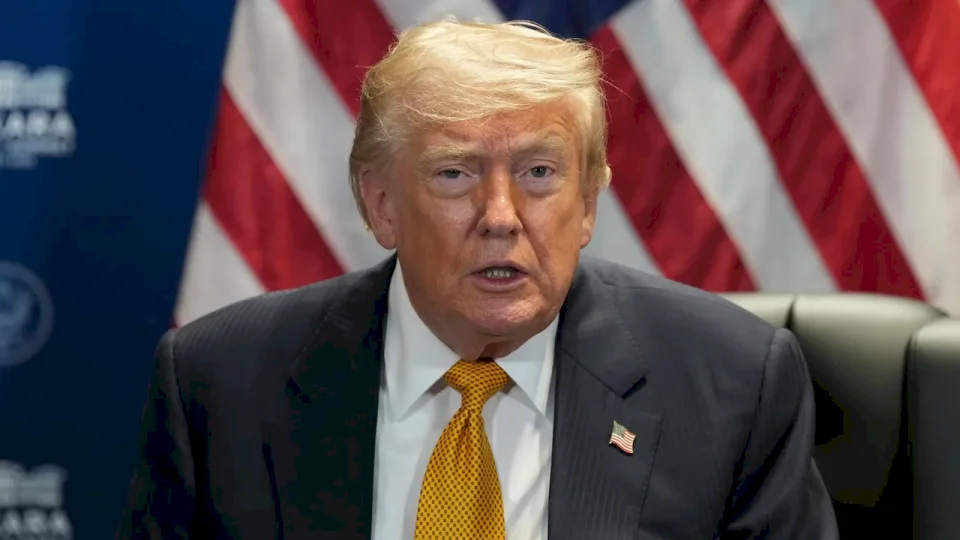
Guardian: Trump is a Weapon of Mass Destruction and the Greatest Threat to the World
Sada News - The writer Simon Tisdall offers a sharp critical reading of U.S. President Donald Trump's policy towards Iran, arguing that the greatest danger lies not only in the strength of the adversaries or the nature of the conflict, but in the absence of a clear strategy to manage the crisis.
The foreign affairs commentator for the Guardian believes that Trump's self-love is the number one global enemy, stating, "It is the main reason behind the escalation of this war in an uncontrollable manner. He is a mobile weapon of mass destruction."
He adds that Trump has become the most dangerous factor in the Iranian crisis, claiming that his management of the conflict has led the United States and the world into a political, economic, and military deadlock that is hard to escape from.
In his column for the Guardian, the writer describes the renewed war against Iran as a result of hasty decisions lacking a clear strategic vision, warning that continued escalation could lead to a long-term open war with global repercussions.
Statements Inconsistent with Reality
The writer points out that the United States has resumed bombing Iran, including civilian facilities and infrastructure, without achieving decisive goals, noting that these strikes do not weaken the Iranian regime as Washington expects, but may bolster the position of hardline factions within Iran, helping them rally support and justify their security policies.
Tisdall criticizes Trump’s and U.S. Defense Secretary Pete Hegseth’s statements about achieving victory, considering that discussions of a "great victory" do not align with reality, as the United States has failed to achieve its major goals, and the humanitarian, economic, and political costs of the war are rising.
According to the writer, the most realistic current U.S. objective is to control the Strait of Hormuz or reopen it to international navigation, after it has become a strategic pressure point in the conflict.
As for the original goals announced by the United States and Israel, such as eliminating the Iranian nuclear program, weakening Tehran's allies in the region, or changing the Iranian regime, they have become more difficult than ever, the writer notes.
Stuck in a War of Attrition
The article contrasts Trump’s approach with that of former President George W. Bush during the Iraq War, noting that although Bush's war was disastrous, he decided on a full ground invasion when he believed Iraq posed a significant threat, whereas Trump does not want to bear the consequences of a full-scale war in Iran, while simultaneously refusing to acknowledge the failure of the path he has chosen, leaving him stuck in a long war of attrition, according to the writer.
The writer holds Trump’s personality and thinking style primarily responsible for the ongoing crisis, believing that his decisions are influenced more by a desire to display strength and achieve political victories than by long-term strategic calculations, indicating that the problem lies not only in the nature of the Iranian regime but also in the American leadership style that has pushed escalation without a clear exit strategy.
The article affirms that this decision-making pattern has recurred in other international issues, citing Trump’s plan regarding Gaza and his stance on the Russian-Ukrainian war. In the Gaza issue, the writer states that Trump’s peace plan did not achieve significant progress; indeed, issues of reconstruction, disarmament, and security arrangements remain unresolved, while the humanitarian and political situation continues to deteriorate.
As for the Russian-Ukrainian war, the writer criticizes Trump’s handling of the crisis, arguing that he focused on pressuring Ukraine instead of addressing the causes of the war or confronting Russian President Vladimir Putin’s policies, in a manner that reflects, in the writer's opinion, a consistent pattern of hasty decisions that disregard long-term consequences.
Who Can Stop Trump?
Tisdall warns that the continuation of the war could lead to widespread ramifications that extend beyond the Middle East, as ongoing tensions in the Gulf threaten global trade and energy flows, and any disruption in the Red Sea due to movements by Iranian-backed Houthis could lead to rising oil prices and increased economic pressures on developing countries.
The writer also believes that Washington’s European allies are concerned about the American path and that U.S. adversaries, particularly Russia and China, could benefit from the disorder and the diminishing image of Washington internationally.
At the end of the article, the writer poses a fundamental question: who can stop Trump? He points to the lack of response from the administration to Congress and its failure to engage with the widespread public opposition to the economic costs of the war, as well as the inadequacy of allies and their fear of retribution from Trump.
Tisdall concludes that continued escalation could transform a limited confrontation into a global crisis affecting international economy and security, at a time when opportunities for a political solution appear to be more challenging due to the loss of trust among the parties.
 Follow the latest Sada News via Google News
Video: Iranian Missiles Strike Jordan and Israel as the United States Responds

Martyr and Injured in Israeli Airstrike in Khan Younis

After US Announcement.. Jordan Denies Evacuating Aqaba Airport and Its Port

The Presidency: There is no legitimacy for the occupation's actions in Jerusalem, the West...

The Most Significant Interventions Implemented by the Palestinian Government Last Week

The Ministry of Education Announces the General Implementation of Open Educational Resourc...

To Demolish Them.. Occupation Forces Notify Eviction of Houses in Kafr Aqab North of Jerus...
