

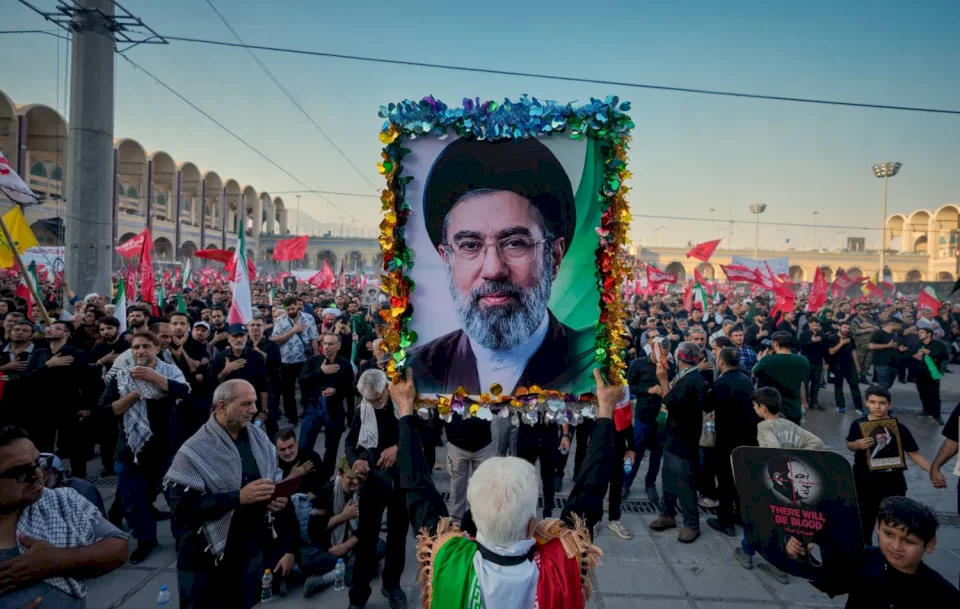
Injured Son Fears Assassination... Why Did Mojtaba Khamenei Abscond from His Father's Funeral?
SadaNews - The absence of the new Iranian leader Mojtaba Khamenei from his father's funeral intensified speculation surrounding him, raising questions about whether he is truly managing the country, and how serious his injuries are from the Israeli-American attack at the beginning of the war on Iran, according to the U.S. news network "CNN."
The network added that it is believed the new leader was injured in the attack launched by Israel and the United States in February, which killed his father, mother, and wife; since the outbreak of the war, he has remained in hiding, communicating with his supporters only through written statements, without showing his face or being heard publicly.
Token Figure...
It pointed out that Mojtaba's absence from his father's funeral could reinforce the opposition's belief that he is incapable of performing his duties, suggesting that his appointment was intended to assign decision-making responsibility to a token figure; his absence may make it impossible to target or eliminate him.
However, even among the most enthusiastic supporters of the regime, Khamenei's absence may arouse doubts and open the door to criticisms that were previously considered taboo, amid internal struggles regarding diplomacy with Washington, an approach staunchly opposed by Iran's most hardline factions.
Meanwhile, Iranian officials attempted to downplay the seriousness of his injuries and promote an image reflecting his complete recovery, claiming that he was the one managing Tehran's negotiations with Washington, while also trying to establish a respectful image of him on the street and in the official media narrative.
If Mojtaba had appeared at his father Ali Khamenei's funeral, it would have been his first known public appearance since his appointment as leader.
Before the funeral, Israel had also issued threats against "Khamenei the son"; Israeli Defense Minister Israel Katz stated that the new leader "is threatened with assassination."
U.S. President Donald Trump stated last month that Khamenei the son is "more rational" than his father, before implicitly acknowledging that the new leader is alive but suffers from "severe injuries."
In contrast, Iranian medical officials stated that Khamenei did not sustain serious injuries from the strike.
In May, U.S. intelligence estimated that he had played a pivotal role in shaping the war strategy alongside senior Iranian officials.
Mohsen Milani, a university professor and author of the book "Iran's Rise and Its Competition with the U.S. in the Middle East," stated: "Given Iran's significant intelligence failures during the war, any public appearance by Mojtaba could expose him to assassination.”
He added that this would endanger "both the leadership succession process and Tehran's ability to negotiate with Washington or manage a renewed conflict."
Ali Vaez, director of the Iran Project at the International Crisis Group, stated: "His absence indicates either excessive security concerns or severe injuries from which he has not sufficiently recovered to appear publicly."
Vaez added: "The continued absence may raise some questions among the principal backers of the regime, but equally importantly is the role he plays behind the scenes in mediating between the political and security elites who may differ in their views on domestic and foreign policy issues."
He noted that "not appearing publicly does not mean escaping accountability, whether due to the authority he theoretically possesses or the lack of such authority in practice."
Managing Authority...
For its part, the French newspaper "Le Figaro" published an analysis regarding the new leader's absence from his father's funeral, raising questions about how power is managed in Iran, at a time when estimates suggest that the recent war has prompted the regime to rearrange centers of power to suit the new phase.
The "Revolutionary Guard" at the Forefront
Despite the new leader's absence from the public scene, several indicators suggest that he is managing the country in coordination with senior National Security Council members and leaders of the "Revolutionary Guard" and intelligence agencies, amidst a clear decline in the role of civilian figures, including President Masoud Bezhakian.
Observers believe that the war has produced a bolder leadership in decision-making, without this being reflected in its approach to dealing with opponents, as the strict security approach remains present, while the influence of military and security institutions in managing strategic files has intensified.
Internal Flexibility
On the other hand, experts warn against interpreting the rise of the "Revolutionary Guard" as a complete exclusion of other institutions, considering that the current phase is based on a distribution of roles between the military institution, which is responsible for enhancing deterrent capacities, and diplomacy, which continues to manage the political and legal trajectory of relations with the United States.
On the domestic front, the new leadership demonstrates flexibility in certain social issues, as the authorities have continued to look the other way regarding many women's failure to adhere to wearing the hijab, indicating their awareness of the difficulty of reverting to past policies after the protests that have beset the country.
Observers believe that the reconfiguration of power did not begin only with the recent war, but has roots dating back to 2018, following the U.S. withdrawal from the nuclear agreement and the return of sanctions. Since then, a new generation within the state institutions has emerged, possessing greater academic and organizational experience, but not differing from their predecessors in their adherence to hardline approaches, which has, according to these estimates, enhanced the regime's ability to endure during the recent confrontations.
 Follow the latest Sada News via Google News
High-level sources reveal to SadaNews: Washington seeks to hold a Gaza Reconstruction Conf...

Injured Son Fears Assassination... Why Did Mojtaba Khamenei Abscond from His Father's Fune...

Estimates: 40 Million Tons of Rubble in Gaza Need $2.5 Billion for Removal

Hebrew Media: Abbas's Call to "Shaath" Holds Political Significance for a New Administrati...

أموال المقاصة.. الغريق يتعلق بقشة!

"Mistreatment After Death".. 104 Palestinians Died or Were Killed While in Custody in Isra...

Report: Israeli Prisons Have Turned into a 'Grave' for the Living
