

Yasser Arafat Foundation Holds Seminar on Israeli Elections, Change Prospects, and Their Reflections on the Palestinian Cause
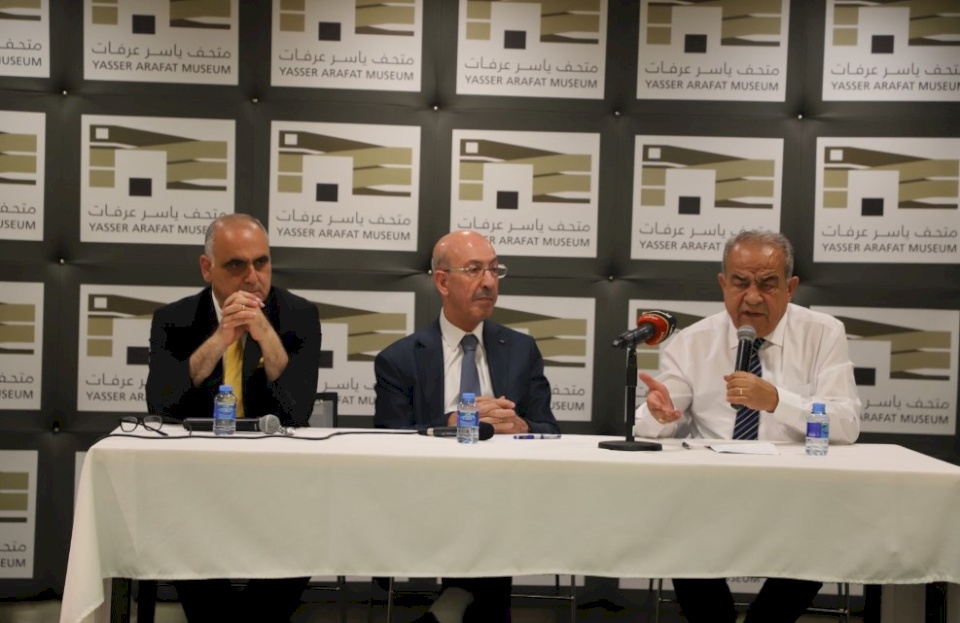
SadaNews - The Yasser Arafat Foundation held a discussion seminar titled "Israeli Elections: Prospects for Change and Their Reflections on Us" on Tuesday, June 30, 2026, at the forum hall of the Yasser Arafat Museum, attended by members from the Central Committee and Revolutionary Council of Fatah movement, along with notable figures, writers, and activists.
The seminar featured participation from Dr. Nazih Majali, a researcher on Israeli affairs and Palestinian writer, Wadi Abu Nasar, director of the International Consultancy Center and honorary consul of Spain in Haifa, and Dr. Ahmad Sobhi, chairman of the Yasser Arafat Foundation.
In his opening speech, Dr. Ahmad Sobhi stated that the seminar aims to shed more light on the upcoming Israeli elections as well as the American midterm elections, considering that the results of both will have a direct impact on the Palestinians. He emphasized that a realistic engagement with ongoing events is necessary to serve the Palestinian cause.
He added that Palestinians are committed to utilizing all their political, legal, and activist tools, primarily steadfastness and the international legal path, to keep the Palestinian cause present on the international agenda. He emphasized that maintaining momentum and international support for the Palestinian cause requires reinforcing national unity in the West Bank, Gaza Strip, Jerusalem, and inside Palestinian territories.
For his part, Dr. Nazih Majali affirmed that Israeli elections affect the Palestinian cause both temporally and spatially; however, the essence of the cause remains regardless of the succession of Israeli governments. He noted that Israel is experiencing a decline on various political, economic, social, and educational levels, alongside rampant corruption within its institutions, pointing out that several ministers are facing trials related to corruption charges amid an internal crisis faced by the state due to the current government's policies.
He added that personal considerations play a major role in Israeli elections, as Prime Minister Benjamin Netanyahu seeks to remain in power, while opposition forces work to change him without providing a more serious political alternative. He explained that Netanyahu exploits various developments to strengthen his political position and prolong his time in office.
Majali indicated that the Israeli right remains the most influential political force and urged Palestinians inside to work on two parallel levels: one field-based and the other political, to enhance their presence and influence. He also stressed the importance of not losing hope, remaining committed to the national cause, and preparing to face upcoming challenges, affirming that the formation of a joint Arab list would enhance unity among Palestinians within the 1948 territories and grant them greater political influence.
Furthermore, Wadi Abu Nasar emphasized the importance of strengthening unity within the Arab ranks, so that Palestinians do not turn into a party subjected to the political reality, noting that true strength lies in internal cohesion and not allowing others to dictate national choices.
Abu Nasar explained that there are three main approaches to understanding governance systems: class-based, pluralistic, and elitist, calling for utilizing these perspectives in reading the upcoming Israeli elections. He also stressed the need for wise, courageous, and sincere Arab leadership to confront the policies of the Israeli government, which, as he put it, seeks to liquidate the Palestinian cause, displace populations, and spread despair within the Palestinian community.
He confirmed the necessity for Arab citizens within Israel to exercise their democratic right to choose who represents them and influences the formation of the Israeli government, considering that the results of the elections could affect the trajectory of the Israeli project in the region, and that the responsibility for leveraging this influence also rests on the shoulders of Palestinians and Arabs.
He also pointed out the importance of integration among components of Palestinian society and working according to a clear plan to minimize losses and maximize national gains, noting that small parties often play a decisive role in forming Israeli governments, and that the leftist current still exists, although its presence is limited. He further noted that former President Donald Trump represents an influential factor in the upcoming Israeli elections.
At the end of the seminar, the floor was opened for discussion, where opinions were exchanged and questions regarding the Israeli political scene and its ramifications on the Palestinian cause were addressed.
 Follow the latest Sada News via Google News
Yasser Arafat Foundation Holds Seminar on Israeli Elections, Change Prospects, and Their R...

Sheikh Receives French Consul General and Swiss Confederation Representative in Farewell M...

Occupation Storms Al-Mughayir Following Settler Attack on the Village Outskirts

RVF Foundation Launches New Water Desalination Unit in Northern Gaza Strip

Incursions and Arrests Targeting Workers in the West Bank

Media Without Walls: Reality, Effects, and Testimonies of Journalists' Journey to Homeless...
Media Without Walls: Reality, Impacts, and Testimonies of the Journeys of Displacement for...
