

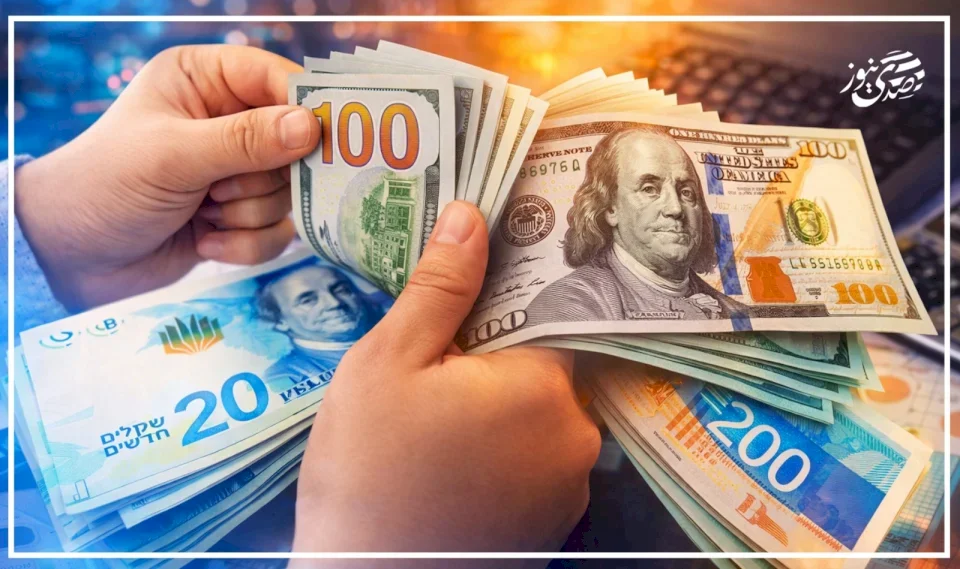
Israeli Economists Discuss Fluctuations in Dollar and Shekel Exchange Rate
SadaNews Economics Translation - The Israeli Shekel has stopped rising noticeably and unexpectedly during this month, after trading at 2.80 against the dollar, or slightly above or below that in May, only to return again to 3 Shekels, making the Shekel one of the weakest currencies in the world last month.
In fact, the only currencies that outperformed the Shekel in terms of exchange rates were the Norwegian Krone and the Russian Ruble, both of which were affected by falling oil prices, as noted by the Globes Hebrew economic newspaper, translated by SadaNews Economics.
Moody Shaffer, chief financial market strategist at Bank Hapoalim, said that the sharp change in the value of the Shekel compared to other currencies around the world is due to several factors, including: the rise in the value of the dollar globally (with an increase exceeding 2% against a basket of currencies during last month), the increase in risk premium in Israel since the signing of the agreement between the United States and Iran, the intervention of the Bank of Israel in the currency, the decline in the Nasdaq index, and the interest rate differentials between Israel and the United States.
He pointed out that this is parallel to the reflection of the trend of financial institutions' exposure to fluctuations in foreign exchange rates after a year and a half, which may lead to a worsening decline in the value of currencies.
One way to measure the risk premium is by comparing the yield on Israeli bonds with the yield on American bonds, where the difference between them, known as the "spread," reflects the risk premium that the market assigns to Israel.
Shaffer noted that there is another method based on credit risk swap contracts, which are financial instruments issued by financial institutions and used as collateral against default for bondholders, where the investor pays a periodic premium, and in return, if Israel defaults, the institution that issued the contract will pay the interest and the principal on its behalf according to the terms of the agreement.
The economist explained, as translated by SadaNews Economics, that the price of the credit risk swap contract is determined by basis points, citing that in November 2022, before the announcement of the legal reform, the risk insurance premium in Israel was just below 40 basis points, which means that the insurance cost at that time was 0.4% of the insured amount. At the peak of the reform, it ranged between 60 and 65 basis points, and with the outbreak of the war on October 7, it jumped to between 140 and 160 basis points.
He noted that after the ceasefire agreement, there was a sharp decline, reaching about 49 points, but since then it has begun to rise steadily and is currently around 54 points.
The risk premium reflects investors' perception of the risks of the Hebrew state, including geopolitical risks. The performance of the Israeli stock market and the Shekel moves in parallel with the risk premium, although each has many other factors affecting it, as Shaffer says.
He added: Currently, both the Israeli stock market and the Shekel are experiencing weakness, and the geopolitical situation has led to inflated market prices in the Israeli capital market, according to investors' opinions.
According to Shaffer, the differences in interest rates between Israel and the United States also weaken the Shekel. While markets in Israel expect an interest rate of 2.9% yearly, the markets in the United States still anticipate an increase in interest rates despite the decline in inflation expectations in light of falling oil prices.
He continued: The most important factor beyond the interest rate expectations is the real interest rate, meaning the one adjusted for inflation, which indicates the purchasing power generated for the investor after accounting for inflation.
He pointed out that last May, the Bank of Israel purchased approximately $800 million to ensure the market's stability, while market estimates indicate it continued to intervene in the foreign exchange market in June as well.
He referenced statements made by Bank of Israel Governor Amir Yaron at a recent economic conference, where he emphasized that the bank's intervention goes beyond mere visibility, stating: With falling inflation expectations nearing the minimum, this justifies a faster expansionary monetary policy.
The Israeli economist explained Yaron's statements, stating that as inflation expectations approach 1% after the sharp rise in the Shekel's value, the bank accelerates its interest rate cuts. As translated by SadaNews Economics.
Globes reports that recent declines in technology stocks have caused significant drops on Wall Street, directly impacting the Shekel's value.
Meanwhile, Jonathan Katz, chief economist at Leader Capital Markets, one of Israel's leading financial and investment institutions, said: Financial institutions in Israel determine their exposure to fluctuations in exchange rates, but let’s suppose that the exposure ratio is stable and American company stocks have risen, these institutions would have to sell foreign currencies to maintain the same level of exposure they planned for.
Katz added, as translated by SadaNews Economics, that in addition to this principle linking American stock performance with exchange rates, there is another new trend emerging on the horizon.
Katz analyzed data from the Bank of Israel and found that in April (when the temporary ceasefire with Iran was signed on the 8th of the month), financial institutions increased their exposure to the foreign exchange market to 20.5% compared to 19.1% in March, which also indicates investors’ evaluations of risks in Israel, representing a change in the overall trend.
He explained that the exposure rate to fluctuations in foreign exchange began to rise during 2023 under the legal reforms, increasing from about 19% before the war to about 23% in September 2025, and since then, this rate has been witnessing a steady decline.
Katz commented: Institutional investors recognized the improvement in geopolitical risks, but this data is from April, and we are now in June ... We must remember that we witnessed strong Shekel performance in March and April, which was positive for global markets... I can only assume that they have not changed their position since then amidst the fragility of the ceasefire and ongoing fighting in the north, while the geopolitical interpretation of the agreement in Iran may not be in Israel's favor.
He added: If institutional investors continue to increase their exposure, this is a definite factor contributing to the currency's decline, affirming at the same time that the exchange rate issue is affected by a complex array of factors, with institutional investors being among the most important of these factors, but not the only one.
He noted that institutional investors influence in two ways: the first is their reaction towards foreign stocks, and the second is Israel's perspective on the risks associated with its exposure level to the foreign exchange market. He added: It is likely that the element of reducing exposure is no longer available at this stage, so we will be more affected by the direction of the US stock market.
According to the Hebrew site, economists point out that this is still a historically low level for the Shekel, unprecedented in the past thirty years.
He pointed to a memo sent by Bank of America to its clients, suggesting they open buying positions on the dollar against the Shekel and the Hungarian Forint, highlighting the structural factors affecting the Shekel, and its near-complete dependence on the performance of the S&P 500 index, which the bank expects to sharply decline by about 5% over the next year.
Bank of America sets a timeframe of three months and assigns goals for investors, as while the exchange rate is roughly 2.99 Shekels, the target set by the bank is 3.14 Shekels, indicating that the exit point from the deal and loss reduction is the dollar price dropping to 2.9 Shekels.
The site emphasized that the foreign exchange market is a deep and complex market affected by numerous factors and is difficult to predict, if not impossible, citing that prior to the start of the war in Iran last March, which was followed by a rapid rise in the value of the Shekel, Goldman Sachs recommended selling the Shekel and buying the dollar.
According to Shaffer, the factors leading to the Shekel's weakness against the dollar are present, but there are fundamental forces supporting the Shekel's strength in the long term, including a surplus of exports over imports and significant investments in Israel's high-tech sector.
Shaffer adds: The Shekel remains strong, and despite its weakness, it is expected that the Bank of Israel will cut interest rates ... Both we and the market expect a 100% rate cut in July, but it does not seem that it will be sharp.
According to him, after the price index in May, which was a positive surprise, there was talk of reducing the interest rate by half a percentage point, but the Shekel's weakness does not encourage that. He said. As translated by SadaNews Economics.
Shaffer concludes that in the past year and a half, the rise in the Shekel's value has contributed to reducing inflation, but looking at the next six months or more, if inflation remains at these levels or decreases, the situation would be slightly more inflationary, but this is a long-term process. He said.
 Follow the latest Sada News via Google News
Soaring Oil Prices Burn the Pockets of the Palestinian Citizen "The Poor"

Millions of Dollars in Losses.. "SadaNews" Reveals Shocking Figures for Traders from Pales...

The Problem of Shekel Overcrowding Worsens.. Fuel Station Owners Threatened with Closure o...

The Palestinian Economy at a Crossroads: 4 Files Awaiting Resolution

Israeli Economists Discuss Fluctuations in Dollar and Shekel Exchange Rate

The Coordinating Council for the Private Sector: We hold the Israeli side responsible for...

Bank of Israel: Limited Increase in Financial Assets Driven by Domestic Factors and Declin...
