

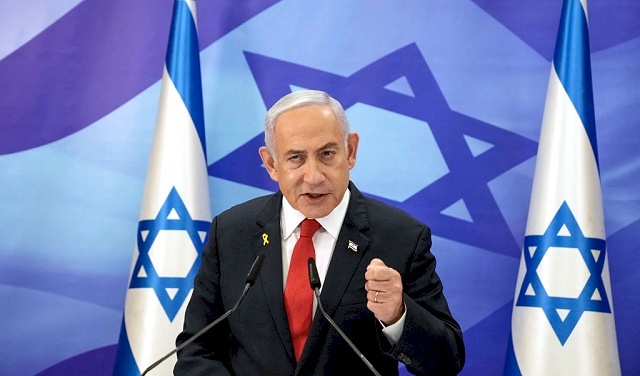
Israeli Poll: Netanyahu Leads Eizenkot, His Bloc Stuck at 52 Seats
SadaNews - A public opinion poll in Israel has shown that the Likud party, led by Benjamin Netanyahu, would be the largest party if elections were held today, securing 24 seats, while the "Yeshar" party, led by Gadi Eizenkot, solidifies its position at the forefront of the opposing bloc, compared to an additional decline for the "Biyahad" party led by Naftali Bennett.
According to a poll by Channel 12, the results of which were published on Monday evening, the overall picture of the camps remains unchanged; the current coalition parties would secure 52 seats, while the "Zionist opposition" would receive 58 seats, and the Arab parties would garner 10 seats.
The poll gives Likud 24 seats, keeping it at the top of the parties, followed by the "Yeshar" party led by Eizenkot, which gains one seat for a total of 22 seats, while the "Biyahad" party, which united Bennett and Yair Lapid, continues to decline, securing 17 seats.
The "Democrats" party led by Yair Golan ranked fourth with 10 seats, while both Shas, led by Aryeh Deri, and "Yisrael Beiteinu" led by Avigdor Lieberman maintained their strength, each obtaining 9 seats.
The "Otzma Yehudit" party led by Itamar Ben Gvir declined by one seat, securing 8 seats, while the "Yahadut HaTorah" party led by Yitzhak Goldknopf maintained its strength with 7 seats.
The Joint List and the Arab List for Change declined by one seat compared to the previous poll, each obtaining 5 seats. Meanwhile, "Religious Zionism" led by Bezalel Smotrich crosses the electoral threshold, securing 4 seats.
According to the poll, the "Kahol Lavan" list led by Benny Gantz would remain outside the Knesset, receiving 2.5% of the voters' support, along with the Yoaz Hendel list, which attracts reserve soldiers, with 2.2%.
The poll also examined a scenario involving a joint list led by Gantz, including "Kahol Lavan" and Hendel, and General in Reserves Samhi. In this scenario, the joint list would secure 6 seats, gaining one seat compared to last week.
In this scenario, the coalition bloc would decline to 50 seats, with the current Zionist opposition parties obtaining 54 seats, while the two Arab lists maintain 10 seats. Likud would decrease to 22 seats, and the "Yeshar" party would go down to 20 seats, while Bennett's "Biyahad" would fall to 15 seats.
In terms of suitability for the premiership, Netanyahu regained the lead over Eizenkot after four weeks, widening the gap between him and other candidates. In a direct face-off between Netanyahu and Eizenkot, Netanyahu received 37% compared to 36% for Eizenkot.
In a matchup between Netanyahu and Bennett, Netanyahu received 40% compared to 32% for Bennett. Against Lieberman, Netanyahu also received 40%, while Lieberman garnered 23%.
The poll also addressed the framework agreement signed over the weekend between Israel and Lebanon, with 46% of respondents supporting the agreement, while 19% opposed it, and 35% stated they did not know.
The results showed that support for the agreement with Lebanon was higher among opposition party voters, with 54% indicating their support, compared to only 44% among coalition party voters.
Conversely, a majority of those surveyed opposed the deal being discussed between Netanyahu and the ultra-Orthodox parties, which, according to the channel, involves granting the Haredim a package of legislation including "Basic Law: Study of the Torah" and immunity from arrest for draft dodgers, in exchange for Netanyahu passing laws to separate the role of the legal advisor to the government, media laws, and a law to form a political investigation committee into the failures of October 7 and set a mutually agreed-upon date for elections.
The poll showed that 60% of participants opposed this deal, compared to 26% who supported it, indicating a widening gap between Netanyahu's coalition considerations and the positions of Israelis on issues of conscription, judiciary, media, and the investigation committee.
 Follow the latest Sada News via Google News
اللجنة التنفيذية لمنظمة التحرير تعقد اجتماعا لمناقشة المستجدات والاستحقاقات الانتخابية الم...

Israeli Poll: Netanyahu Leads Eizenkot, His Bloc Stuck at 52 Seats

Smotrich: We are ready to establish 3 settlements in northern Gaza

2 Martyrs and More than 25 Injured in Israeli Bombing of Khan Younis Since Morning

Trump speaks about a meeting with Iran in Doha on Tuesday, while Tehran denies it

Mustafa: Our children are not alone and the government continues its efforts to provide ev...

Child Martyred by Occupation Gunfire in Al-Bireh
