

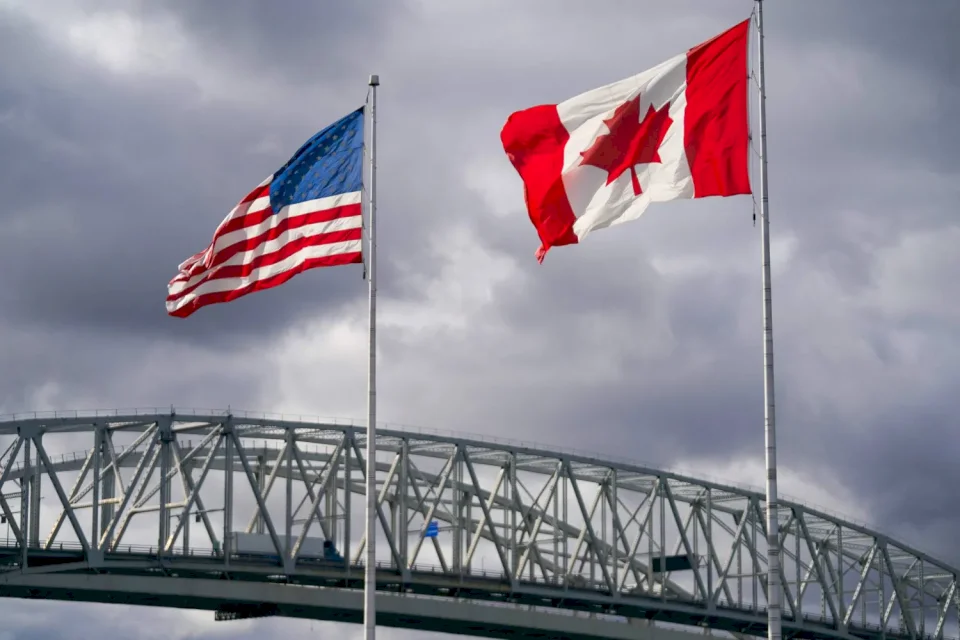
Trump Imposes Tariffs on Canadian Imports... Ottawa Vows to Respond
SadaNews Economy - U.S. President Donald Trump has opened a new front in the global trade war by announcing new tariffs of 50% on Canadian imports worth approximately $20 billion, citing a legal provision that has not been used since its enactment nearly a century ago. Canada has pledged to continue negotiating with Washington, with Canadian officials hinting at retaliation if the measures are implemented.
The new tariffs, set to take effect on August 19, will cover a wide range of Canadian products, including wine, dairy products, cement, hockey equipment, swimming pools, furniture, fishing rods, seeds, clothing, wigs, and other goods.
The U.S. Department of Commerce stated that the tariffs will apply to imports valued at around $20 billion, which is equivalent to 5.2% of total U.S. imports from Canada, which reached $382 billion in 2025.
Basing on a Law from 1930
Trump based his decision on Article 338 of the Tariff Act of 1930, which grants the U.S. President the authority to impose punitive tariffs of up to 50% on countries deemed to discriminate against U.S. exports.
This marks the first known use of this article since it came into effect nearly 96 years ago, lending the decision a significant legal and historical dimension.
The U.S. administration justified the move by describing what it called the "discriminatory treatment" Canada applies to U.S. cars, alcoholic beverages, and dairy products, in addition to its retaliatory measures following tariffs previously imposed by Washington.
U.S. Trade Representative Jamison Greer stated in a statement: "While the administration continues to negotiate fair and reciprocal trade agreements with its partners, Canada continues, unlike other partners and allies, to take retaliatory actions against the United States due to its efforts to rebalance trade and protect U.S. industries vital to national security."
He added that the new tariffs also come in protest against Canada's dairy supply management system, the restrictions on U.S. cars, as well as the cessation of most Canadian provinces from selling U.S. alcoholic beverages.
The U.S. administration noted that imports of U.S. cars to Canada dropped by 22% last year, while imports of U.S. alcoholic beverages fell by 81%.
Canada: The Tariffs Violate the Trade Agreement
In contrast, Canadian Prime Minister Mark Carney confirmed that his government has put forward comprehensive proposals to resolve trade disputes with the United States, considering that the previous U.S. tariffs violate the U.S.-Mexico-Canada Agreement (USMCA).
Carney stated in a press release: "This trade dispute has raised living costs for households, particularly in the United States," adding that Canada "is ready to engage in intensive negotiations to address the outstanding issues in a manner that serves the citizens of both countries."
He emphasized that his country still believes in "the benefits of fair and free trade," noting that Canada has concluded more than twenty new economic and security partnerships in the recent period.
Although the U.S. decision allows for a thirty-day period before implementation, Canadian officials have hinted at countermeasures if Washington proceeds with its threats.
Ontario Premier Doug Ford stated: "If these tariffs go forward, Canada must respond with similar tariffs, dollar for dollar."
For her part, the CEO of the Canadian Chamber of Commerce, Candice Laying, described the decision as "unfortunate," but called for utilizing the thirty-day period to make progress in formal negotiations.
Exemptions Despite the Expansion of Tariffs
Despite the expansion of the tariffs, the U.S. administration exempted a number of goods, including energy products, potash, fish, vital metals, in addition to goods already subject to tariffs imposed under Article 232 related to national security.
The new tariffs will also apply to some goods that were previously exempt under the U.S.-Mexico-Canada trade agreement, reflecting a greater hardening in U.S. trade policy.
The use of a law dating back to the Great Depression has drawn criticism from international trade experts who warned that it could open the door to using the same mechanism against other trading partners and increase uncertainty in the global economy.
John Veron, a former U.S. trade official under President George W. Bush, stated that Article 338 was designed to ensure that countries apply equal tariffs to all trading partners, arguing that its use under current circumstances "contradicts the spirit of the law."
He added: "While these tariffs may be technically legal, they stray from the principle on which the article was founded, which is achieving equal treatment among nations."
Scott Lincicom, Vice President of the Cato Institute, described resorting to Article 338 as the "nuclear option" in Trump's tariff policy, warning that it could create "a tremendous amount of uncertainty" in the global economy.
Analysts believe that the decision also carries political dimensions, coming before the midterm elections for Congress amidst criticism facing the Trump administration regarding rising prices.
The White House asserts that the tariffs will encourage companies to move production to the United States; however, critics argue that they will increase import costs for U.S. companies, which will ultimately be passed on to consumers.
The decision comes at a time when U.S.-Canadian relations are witnessing escalating tensions, including trade disputes, U.S. criticism of Canada's handling of wildfires affecting air quality in the United States, as well as ongoing disagreements over automotive, dairy, and alcoholic beverage trade.
 Follow the latest Sada News via Google News
Dollar Steadies Near One-Week High Amid War Developments

Trump Imposes Tariffs on Canadian Imports... Ottawa Vows to Respond

Oil Prices Drop After Reports of Mediation Efforts Between the U.S. and Iran

Gold Price Rises Supported by Increased Buying Amid Lower Prices

Due to "Hazardous and Counterfeit Products".. Europe Fines "AliExpress" $627 Million

Gasoline Prices Exceed $4 Again in America Amid Resumed War

What was the financial reward for Spain after winning the World Cup?
