

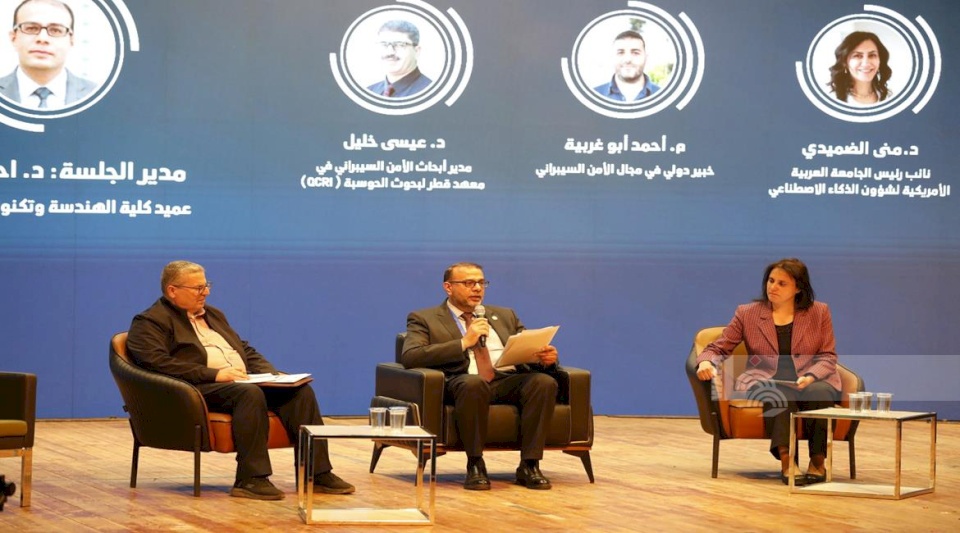
Launch of the First Palestine Conference on Cybersecurity and Artificial Intelligence
SadaNews - The First Palestine Conference on Cybersecurity and Artificial Intelligence kicked off today, Wednesday, at the premises of Birzeit University. The conference is organized by the Palestine Institute for National Security Research under the patronage of President Mahmoud Abbas, in partnership with Palestinian universities.
The conference will continue for two days, featuring dozens of officials, experts, specialists, and university presidents, discussing numerous working papers related to digital transformation, information security, artificial intelligence breakthroughs, and their applications in practical life.
In a speech on behalf of Prime Minister Mohammad Mustafa, Minister of Communications and Digital Economy Abdul Razak Natsheh expressed that the conference represents an important beginning for building an advanced Palestinian national system in cybersecurity, based on partnership between the government, universities, private sector, startups, and Palestinian expertise around the world.
Natsheh stated: The secure digital future cannot be built solely with technology, but requires vision, competencies, cooperation, and long-term investment.
He added: The world has entered a phase where digital infrastructure has become part of the critical national infrastructure, just like electricity, water, communications, and the banking sector. Any breach or disruption of digital systems can lead to economic paralysis, disruption of government services, loss of trust, and even a threat to national stability.
He explained that over 90% of government, financial, and commercial services globally now rely on digital systems, cloud computing, data centers, digital identity platforms, integration between systems via "APIs," and data exchange. With this transformation, the volume of cyber threats has increased unprecedentedly, with global estimates indicating that the cost of cybercrime will exceed $10 trillion annually, while global spending on cybersecurity surpasses hundreds of billions annually, reflecting that cybersecurity has become an essential part of the global digital economy.
In Palestine, Natsheh mentioned that this sector gains double importance, "because we are rapidly moving towards digital governance, electronic services, digital payment systems, digital national records, and integration between governmental institutions, in addition to national data projects and artificial intelligence, raising the pivotal question: How can digital transformation be built without an integrated national cybersecurity infrastructure?"
He continued: We have a real opportunity in Palestine to build a digital economy based on knowledge and high-value technological services, especially since cybersecurity is one of the sectors that relies more on human competencies than traditional resources, where today, Palestinian youth are capable of competing globally in security assessments, developing solutions, analyzing threats, and managed services and research related to cybersecurity and artificial intelligence.
For his part, the General Director of the Palestine Institute for National Security Research, Habes Al-Shrouf, stated that the conference convenes at a global moment witnessing unprecedented transformations led by the digital revolution and the rapid development in the fields of artificial intelligence and cyber technologies.
He added: The world is not just moving towards technology today; it is being completely reshaped by it. Artificial intelligence is no longer just a technical tool but has become a main driver of the global economy, shaping transformations in education, health, security, media, energy, and government management. In contrast, cybersecurity has become the first line of defense for countries, institutions, and communities against increasing digital threats.
He continued: In Palestine, we are well aware of the importance of keeping pace with these global transformations, despite all the political and economic challenges we face. Our Palestinian people possess young and creative human capacities, able to innovate and engage in the global digital economy if provided with a supportive environment and appropriate scientific and investment partnerships.
He expressed hope that the conference would provide a national and scientific platform bringing together experts, academics, government institutions, the private sector, and technology pioneers, aimed at exchanging experiences, building partnerships, raising awareness of the importance of cybersecurity, and exploring the vast opportunities offered by artificial intelligence in serving Palestinian development, education, economy, and national security, emphasizing that this requires integration among universities, research centers, governmental institutions, and the private sector, alongside real investment in young Palestinian competencies.
President of Birzeit University, Talal Shahwan, stated: "We meet in an era where technology is no longer just a luxury tool but has become an existential pillar for national security and sovereignty, especially in light of the significant challenges posed by the abhorrent colonial targeting. Hence, the vision of Birzeit University aligns with the message of this conference in harmonizing practical experience with scientific competence as an urgent necessity to study the challenges and opportunities related to technology."
He expressed his hope that the conference would achieve its strategic goals by enhancing national cybersecurity, developing infrastructure, exploring applications of artificial intelligence in building institutions and accelerating digital transformation, all the way to formulating legal and ethical frameworks to ensure secure and sustainable digital governance, thereby enhancing Palestine's digital sovereignty amid the complex geopolitical challenges we are experiencing.
He said: The success of this conference sends a clear message to the world that Palestine, despite the obstacles, possesses a human resource and innovative minds capable of harnessing technologies and building digital security fortifications with authentic national hands. We look forward to deriving actionable policy recommendations from your sessions and in-depth discussions, establishing a clear roadmap for comprehensive digital development, and enhancing Palestine's position on the global technological map.
For his part, the regional director of the Arab Bank, the strategic sponsor of the conference, Jamal Hourani, stated: Artificial intelligence has become a pivotal tool in enhancing the banking experience, contributing to real-time data analysis, monitoring unusual activities, and reducing fraud attempts, alongside providing faster and more personalized services that meet the expectations of clients.
He added: Based on this, we affirm the importance of enhancing cooperation between the banking sector, regulatory agencies, government entities, technology companies, and academic institutions, to build a more secure and sustainable digital system that supports innovation and enhances trust in digital services.
Hourani pointed out that the banking sector is witnessing a rapid shift towards smart solutions and advanced digital services, making cybersecurity a strategic necessity to protect client data, digital infrastructure, and its information, and to enhance trust in banking services, especially in light of the rapidly evolving cyber threats and financial fraud methods.
He stated: The Arab Bank's support for this conference, as a strategic partner, stems from our deep belief in the importance of cybersecurity and artificial intelligence issues, as both are essential elements in building more ready, efficient institutions capable of keeping pace with the rapid transformations the world is witnessing today, alongside our commitment to supporting initiatives that contribute to developing the digital environment and enhancing a culture of innovation and knowledge.
For his part, the head of the conference's preparatory committee, Ishaq Sidr, stated that discussing cybersecurity and artificial intelligence in Palestine has become no longer a scientific luxury or an option we can defer, but an inevitable necessity imposed by the reality of digital transformation, witnessing widespread and rapid application in all governmental, academic, and private sectors.
Sidr, who was the Minister of Communications and Digital Economy in the previous government, recalled with pride the initial building blocks and solid foundations we established together to strengthen the digital infrastructure, formulate national cybersecurity strategies, and launch electronic services.
He added: That phase was a mark and a national accomplishment firmly established by Palestinian minds and hands, to be a foundation relied upon. Today, we see with great joy and pride how the current government, led by Mohammad Mustafa, is building upon these achievements and developing them with a promising vision that aligns with the requirements of the modern digital economy.
He continued: In the preparatory committee for the conference, we were keen to formulate a scientific and dialogue agenda that gathers a select group of academic figures, experts, and decision-makers, both from within Palestine and abroad.
Over two days, the conference will distribute its works over 9 sessions, with participation from 64 individuals, including interventions, working papers, and scientific research presented by 64 civil, security, expert, academic, and research officials.
 Follow the latest Sada News via Google News
Sheikh Offers Condolences for the Martyrdom of Citizens in Deir Jareer

Ministry of Labor Calls for Registration in Licensed Private Vocational Training Centers a...

Occupation Forces Storm the Home of Major General Bilal Al-Natsheh in Jerusalem

The Working Group on Palestine of the Permanent Independent Human Rights Commission Issues...

Arrests in Occupation Attacks in the West Bank and Jerusalem

Ramallah and Al-Bireh Forces Mourn Al-Mughayer Martyr and Emphasize Popular Solidarity to...

More than 38,000 travelers crossed through the Karama crossing last week
