

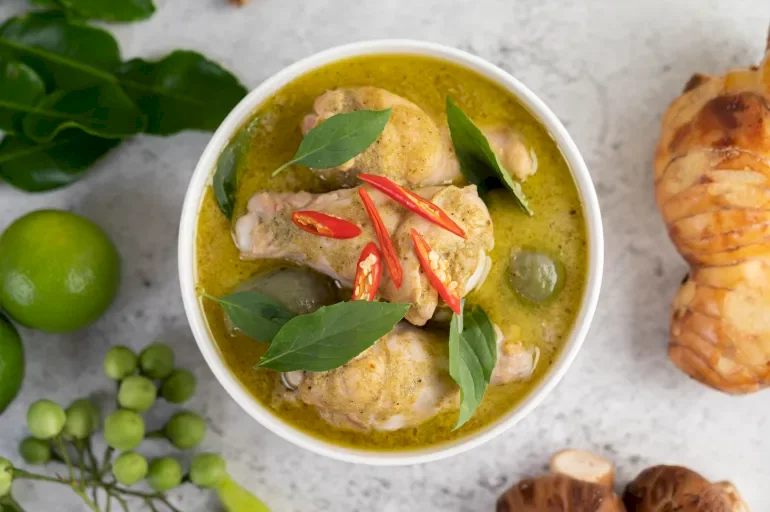
The Secret to the Original Flavor: How to Make Green Curry Paste at Home Like in Restaurants?
SadaNews - In Thai cuisine, green curry is not just viewed as a dish rich in flavors, but as one of the dishes that reflect the philosophy of Thai cooking, which balances spicy, sweet, salty, and aromatic elements simultaneously. The dish combines the heat of green chili, the creaminess of coconut milk, and the aroma of fresh herbs, with various types of proteins, whether seafood, chicken, or plant-based options.
According to Asian cooking sources, the popularity of green curry originates from Central Thailand, where the dishes are known for building balanced flavors that seem simple in their ingredients but are complex in details and composition.
Over time, green curry has become one of the dishes that measure the quality of Thai restaurants, due to the precision required in preparing the paste and balancing the flavors. It has also become a dish that can be prepared at home in a way that approaches a professional level when following its basic steps.
Curry Paste: The Foundation of Flavor
The true flavor of green curry begins with fresh curry paste, which serves as the foundational base for the dish. It typically consists of green chili, lemongrass, garlic, shallots, galangal, along with kaffir lime leaves or peel, coriander roots, and a number of aromatic spices.
In some traditional recipes, shrimp paste or minced fish and anchovies are added to give the dish a salty depth, while in vegetarian versions, these ingredients are replaced with soy sauce or miso.
Traditional Thai cooking platforms, such as (Hot Thai Kitchen), recommend preparing the curry paste at home instead of relying on ready-made products, as the aromatic herbs lose a significant part of their flavor during storage and packaging.
When using ready-made paste, it is recommended to add fresh ingredients such as garlic, galangal, or lemongrass during cooking, to enhance the flavor and give the dish a character closer to those served in Thai restaurants.
How to Prepare Green Curry Paste
Green curry paste can be prepared at home using a variety of aromatic ingredients that are ground until they transform into a thick paste.
The paste requires 6 to 8 green chili peppers, with the option to reduce the quantity for a milder flavor, along with two stalks of lemongrass using only the white part, 4 cloves of garlic, and two small shallots or half a small onion.
A small piece of galangal, or ginger with a little lemon zest as an available alternative, is also added, along with coriander stalks or roots, and kaffir lime leaves or lemon zest.
Spices include ground coriander, cumin, white or black pepper, and salt, with the option of adding shrimp paste or mashed anchovies or soy sauce as desired.
The fresh ingredients are chopped and then ground in a mortar or blender with a little oil until a thick, cohesive green paste is formed.
Frying the Paste: A Crucial Step
One common mistake in preparing green curry is adding the paste directly to the liquid, whereas the traditional method relies on frying it first in oil or in the fatty layer of coconut milk.
This step helps to release the aromatic oils present in the spices and herbs, giving the sauce a clearer depth and preventing a raw or flat flavor from emerging.
After frying the paste until its aroma becomes evident, coconut milk is gradually added while continuously stirring, and then the chosen protein and vegetables are added.
The final sauce should be medium-thick and have a creamy consistency, easily mixing with white rice upon serving, without turning into a sauce that is too heavy.
Balancing Flavors: The Secret of Thai Curry
The recipe for green curry relies on achieving a precise balance between heat, saltiness, sweetness, and acidity, by carefully arranging and adjusting the quantities of the ingredients.
Ingredients
Two tablespoons of green curry paste.
A can of full-fat coconut milk.
300 to 400 grams of chicken, shrimp, or tofu.
A cup of small eggplant, zucchini, or green beans.
Half a cup of sweet bell pepper or peas.
Two kaffir lime leaves or lemon zest.
A teaspoon of sugar, preferably palm sugar.
A tablespoon of fish sauce or soy sauce.
A handful of Thai basil or regular basil. A squeeze of lemon.
White rice for serving.
Preparation Method
Fry the curry paste in oil or the fatty part of coconut milk for one to two minutes until its aroma is clearly released.
Then, gradually add the coconut milk while stirring until the ingredients turn into a smooth, homogeneous sauce.
Next, add the chosen protein and let it simmer gently within the sauce, avoiding strong boiling to prevent the coconut milk from separating or losing its texture.
Vegetables are added gradually based on their cooking time, with hard vegetables placed first, and soft ones added in the final stages to maintain their color and texture.
Finally, adjust the flavor by adding fish or soy sauce for saltiness, sugar to soften the heat, and a squeeze of lemon to give the dish an extra freshness.
Add the basil at the last moments before turning off the heat, so it retains its fresh aroma without wilting completely.
Source: Al Jazeera
 Follow the latest Sada News via Google News
Senegal and Congo as Examples: Why Do Teams Collapse in the Final Minutes?

Heat Waves: Why Do Some People Die While Others Survive?

How 'The Last Miracles' Was Born from Naguib Mahfouz's Story? The Film Director Reveals th...

Hollywood Enters the 'Microdrama' Race, Betting on Smartphone Audiences

6 Surprises Await You at Samsung's Upcoming Conference.. What Will the Company Reveal?

Combining the Flavor of Coffee with the Calm of Tea.. Can Hojicha Become a New Competitor...

What We Don't Know About Our Parents.. 9 Questions That Will Change Your Relationship With...
