

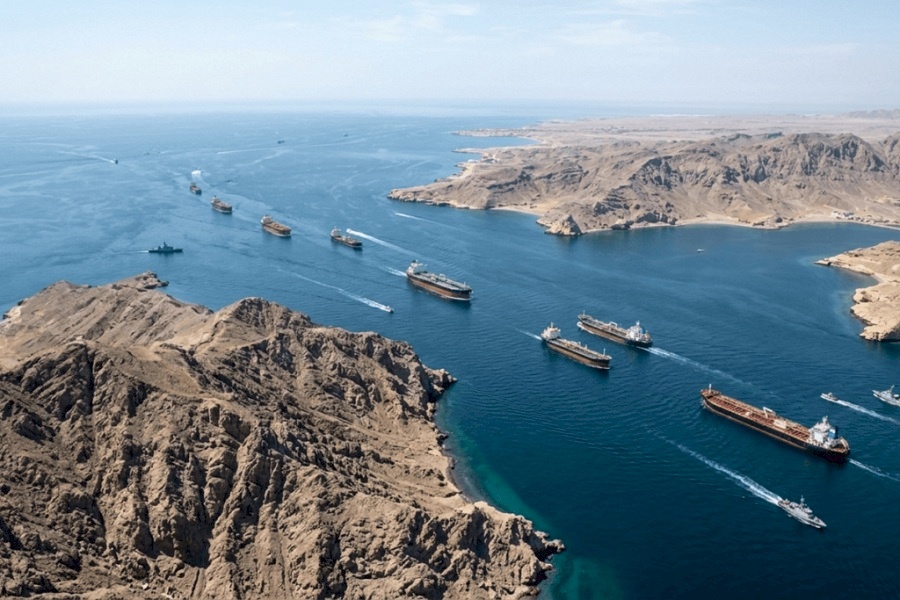
Wall Street Journal: Why Can’t Washington Open the Strait of Hormuz?
SadaNews: The Wall Street Journal reported that the initiative launched by U.S. President Donald Trump, known as the "Freedom Project," reveals the clear limits of Washington’s ability to impose a new reality in the Strait of Hormuz, one of the world's most crucial maritime passages.
In a report on the subject, journalist Jared Malsin described the operation's launch, before President Trump decided today, Wednesday, to freeze it, as a "high-risk adventure" aimed at breaking Iran's effective control of the strait and restoring freedom of navigation.
Malsin anticipated that the initiative faced significant constraints in changing the broader strategic reality, as Trump seeks to force Tehran to make concessions, while the Iranian leadership insists on denying him any clear victory.
Malsin points out that Iran has already responded aggressively, launching cruise missiles at U.S. warships and using drones and fast boats to attack both military and civilian targets.
The author asserts that this reality creates an ongoing threat not only to military forces but also to commercial shipping, which remains hesitant to return to the strait without clear security guarantees.
One of Malsin's most notable conclusions is that the success of the U.S. operation, even if achieved, will not restore shipping to pre-war levels. Before the outbreak of the war, around 130 ships passed through the strait daily, whereas the number of vessels trying to pass now is barely a handful.
This sharp decline, in the author’s view, reflects not only the material risks but also a general climate of uncertainty, as the closure of the Strait of Hormuz led to the worst oil supply shock in history, negatively impacting energy markets and economies worldwide.
Malsin also highlights that Washington is headed towards a prolonged struggle at sea for control of the strait, having already employed its maximum military pressure tools without achieving decisive results, which leaves limited options, the most significant being attempts to secure shipping lanes.
On a practical level, the U.S. Navy relies on a set of measures, such as redirecting ships through safer routes near the coast of Oman, and employing advanced technologies like unmanned maritime aircraft to detect mines.
However, these efforts face significant challenges, in the reporter's view, especially with Iran’s insistence on imposing its conditions, including requiring ships to obtain prior permission to transit.
Finally, Malsin emphasizes that control of the Strait of Hormuz cannot be settled by military force alone, and the decisive factor remains the confidence of markets, insurance companies, and the shipping sector.
Malsin concludes that without this confidence, even the most powerful naval force in the world cannot restore things to normal. Thus, the "Freedom Project" reveals a fundamental truth: that U.S. power is still significant, but it is not absolute.
 Follow the latest Sada News via Google News
High-level sources reveal to SadaNews: Washington seeks to hold a Gaza Reconstruction Conf...

Iraqji Reveals Details of the Attack on the Iranian Supreme Leader's Headquarters

صراع على إرث خامنئي وسط غياب مجتبى.. والمتشددون يتهمون قادة إيران بـ«الانقلاب»

The European Union Reiterates Its Call for Israel to Refrain from Expanding Settlements in...

"Mamdani Berlin".. The German Left Bets on a Politician of Turkish Descent to Lead the Cap...

Hebrew Channel: Kushner Pushing to Enhance Communication Between the United States and the...

SadaNews Report: Israeli Elections with a Settlement Flavor!
