

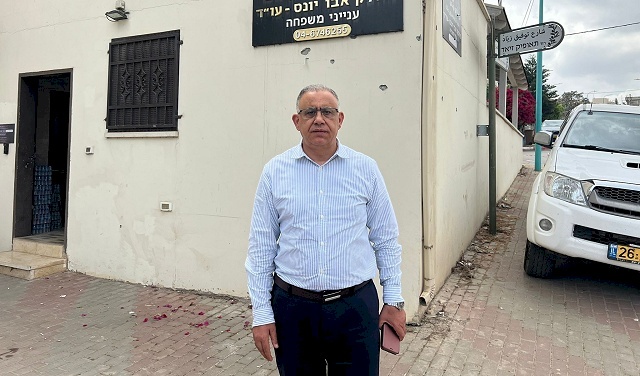
Sakhnin: Repeated Attacks on Lawyer Muwafaq Abu Younes Bring Crime Back to the Fore
SadaNews - The Sakhnin uprising against violence and crime, which peaked with a demonstration attended by more than 100,000 protesters about two months ago, has revived hope for curbing organized crime in the city, after it witnessed a sharp decline in shooting incidents and episodes of violence at that time. However, recent weeks indicate a troubling return to the spiral of violence, with a new surge in shootings and extortion, reinstating the atmosphere of fear and tension in the city.
In light of this escalation, the name of lawyer Muwafaq Abu Younes has emerged as one of the victims of this phenomenon, having been subjected to repeated assaults and gunfire in attempts to enforce extortion, prompting him to set up a protest tent outside his home in protest against the ongoing violence and rejection of the policies of "protection money" and intimidation that have begun to target business owners and citizens in the Arab community.
In a show of solidarity, dozens of lawyers and activists participated yesterday, Saturday, in a protest organized by the Haifa District Committee of the Bar Association, condemning the spread of violence and crime, affirming their rejection of the attacks against lawyer Abu Younes, and calling for serious action to stop the state of lawlessness and escalating violence.
Lawyer Muwafaq Abu Younes, who has been subjected to repeated assaults in an attempt to impose extortion, stated, "In the past week, I faced two successive attacks, which included the burning of cars and gunfire directed at my office and vehicles, as part of attempts to impose extortion. The first incident involved the burning of my wife's car parked in front of the office, after which I received a threatening message via WhatsApp demanding payment (protection money)."
Abu Younes added that "the assailants later returned and fired shots at the office and vehicles, noting that I have no personal or professional disputes that could explain these attacks, whether with neighbors, clients, or colleagues in the legal profession."
Abu Younes indicated that "the material damages are significant, as two cars were burned in a short period, one of which was a replacement car I obtained from my brother after my first car was damaged and is still under repair."
He pointed out that "the police have obtained camera footage documenting the incidents of arson and gunfire, in addition to the phone number from which the threatening message was sent, yet he does not feel that there are tangible steps being taken, expressing his dissatisfaction with what he described as police inaction in dealing with crime."
He referred to the rising manifestations of violence and crime in Sakhnin recently, stating that "the city witnesses almost daily shooting incidents targeting homes and business owners and professionals, including doctors and lawyers, which enhances the sense of insecurity among residents. We must unite to confront these phenomena, and we organized a protest yesterday and set up a protest tent in front of my house, with the participation of families, activists, and supporters from various areas."
For his part, Sakhnin Mayor Mazen Ghnaim stated that "the manifestations of violence and crime in the Arab community aim to obscure the successes and achievements attained by community members in various fields. There is a significant percentage of Arab workers in the nursing sector within hospitals, alongside their prominent presence in education and free professions, yet the few who engage in violence serve directly or indirectly policies that seek to weaken the Arab community and occupy it with its internal crises."
Ghnaim addressed the attacks against lawyer Muwafaq Abu Younes, considering that targeting professional and academic figures constitutes a violation of all red lines, clarifying that "the threats against lawyers, doctors, teachers, and business owners signify that society is entering a dangerous phase of lawlessness and organized violence, where this cancer called crime threatens various sectors."
Concerning the role of the police, Ghnaim stated that "Israeli police cannot be absolved of responsibility in combating crime, as they are the entity possessing the legal tools and powers for search, arrest, and enforcement of the law. The prevailing feeling among citizens is that the police do not show enough seriousness in addressing violence and crime in the Arab community, despite the expansion and exacerbation of the phenomenon in recent years."
He pointed out that "all options, including protests and popular movements, are on the table, yet any step of this nature needs to be studied and organized to ensure its success and achievement of its goals, given the difficult economic conditions faced by the Arab community and the repercussions of war, rising living costs, and accumulated crises, which requires serious preparation for any extensive public movement."
 Follow the latest Sada News via Google News
Two killed in Haifa and Rina raise the death toll of murder crimes in the Arab community t...

Indictment in the Murder of Basel Farouni in Nazareth: The Target was Another Person

Two Killed in Haifa and Rina Raise the Toll of Murder Crimes in Occupied Territories to 14...

8 Dead Since the Start of the Week.. Two Young Men from Basmat Tab'un and Sha'ab Murdered...

8 Dead Since the Beginning of the Week.. Two New Crimes in Basma Tabor and Shfar'am

Supreme Court Reduces Prison Sentence of Tareq Dawour from Akka by One Full Year

Worker seriously injured after falling from the roof of a building in Netanya
