

The National Popular Conference for Jerusalem on the Anniversary of Land Day: Combining Official and Popular Efforts Can Foil the Settlement Project
SadaNews - The General Secretariat of the National Popular Conference for Jerusalem confirmed that the anniversary of the immortal Land Day this year specifically comes amid extremely complex local, regional, and global political situations, while the Palestinian land is being relentlessly devoured by Israel following the recent approval of the annexation law by the occupation’s Knesset.
The General Secretariat stated in a statement today, on this occasion: "The land is being swallowed before the eyes of the whole world while the Arab and Western media focus their content on the American-Israeli war against Iran, while Palestine has become a marginal issue in the midst of this war, which affects the entire Palestinian people.
The General Secretariat pointed out that Israel continues day and night the process of swallowing Palestinian land through issuing decisions to seize lands in areas classified A, B, and C, and does not miss an opportunity to devour the land with the fangs of its bulldozers while everyone is preoccupied with the developments of the war.
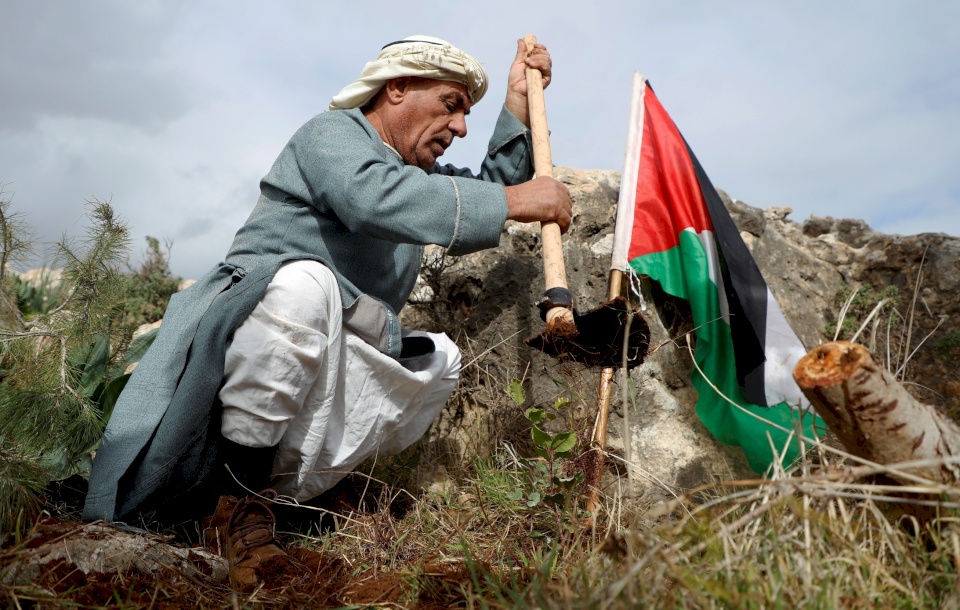
In its statement, the General Secretariat added: "The Palestinian people commemorates Land Day on March 30 of each year, which is an important national day symbolizing attachment to the land and defending it, and affirming commitment to identity and enhancing national unity among the people to face the existential challenges surrounding the Palestinian cause.
The statement continued: "Despite the passage of 50 years since this anniversary, the sons of our people in the homeland in general and the citizens of the 48 territories in particular, whose number has reached about 1.3 million after being only 150,000 after the Nakba, have not been deterred by any obstacle from commemorating this occasion through their attachment to the land and identity, as this occasion represents a historical turning point in the course of their existence, belonging, and identity, affirming their attachment to their homeland and land.
It is noteworthy that during the years from 1948-1972, the occupation government seized more than one million dunams of Palestinian village land in the Galilee and Triangle, in addition to millions of dunams of land that it seized following a series of horrific massacres and acts of forced displacement against Palestinians in the occupied interior.
The General Secretariat of the conference indicated on this occasion that settlers carried out a total of 444 attacks during the month since the outbreak of the war on Iran, explaining that this escalation came in the context of clear exploitation of the prevailing state of unrest to intensify attacks on Palestinian villages and gatherings, especially the Bedouin gatherings in the specific area of Jerusalem, which are considered the first line of defense for the occupied city. It clarified that these attacks were characterized by a higher degree of organization and expansion, involving direct gunfire on citizens which led to martyrs and injuries to dozens of citizens from the fire of the army and settlers, as well as burning houses and properties, alongside imposing new ground realities on the land.
The statement continued: "These attacks, which particularly targeted Jerusalem, fall within a broader dynamic aiming to exploit the regional and international distraction to accelerate the imposition of substantive changes on the geographic and demographic reality in the West Bank and occupied Jerusalem, at the expense of Palestinian existence and reinforcing the colonial project.
It is noted that settlement operations included: 24 attacks in Jerusalem, 108 in Nablus, 99 in Hebron, 76 in Ramallah, 31 in Bethlehem, 23 in Salfit, and Jericho.
The occupation authorities issued 12 orders for seizing land for military and security purposes, through which they confiscated 225 dunams of citizens’ lands in the provinces of Jerusalem, Ramallah, Jenin, Jericho, Tubas, Nablus, Salfit, and Qalqilya, with the aim of opening military roads and establishing sites and buffer zones. The largest of these was the military order numbered T/3/26 which seized 128 dunams of land from the town of Arraba in the Jenin Governorate to establish a military site, and another numbered T/37/26 which targets the lands of the eastern Ma'zarah and Silwad and Deir Jarir by confiscating 41 dunams to establish a security buffer area around Mount Al-Asour, according to data from the Wall and Settlement Resistance Commission.
The occupation authorities also issued a total of 27 military orders under the name of security measures, which mandate the removal of trees over an area of 1391 dunams from citizens' lands in the provinces of Ramallah with 12 orders, 3 orders in Jenin, and 2 orders each for Qalqilya, Tulkarem, Nablus, Salfit, Bethlehem, and Jerusalem, with the largest being the military order numbered 9/26 targeting the tree canopy over an area of 380 dunams from the lands of the villages of Silwad, Atara, and Ain Sinya in the north of Ramallah, as well as the order targeting 139 dunams from the lands of Ramin in the Tulkarem governorate and another order targeting 95 dunams from the lands of the towns of Beita and Huwara in the Nablus governorate.
The mentioned data indicates that the results from the first month since the outbreak of the regional war reveal an unprecedented escalation in settler attacks, accompanied by systematic policies from the occupation authorities to provide cover and support for these violations. The data reaching the media office of the National Popular Conference for Jerusalem indicates that this escalation was not spontaneous, but came in the context of a clear investment in the international and media distraction caused by the war, allowing for intensified attacks and imposing new ground realities at the expense of Palestinian land and its inhabitants.
It is noted that the pace of attacks and forced displacement operations increased during this period, while decisions for confiscation and road opening accelerated, all of which reflect an organized push towards expanding the settlement project and reshaping the geography and demography in Jerusalem and the West Bank over a short period of time.
Finally, the General Secretariat confirmed that confronting the settlement project on Palestinian lands can only be achieved through the collaboration of official and popular efforts, enhancing national unity, and the involvement of civil society institutions in supporting farmers, peasants, and Bedouins in the areas of Jerusalem to strengthen their steadfastness and presence on their land, stressing that settlement, especially pastoral settlement, focuses on uninhabited lands and those abandoned by their owners, and places them under control with the protection of occupation forces, as occurred in the town of Beit Anan northwest of Jerusalem and the surrounding villages and towns. They also called for reviving the spirit of volunteer work among the younger generation and returning to the land, as the real struggle revolves around it, being the collective identity of the Palestinian people as a whole.
 Follow the latest Sada News via Google News
Sheikh Offers Condolences for the Martyrdom of Citizens in Deir Jareer

Ministry of Labor Calls for Registration in Licensed Private Vocational Training Centers a...

Occupation Forces Storm the Home of Major General Bilal Al-Natsheh in Jerusalem

The Working Group on Palestine of the Permanent Independent Human Rights Commission Issues...

Arrests in Occupation Attacks in the West Bank and Jerusalem

Ramallah and Al-Bireh Forces Mourn Al-Mughayer Martyr and Emphasize Popular Solidarity to...

More than 38,000 travelers crossed through the Karama crossing last week
