

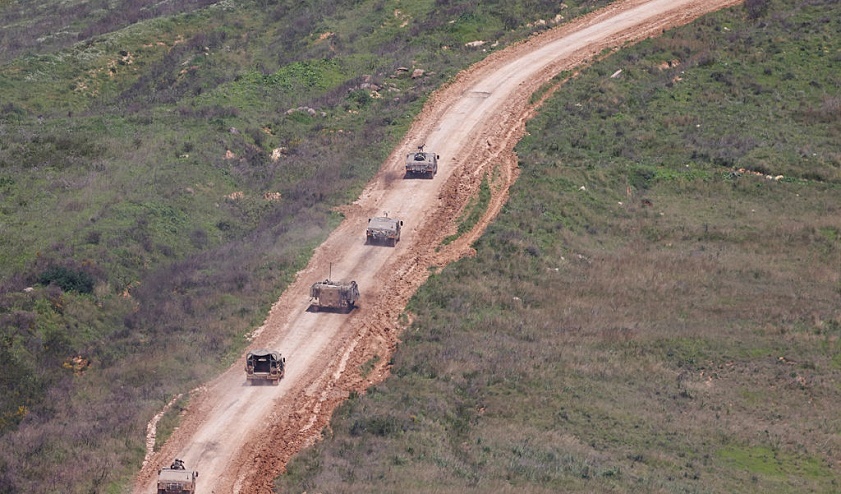
Israel intends to keep its forces in southern Lebanon "for a long time and perhaps for years"
SadaNews - Israeli security assessments suggest that military operations in Lebanon are likely to continue for a long period, as the Israeli army plans to maintain its ground troops deep in southern Lebanon for months, and possibly for years, even if a ceasefire is reached.
This was stated in a report published by the "Yediot Ahronot" newspaper on Sunday, which indicated that a month after the confrontation with Iran began, Israeli forces continue their ground operations in southern Lebanon, where they operate under intense fire, including artillery shelling, anti-tank missiles, and mortars.
These estimates come in parallel with Israeli efforts to expand what it describes as a "security belt" within Lebanon, based on security agencies' belief that the Lebanese state is unable to disarm Hezbollah, which Israel uses as a pretext to continue stationing its troops inside Lebanese territory and to maintain a barrier that separates the "threat" from the border towns.
An Israeli security official stated, "We understand that the Lebanese government cannot disarm Hezbollah, and that the presence of the Israeli army deep within the area will last for several months at least, and perhaps for years," even if an agreement on a ceasefire is reached.
According to the report, Hezbollah has retreated operationally during the ground incursion, but continues to launch intense fire at Israeli forces, which includes hundreds of rockets daily, as well as the use of drones and anti-tank missiles. Data indicated that five Israeli soldiers have been killed since the start of the incursion due to anti-tank missiles, clashes, and rocket fire.
The report states that the ground operations aim to establish a "security area" deep within Lebanese territory, away from the border. In this context, the Israeli army demands that the political level reach an agreement that guarantees the disarmament of Hezbollah.
The report quoted a security official stating, "The situation is different from what it was 25 years ago," pointing out that the Israeli army has "entered deep into enemy territory, controls areas for protection, and will remain there as a barrier between the populations."
However, the prospects of a long stay raise questions within Israel about the army's ability to continue, especially in light of warnings from Chief of Staff Eyal Zamir, who said that the army "might collapse from within" due to the failure to pass a law for the conscription of Haredim and the failure to amend the reserve law or extend mandatory service, adding that "the reserve forces will not endure," and that he "raises ten red flags."
The report noted that the army is effectively working to impose fire control in southern Lebanon, following the destruction of bridges and cutting the area between the border and the Litani River, where it continues to comb areas and remove arms. Soldiers in the field said that operations are being carried out relatively slowly and without significant resistance, sometimes as intermittent advances to avoid mortar shells, with widespread destruction of infrastructure in the area.
Although Israel officially maintains ambiguity regarding its declared objectives in Lebanon, except for the expansion of the security strip, Prime Minister Benjamin Netanyahu spoke of a "radical change in the Lebanese reality," during a meeting with local officials, stating that the matter of disarming Hezbollah "stands before us," adding that this is linked to the ongoing total war with Iran, and affirming that Israel is "determined to change the reality in Lebanon from the ground up."
Netanyahu presented what he described as the threats that Hezbollah has built over nearly four decades, pointing out that it possesses around 150,000 rockets and shells, and considered that this arsenal was directed towards the Galilee and Israeli cities with the aim of turning them into "rubble," as he put it, adding that this threat has been "mostly removed," but he acknowledged the existence of "more work". He also stated that the risk of a ground incursion through the "Radwan" unit has been removed, and that Israel has established a "real security area" to prevent that, indicating that efforts are underway to expand it to remove the threat of anti-tank missiles.
In contrast, according to briefings to ministers in the security cabinet, more ambitious goals have emerged, as one of them said that the plan aims for "complete cleansing of southern Lebanon from weapons up to the Litani River," including "resolving the villages and forests and remaining at control points without withdrawal."
He added that Hezbollah is "weak and deterred," but still possesses a large arsenal, pointing out that it has received additional quantities of weapons from Iran recently, and that Israel is now seeking to enforce complete disarmament up to the Litani, claiming that the party hides huge weapon caches under civilian houses.
The Israeli plan includes the mobilization of several military brigades inside southern Lebanon to expand the control area, with objectives that include removing the direct threat, reducing the indirect threat, creating a long-term security area, isolating the area south of the Litani, and weakening Hezbollah.
In the political context, Israel is trying to convince the United States not to link any ceasefire agreement with Iran to halting operations in Lebanon, while Tehran seeks to link the two paths and condition a ceasefire in Lebanon as part of any agreement.
An Israeli political official pointed out that operations in Iran "provided cover" for action in Lebanon, considering that this operation "has been needed for months," and that the Lebanese front is "more complicated than the Iranian front" and it will not be resolved quickly.
Israeli estimates also suggest the possibility of political intervention from U.S. President Donald Trump to halt operations, given the influence of figures close to him, including Lebanese-American businessman Masad Boulos.
Conversely, other estimates suggest that moderate Lebanese parties may push for granting Israel a wider margin to continue its operations against Hezbollah until its disarmament, which may facilitate the Lebanese government's later imposition of the exclusivity of arms in the hands of the state.
According to Western diplomats, the United States is currently occupied with the Iranian file, which explains the wide margin of maneuver given to Israel in Lebanon, with reservations concerning avoiding targeting civilian infrastructure and focusing on Hezbollah. In this context, an Israeli official indicated that there is U.S. support for the operation, but with a "red line" regarding not harming Lebanese civilian facilities.
 Follow the latest Sada News via Google News
High-level sources reveal to SadaNews: Washington seeks to hold a Gaza Reconstruction Conf...

Iraqji Reveals Details of the Attack on the Iranian Supreme Leader's Headquarters

صراع على إرث خامنئي وسط غياب مجتبى.. والمتشددون يتهمون قادة إيران بـ«الانقلاب»

The European Union Reiterates Its Call for Israel to Refrain from Expanding Settlements in...

"Mamdani Berlin".. The German Left Bets on a Politician of Turkish Descent to Lead the Cap...

Hebrew Channel: Kushner Pushing to Enhance Communication Between the United States and the...

SadaNews Report: Israeli Elections with a Settlement Flavor!
