

Between Relief and Empowerment: The Jerusalem House of Money Agency Concludes Its Ramadan Campaign
SadaNews - The Jerusalem House of Money Agency has concluded its Ramadan campaign in the city of Jerusalem and its surroundings this year, reflecting a consistent Moroccan presence that combines direct humanitarian work with building sustainable projects that enhance the resilience of the Palestinian people on their land.
In this context, the director in charge of managing the Jerusalem House of Money Agency, Mohamed Salem Al-Sharqawy, confirmed that this year's Ramadan campaign, with a budget of about one million US dollars, targeted more than 5,000 Palestinian families, including 3,000 within the city of Jerusalem and 2,000 in the villages and Bedouin communities outside the wall, according to accurate databases ensuring that support reaches the most vulnerable groups.
These interventions included distributing 5,112 purchasing vouchers (coupons) worth 350 shekels (equivalent to 140 US dollars), along with providing comprehensive food baskets that include 22 items, sufficient to meet the needs of an average family of 4 to 5 individuals for a whole month. This diversity in support mechanisms reflects the agency's commitment to combine efficiency in targeting while maintaining the dignity of beneficiaries by enabling them to choose their basic needs.
Al-Sharqawy clarified that adopting a voucher system was not just a distribution mechanism but a strategic choice that balances humanitarian work with economic development, as it contributed to creating commercial activity within the city by contracting with 16 commercial outlets across more than 30 areas in the Jerusalem governorate.
The agency's teams also worked to deliver aid to remote areas outside the wall, where residents find it difficult to reach distribution centers, enhancing fairness in access and ensuring that the most marginalized groups are included in support programs.
The aid included distributing 20 tons of basic food materials to charity houses in the villages adjacent to the wall, social centers, and hospitals, especially the Al-Maqasid Charity Hospital, to prepare iftar and suhoor meals, which were distributed daily to targeted groups totaling more than 20,000 meals throughout the holy month, averaging 700 meals daily.
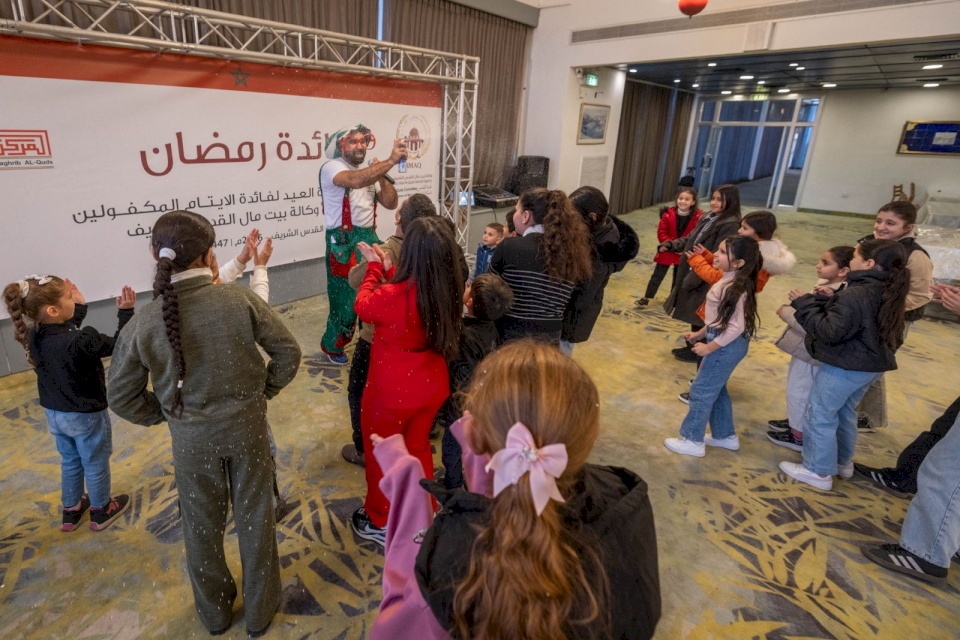
This year's campaign culminated in distributing Eid clothes to 500 orphans sponsored by the agency, alongside an additional allocation of 100 outfits for children in the villages and Bedouin communities affiliated with the Jerusalem governorate.
In the health sector, the agency executed six field medical campaigns in the villages and remote population clusters, benefiting about 600 citizens, including specialties in internal medicine, ophthalmology, and obstetrics and gynecology, along with a mobile laboratory providing on-site tests.
From Relief to Economic Empowerment:
The agency's interventions did not stop at relief support but extended to economic empowerment programs aiming to create sustainable opportunities. It organized training courses for merchants in areas such as online marketing and enhancing legal knowledge regarding export procedures in cooperation with the Jerusalem Arab Chamber of Commerce and Industry.
Al-Sharqawy noted that the agency, in cooperation with the "Alia" Foundation in Beit Hanina, organized a week of training and traditional crafts, with the participation of professional Moroccan artisans in fields such as textiles, wood carving, silver, and metalwork, attended by about 400 trainees, of whom 36 participants qualified for the final stage.
He explained that these programs aim to preserve the architectural and artisanal identity of Jerusalem by transferring Moroccan expertise in fields that align with the needs of the local market, contributing to the training of a new generation of artisans capable of protecting Palestinian artisanal identity and preserving the civilizational character of the holy city.
In this context, Al-Sharqawy stated that the agency launched the initiative "Made for Palestine" to enhance the competitiveness of Palestinian products, as part of its action plan for the current year 2026.
The agency also continues to support the health and education sectors and has proposed an urgent initiative to mitigate the impacts of ongoing events in the Middle East.
Increasing Challenges Requiring Broader Support:
Al-Sharqawy highlighted that the agency relies on a financial model based entirely on Moroccan funding since 2011, with an annual budget of approximately 3 million dollars for management, alongside fundraising from state sectors, economic institutions, civil society, and individuals to fund projects up to 4 million US dollars annually.
He confirmed that all donations are directed directly to field projects without deducting any administrative costs, while the Moroccan state covers management expenses, enhancing transparency and credibility, especially as the agency has received international quality certificates (ISO) in governance and monitoring donations.
Despite these achievements, Al-Sharqawy noted that the agency operates in an environment of increasing challenges, most notably security instability and worsening economic conditions, in light of many Palestinians losing their sources of income and rising living costs.
He explained that the increase in needs against limited funding sometimes requires prioritizing, while ensuring the expansion of the beneficiary pool as much as possible and guaranteeing the sustainability of development programs.
Jerusalem's Appreciation for the Humanitarian and Economic Impact:
The Grand Mufti of Jerusalem and the Palestinian Territories, Sheikh Mohammed Hussein, praised the efforts made by the Jerusalem House of Money Agency during the month of Ramadan, confirming that its humanitarian interventions had a tangible impact in enhancing social cohesion and alleviating the suffering of the most needy groups, especially in camps and remote communities.
He considered that these initiatives embody the values of solidarity and contribute to boosting morale and establishing a sense among Jerusalemites that their brothers stand beside them, praising the support provided by the Kingdom of Morocco under the leadership of King Mohammed VI, and commending the agency's efficient management and continuity of work. He also called for expanding these efforts and enhancing Arab and Islamic support for the resilience of the Palestinians.
For his part, the head of the Jerusalem Affairs Department in the Palestine Liberation Organization, Adnan Al-Husseini, affirmed that the difficult economic and living conditions, amid closures and declining job opportunities, make these initiatives vital support that is indispensable, especially for the most marginalized groups in the surrounding villages and Bedouin communities.
He stressed the necessity of continued Arab and Islamic support at various levels, including the health sector, to enhance the Palestinians' ability to endure and face increasing pressures.
Furthermore, the director of the Arab Chamber of Commerce and Industry in Jerusalem, Luay Al-Husseini, highlighted the direct economic impact of the campaign, pointing out its role in revitalizing trade and supporting merchants, especially given the sharp decline seen in vital sectors such as tourism.
He explained that these interventions contributed to stimulating demand, reducing losses, and maintaining job opportunities, despite restrictions on movement and declining purchasing power. He affirmed that such initiatives represent a fundamental lever for supporting the local economy and enhancing the stability of daily life in the city.
 Follow the latest Sada News via Google News
Lt. General Al-Natsha Undergoes Lengthy Interrogation at Moskobiya Regarding His Represent...

Sheikh Offers Condolences for the Martyrdom of Citizens in Deir Jareer

Ministry of Labor Calls for Registration in Licensed Private Vocational Training Centers a...

Occupation Forces Storm the Home of Major General Bilal Al-Natsheh in Jerusalem

The Working Group on Palestine of the Permanent Independent Human Rights Commission Issues...

Arrests in Occupation Attacks in the West Bank and Jerusalem

Ramallah and Al-Bireh Forces Mourn Al-Mughayer Martyr and Emphasize Popular Solidarity to...
