

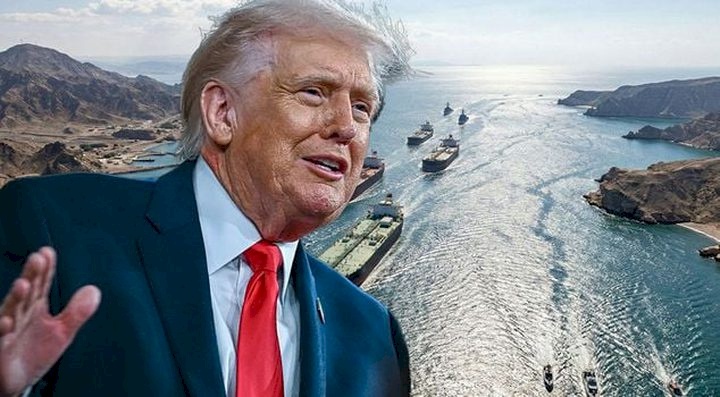
What Is Causing Trump's Allies to Hesitate in Securing the Strait of Hormuz?
SadaNews - President Donald Trump is pressuring his allies to help reopen the Strait of Hormuz and ease the pressures on the global economy, but most of them, so far, do not seem ready to respond.
Trump has attacked US allies, accusing them of letting him down regarding securing navigation through the Strait of Hormuz, reiterating his criticisms of NATO, at a time when he announced the postponement of his planned visit to China, asserting his country’s ability to decisively end the war with Iran in just one week.
Trump addressed NATO, saying: "Is it reasonable that we've been protecting you for 40 years and then you refuse to participate in such a secondary matter?".
Germany has refused to participate, while Japan and Australia indicated that they likely will not send naval vessels to help.
Meanwhile, Britain and France confirmed they are studying possible courses of action, without committing to any step before a ceasefire occurs. All these countries are considered close allies of the United States.
In this context, German Defense Minister Boris Pistorius rejected Trump’s call for support on Monday, questioning: "What does Trump expect a handful or even two handfuls of European frigates to achieve in the Strait of Hormuz, that the strong US Navy present there cannot achieve alone?"
He added: "This is not our war, and we did not start it."
Over the weekend, Trump sent a sharp message to the allies, telling reporters aboard Air Force One that if countries refuse to join efforts to open the Strait of Hormuz, "the United States will remember that." He also stated in an interview with the Financial Times that the lack of assistance from NATO allies would be "very bad for the future" of the alliance.
For her part, White House spokesperson Caroline Leavitt said on Monday that Trump "continues to talk with allies in Europe and urges them to provide support."
What Is Causing European Hesitation?
European hesitation to engage in this move reflects, in part, the tension in relations with the current US administration, which has persistently criticized traditional allies and used the economic and military weight of the United States to impose its positions.
Andreas Krieg, an associate professor at King's College London, stated that Trump "has attempted to use economic interdependence as a weapon, leveraging American power to coerce partners and allies into doing what he wants," adding that this approach has been "overused to the extent that the world has started, wherever possible, to move towards decoupling from Washington."
Nevertheless, none of Washington's traditional partner countries can entirely ignore the pressures from the White House, as European countries still try to keep Trump engaged with the Ukrainian issue and push him away from any rapprochement with Russia, fearing that it could undermine Kyiv's sovereignty and ease economic pressures on the Kremlin.
Europe also appears highly affected by the near-total closure of the Strait of Hormuz, while most countries in the continent continue to face the repercussions of rising energy prices since the Ukrainian war in 2022, while simultaneously reducing their energy imports from Russia. The US administration's decision last week to temporarily suspend sanctions on Russian oil exports provoked European displeasure.
However, Trump's threats no longer carry the same momentum they had a year ago.
Last summer, European capitals responded to Trump's demands to increase NATO defense spending to 5 percent of GDP and agreed to a trade deal that accepted US tariffs on European goods.
But this compliance has begun to wane in recent months, as Trump's level of influence has decreased. The US administration's decision to halt all forms of direct financial aid to Ukraine pushed Europe to intervene and compensate for this absence, keeping Kyiv in the confrontation despite the White House's efforts to resolve the conflict.
In another instance reflecting the limits of US pressure, Trump's attempts to acquire Greenland, a self-governing island under Danish sovereignty, triggered European threats to cancel the trade agreement made last summer, causing markets to decline and pushing Trump to back down.
In the same context, the British government initially refused to allow the US to use its bases to launch attacks on Iran, with Prime Minister Keir Starmer stating he would not join a war unless it was legal and based on a "viable and well-thought-out plan."
However, Trump later wrote on social media, after the British government changed its position days later: "That's fine, Prime Minister Starmer, we no longer need them... We don't need anyone to join the wars after we have already won them."
Nevertheless, Starmer, who spoke with Trump on Sunday, said the UK is working with the US and Gulf states and European partners to prepare a plan to secure the strait, but emphasized that no decisions have been made yet and refrained from answering whether his country would engage before a ceasefire between Washington and Tehran is reached.
He added: "We will not be drawn into a wider war... Ultimately, we have to open the Strait of Hormuz, but this is not a simple task."
For his part, French President Emmanuel Macron sent eight frigates, two amphibious assault ships, and an aircraft carrier to the region, stating that some ships will be deployed near the Strait of Hormuz.
Macron is also trying to form his own coalition that includes European, Asian, and Gulf countries, although French officials clarified that any potential operation would not begin until after the fighting stops.
Macron said in a post on "X" on Monday that he spoke with Iranian President Masoud Pezeshkian, informing him that freedom of navigation in the strait "must be restored as soon as possible."
In Brussels, EU foreign ministers held a meeting on Monday to discuss the situation, including the possibility of expanding a small European naval operation in the Red Sea to assist in the Strait of Hormuz, but they decided not to modify the mission at this time as it continues its patrols against the Houthis there.
EU foreign policy chief Kaja Kallas stated after the meeting: "No one wants to actively engage in this war."
Conversely, Fabrice Bouthe, a former political planning official at NATO and the current CEO of Rasmussen Global, opined that European countries should provide a degree of support that ensures Washington remains within a more coordinated approach to dealing with common challenges.
He stated that the European response "should not be based on ignoring Trump to punish him for his unilateral approach, but rather on pushing him to work with his allies," including on the Ukrainian file, adding that the deployment of French or other European military assets in the region "could be logical, and could give us a degree of leverage."
 Follow the latest Sada News via Google News
High-level sources reveal to SadaNews: Washington seeks to hold a Gaza Reconstruction Conf...

Iraqji Reveals Details of the Attack on the Iranian Supreme Leader's Headquarters

صراع على إرث خامنئي وسط غياب مجتبى.. والمتشددون يتهمون قادة إيران بـ«الانقلاب»

The European Union Reiterates Its Call for Israel to Refrain from Expanding Settlements in...

"Mamdani Berlin".. The German Left Bets on a Politician of Turkish Descent to Lead the Cap...

Hebrew Channel: Kushner Pushing to Enhance Communication Between the United States and the...

SadaNews Report: Israeli Elections with a Settlement Flavor!
