

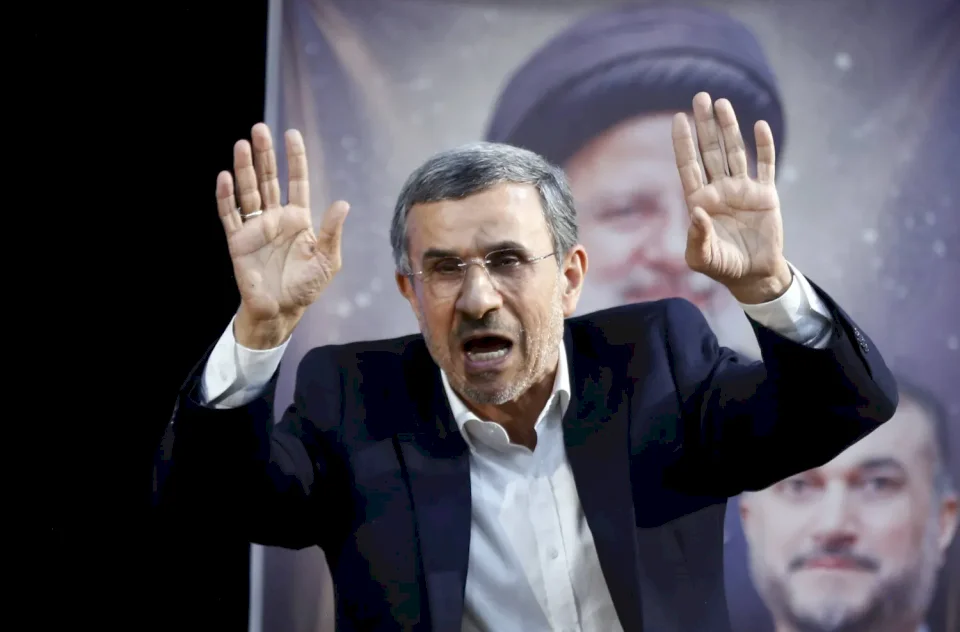
Is Ahmadinejad Returning to the Forefront of Iranian Politics?
SadaNews - A report published by The Atlantic magazine stated that the strike targeting the area near the home of former Iranian President Mahmoud Ahmadinejad in the early days of the war on Iran has highlighted a controversial political figure, over a decade after he left power.
The report indicated that news of the strike was overshadowed by reports of the assassination of Supreme Leader Ali Khamenei, but the targeting of Ahmadinejad's neighborhood raised questions about why he was targeted, especially as he has become a prominent critic of the regime in recent years, having been one of its symbols during his presidency from 2005 to 2013.
During that period, Ahmadinejad was associated with hardline policies and controversial statements, including denying the Holocaust and emphasizing the Iranian nuclear program, making him a symbol of a period of ideological rigidity in Iranian politics before his political position changed later.
For more than a decade, he became known as an opponent of the regime rather than a supporter, especially after he publicly criticized the Iranian authorities, prompting the Guardian Council to officially disqualify him from running for the presidential elections.
In this context, Iranian affairs researcher Meir Javidanfar, residing in Tel Aviv and co-author of a biography on Ahmadinejad, said that targeting him remains a mystery, questioning why Israel might want to kill him despite his distance from the centers of power, adding that the hypothesis of "settling scores" does not seem logical in light of his current political status.
However, close associates of Ahmadinejad claim that he is still alive, noting that the strike that occurred on February 28 targeted security forces stationed near his home in the Narmak neighborhood in northeastern Tehran, rather than the home itself.
According to these accounts, the chaos following the attack allowed the former president and his family to leave the house and go into hiding, at a time when authorities believed he had been killed, and some official channels and local media reported news of his death.
The report noted that Iranian authorities had imposed strict restrictions on Ahmadinejad's movements before the war, seizing his phones, and increasing the number of guards assigned to monitor him to about 50 personnel, who were stationed near his house and established a checkpoint in the street to monitor the surrounding area.
The report highlighted that the Iranian regime has never been certain about how to deal with Ahmadinejad, who still retains a degree of popularity within the country in addition to his extensive knowledge of state mechanisms as a former president close to the centers of power.
In this regard, former Iranian Defense Minister Hossein Dehghan compared Ahmadinejad in 2018 to "the door of the mosque that cannot be burned or disposed of without burning the mosque itself," indicating the sensitivity of dealing with him politically.
Rumors about his survival after the strike raised doubts among some circles in the regime, as some parties believed that he might have been transferred to participate in an attempted coup.
His public appearances have been limited since the attack to a brief statement in which he mourned Supreme Leader Ali Khamenei, an action interpreted as an attempt to prove his survival and deny speculations that he had declared enmity towards the state.
Despite Ahmadinejad's distance from power, he remains a significant political figure within Iran, as his supporters believe he has a popular support base that could make his presence beneficial in any potential political arrangements after the war.
The report suggests that Ahmadinejad's continued presence in the political scene could be important in different scenarios, as the current regime may need figures with some degree of popular legitimacy if it continues to rule, while the United States may need a figure with deep, albeit old, knowledge of Iranian state institutions, should the power change, to help manage the upcoming phase.
 Follow the latest Sada News via Google News
Trump: We will make great progress with Beirut.. Aoun: It is time for Lebanon to be stable

The Lebanese Army Deploys in the South and Comes Under Gunfire; Israel Clarifies

Bezhkian: Directives from the Leader to End the State of No War, No Peace

Saudi Arabia condemns the Houthi threats to navigation and pledges to protect its ships

Global Warning to Americans Due to Rising Tensions in the Middle East

Houthi Movement Announces Ban on Maritime Navigation Against Saudi Arabia

Earthquake of 5.5 Magnitude Hits Western Iran
