

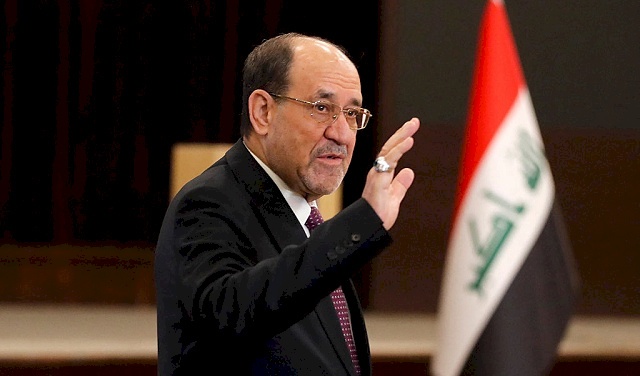
Maliki: Limiting Weapons to the State and a Unified Army is Essential for Iraq's Stability
SadaNews - The head of the "State of Law Coalition" in Iraq, Nouri al-Maliki, stated on Wednesday that limiting weapons to the state and having a single army that includes all components of the people under one command "represents the foundation for building a stable state."
This came in response to journalists' questions through the media contact window on al-Maliki's media office website, according to the Iraqi News Agency (INA).
Al-Maliki said that the Iraqi people have suffered for a long time from wars and violence, and "they deserve to live in security and dignity today."
He added that "calmness, unity among all, enforcing the rule of law, limiting weapons to the state, and having a single army comprising all segments of the people under the leadership of the Commander-in-Chief of the Armed Forces represent the foundation for building a stable state."
He pointed out that this stability prepares a safe environment that encourages investment, provides real job opportunities for youth, and contributes to completing the construction and reconstruction process across the country.
On January 24, 2025, the "Coordination Framework" announced al-Maliki's nomination for the premiership following the results of the parliamentary elections in November 2025.
The "Coordination Framework" is the largest and most prominent Shiite political alliance in Iraq, playing a major role in choosing and forming the government.
However, US President Donald Trump warned against halting his country’s support for Iraq if al-Maliki, who is close to Iran, assumes the position of Prime Minister.
Trump stated, "The last time al-Maliki was in power, Iraq descended into poverty and total chaos," adding, "That should not be allowed to happen again."
The "Coordination Framework" still insists on al-Maliki's nomination, which he described as Trump's warning being a "blatant intervention" in the country's internal affairs.
Al-Maliki previously served as Prime Minister for two consecutive terms from 2006 to 2014 before leaving office, succeeded by Haider al-Abadi.
His terms in office witnessed significant security challenges, particularly with the rise of attacks by the terrorist organization "ISIS," which controlled about one-third of Iraq's territory before Baghdad declared victory over them in 2017.
On November 11, 2025, Iraq witnessed parliamentary elections with a participation rate of 56.11%, resulting in the election of members of the House of Representatives, who are responsible for electing the President and granting confidence to the government.
 Follow the latest Sada News via Google News
Bezhkian: Directives from the Leader to End the State of No War, No Peace

Saudi Arabia condemns the Houthi threats to navigation and pledges to protect its ships

Global Warning to Americans Due to Rising Tensions in the Middle East

Houthi Movement Announces Ban on Maritime Navigation Against Saudi Arabia

Earthquake of 5.5 Magnitude Hits Western Iran

To Enhance His Support for "Increasing Children"... Vance Announces the Birth of His Fourt...

Death of a Mosque Imam in Armed Attack in Southeastern Iran
