

Associated Press: Kushner's Vision for Gaza Reconstruction Faces Major Obstacles
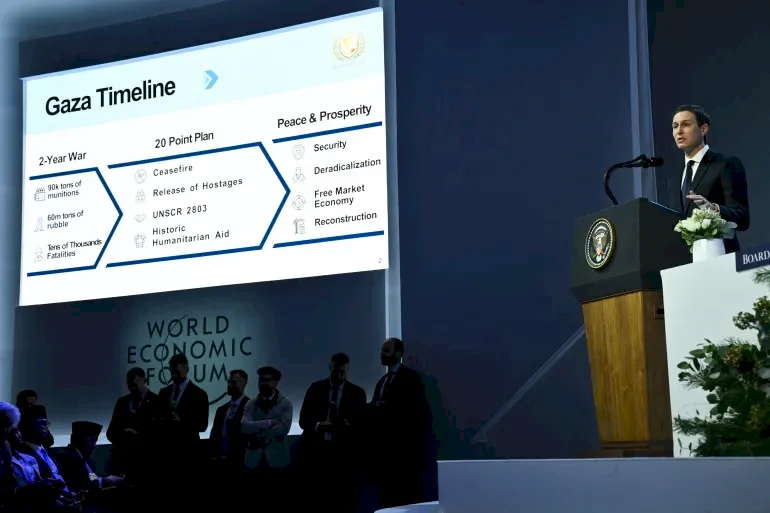
SadaNews - The "Associated Press" commented on the vision proposed by Jared Kushner, son-in-law of U.S. President Donald Trump and his advisor on Middle Eastern affairs, regarding the reconstruction of the Gaza Strip, presented at the economic forum in Davos, Switzerland, saying it faces major obstacles.
In his 10-minute speech on Thursday, Kushner claimed that it would be possible - if security were established - to rebuild Gaza swiftly, which has now become rubble after more than two years of war between Israel and "Hamas."
He added that modern cities could be built with sleek skyscrapers, a picturesque coast to attract tourists, and a developed port extending into the Mediterranean Sea.
Kushner, who helped mediate the ceasefire agreement effective since October, stated, "In the Middle East, they build cities like these in three years, so things like this are very feasible if we work towards achieving them."
According to the agency, this timeline contrasts with what the United Nations and Palestinians anticipate, which is a very long process of rehabilitating Gaza, throughout the area home to approximately two million residents, where previous residential blocks have turned into hills of rubble, unexploded ordnance is scattered beneath the debris, and diseases are spreading due to water contaminated with sewage, making city streets resemble dirt valleys.
The United Nations Office for Project Services states that Gaza contains over 60 million tons of debris, enough to fill nearly 3,000 container ships, and they say that clearing this debris will take more than seven years, with additional time needed for demining.
Kushner spoke while Trump and a group of world leaders gathered to ratify the "Peace Council" charter, the body that will oversee the ceasefire and reconstruction process.
The agency highlighted key points derived from the presentation and some questions it raised.
Reconstruction is Conditional on Security
Kushner stated that his reconstruction plan would only succeed if security prevailed in Gaza, a condition that is difficult to verify, and it remains uncertain whether "Hamas" will disarm, while Israeli forces shoot Palestinians in Gaza almost daily.
Leaders from the armed group assert their right to resist the Israeli occupation, but they stated they would consider "freezing" their arms as part of the process toward achieving a Palestinian state.
Since the latest ceasefire took effect on October 10, Israeli forces have killed at least 470 Palestinians in Gaza, including children and women, according to the health ministry in the strip.
Israel claims it opened fire in response to ceasefire violations, yet dozens of civilians have been among the dead.
In the face of these challenges, Kushner stated that the Peace Council is working with Israel on "de-escalation," and is now moving toward the disarmament of "Hamas," a process that will be managed by a U.S.-backed Palestinian committee overseeing Gaza.
It is uncertain whether "Hamas" will comply with the committee, which is expected to eventually hand over control of Gaza to a reformed Palestinian authority.
"Hamas" claims it will dissolve the government to make way, but has been vague about the fate of its forces or arms.
“Hamas” took control of Gaza in 2007 from the Palestinian Authority.
Another factor that may complicate the disarmament process is the presence of competing armed groups in Gaza, which Kushner's presentation indicated would be "dismantled or integrated"; during the war, Israel supported Palestinian armed groups and gangs in Gaza in a move it claims was to counter "Hamas."
Kushner stated that without security, there would be no way to attract investors to Gaza or stimulate job growth.
The latest joint estimates from the United Nations, European Union, and World Bank suggest that rebuilding Gaza will cost $70 billion.
Kushner's presentation stated that reconstruction would not begin in areas that have not been fully disarmed, but he avoided mentioning what Palestinians would do in the meantime.
When Kushner revealed his plan for Gaza reconstruction, he did not clarify how to handle demining or where Gaza's residents would live during the rebuilding of their areas. Currently, most families shelter in a strip of land encompassing parts of Gaza City and most of the strip's coastline.
In Kushner's vision for Gaza's future, there will be new roads and a new airport - which Israel destroyed over 20 years ago - as well as a new port, and an area along the coast dedicated to "tourism," which is where most Palestinians currently reside.
The plan calls for the establishment of eight "residential areas" interspersed with parks, agricultural lands, and sporting facilities.
Kushner also highlighted areas designated for "advanced industries," "data centers," and an "industrial complex," though it is unclear what industries these centers would support.
Kushner remarked that construction would initially focus on building "worker housing" in Rafah, the southern city that was destroyed during the war and is currently controlled by Israeli forces. He added that debris removal and demolition work is already underway there.
Kushner did not address the issue of demining, and the United Nations states that unexploded shells and missiles are widely scattered throughout Gaza, posing a threat to individuals searching the rubble for relatives, belongings, and firewood.
Human rights organizations assert that debris removal and demining have not been initiated in earnest in the area where most Palestinians live, as Israel has barred the entry of heavy machinery.
Kushner stated that after Rafah, the city of Gaza would be rebuilt, or "New Gaza," as he calls it in his presentation, adding that the new city will be a place where people will find "excellent job opportunities."
Will Israel Approve?
Nomi Bar-Yakov, an international lawyer and conflict resolution expert, described the initial concept of the council to redevelop Gaza as "completely unrealistic" and an indication that Trump views the issue from a real estate developer's perspective, rather than that of a peacemaker.
Yakov, a research fellow at the Geneva Center for Security Policy, noted that a project involving such a large number of skyscrapers would never be acceptable to Israel, as each building would provide a clear view of its military bases near the border.
Additionally, Kushner's presentation noted that the National Council for Gaza Reconstruction would eventually hand over oversight of Gaza to the Palestinian Authority after reforms are made, but Israeli Prime Minister Benjamin Netanyahu has strongly opposed any post-war Gaza proposals that involve the Palestinian Authority, and even in the West Bank, where it governs, the Palestinian Authority is not widely popular due to allegations of corruption and cooperation with Israel.
 Follow the latest Sada News via Google News
12 Martyrs in Gaza Strip since Dawn Today

A Series of Important Decisions Taken.. The Cabinet Discusses Developments in the Deterior...

Organizations of the Temple Prepare for the Largest Raid on Al-Aqsa on What is Called the...

Smotrich: Israel Has No Interest in Joining the War Against Iran

Occupation Issues Military Order to Seize 5 Dunams of Land in Jaba'

Axios: Proposal for a 10-day Ceasefire Between Washington and Tehran and Two Options for M...

In a Rapid Pace.. The Occupation Builds a Huge Earth Barrier Inside Gaza
