

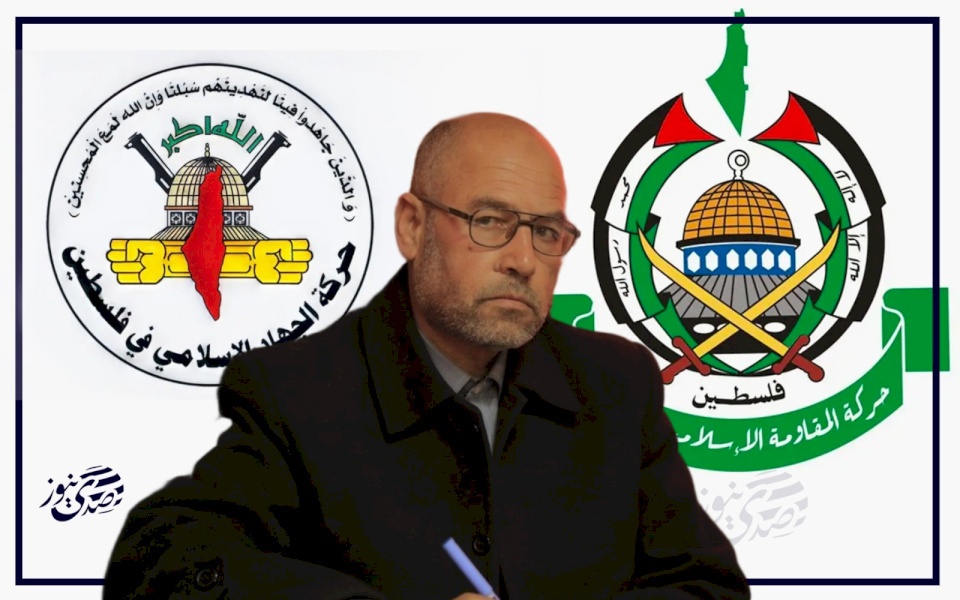
Exclusive "SadaNews": Member of the Political Bureau in "Islamic Jihad" Criticizes and Attacks "Hamas" with Unprecedented Severity
Exclusive SadaNews - A foundation affiliated with the Islamic Jihad movement recently published a book authored by Dr. Walid al-Qatta, a member of the movement's political bureau, in which he discusses the Israeli war on the Gaza Strip, focusing on political messages on one hand, and his daily life and the lives of Gazans during that difficult war that lasted two years.
Al-Qatta is a general member of the political bureau in Islamic Jihad and is a resident of Rafah in southern Gaza. He is considered one of the founding early members of the movement, although he only became a member of the political bureau after revising internal organizational laws that led to elections over two consecutive terms, in which he succeeded.
The book is titled "A Palestinian Tragedy Inspired by War," sharply criticizing the policies of "Hamas" from the onset of the attack on October 7, 2023, until the end of the war and beyond. Readers of the book, including several intellectuals inside and outside Islamic Jihad, consider this book a kind of "intellectual coup against the Al-Aqsa flood".
Al-Qatta is known to lead a political research center affiliated with the Islamic Jihad movement and is considered one of the influential intellectuals within the movement, having authored numerous books and writings.
In the beginning of his book, which "SadaNews" summarized its main political points, al-Qatta talks about the journey of hiding and moving from one place to another amid difficult security and living conditions from one "safe" house to another. He questions, from the first moments of "Hamas"' attack, the reason that prompted them to this "unconsidered adventure," as he mentions in his book specifically on page 36 in a chapter titled "The Flood Destroys the Dam," recalling unprecedented scenes that Israel experienced on the day of the attack and the losses on human, moral, and material levels.
The author, who is an Islamic politician who frequently participated in meetings with "Hamas" leadership, questioned: "What comes after the Al-Qassam attack? What was going on in the minds of those who decided to attack Israel? Did they overlook the Israeli reaction after the attack, placing it in an existential threat that would compel it to unleash all the evil within it to preserve its life?" He considered what happened to have unleashed the "Israeli beast from its den".
On page 45 of the book, al-Qatta wrote under the title "Strategic Failure Devours Tactical Success," pointing to what he described as the "mistake" made by "Hamas" when it decided to attack from a small military group, without discussion with the political leadership, which he believes, had it been presented to them, would have changed its course or canceled it. He questions the objective that the group had in mind when they made the war decision? And their estimates of the Israeli reaction?" He argues that what Israel later did consumed all the accomplishments of the "Al-Aqsa flood" from day one, including prisoner exchange deals.
In his personal book, the Islamic Jihad political bureau member considers that the lack of coordination of "Hamas"' attack with the "Resistance Axis" put them in a predicament, especially regarding "Hezbollah"'s situation in Lebanon, pointing out that if the matter had been presented to them, they would have asked for a postponement or change in timing, or even perhaps cancellation due to the regional situation, noting that this axis was surprised by the wrong timing of the attack.
Al-Qatta directed strong criticism at "Hamas," stating on page 50: "For Hamas to start the war and then ask others in the Resistance Axis to catch up with it and follow it is an unethical, illogical matter that no one in the Resistance Axis accepts." He later indicated in other pages that this operation led to a series of setbacks within the "Resistance Axis," which resulted in the assassination of its leadership and most prominent figures, resulting in a state of frustration among the supporters of the axis, and causing the axis to gradually collapse and be defeated after the downfall of the Assad regime despite the continuation of "resistance." As "SadaNews" followed up and summarized.
On page 52, he reveals that he sent a message to one of the influential figures in "resistance" abroad in late January 2024, as an influential figure on "Hamas," seemingly referring to the Secretary-General of the "Islamic Jihad" movement, Ziad al-Nakhala, especially since he has a direct relationship with him. He asked him to work on saving what remains of the people and "resistance" as it is a national responsibility that mandates overcoming many of the fixed lines of "resistance" in light of the dire situation in Palestine and the Gaza Strip and the region. He noted in his revealed message the state of discontent and anger among the population towards "Hamas" and the leadership of "Al-Qassam" and "resistance," as well as the significant public desire to end the war even without reaching any prisoner exchange deal. He warned that any achievements that would be presented would remain illusory in the eyes of the population, urging him to work to stop the war at any cost, even if the Israeli captives were handed over without a Palestinian prisoner exchange.
Al-Qatta saw in the subsequent pages that the decision for war was "naivety" because they did not realize its repercussions. He pointed out that rounds of negotiations regarding the numbers of Palestinians who would be released in exchange for each Israeli captive, which were ongoing amid the daily rising death tolls, were of no value.
On page 63, al-Qatta describes what "Hamas" did as an "unconsidered adventure that will impact the reality of resistance in the Gaza Strip after the war ends," asserting the need to search for a new national existence by making the Strip a viable area again through its reconstruction, rebuilding what was destroyed by the Palestinian division, and achieving national unity, combining the experience of armed resistance with the Palestinian Authority.
Later he noted that during rounds of negotiations, there was a state of "political stupidity" on the part of "Hamas" that was negotiating for a prisoner exchange deal and its governance of the Gaza Strip, at a time when the number of casualties was increasing daily to a very large extent, indicating that its handling of the initiatives proposed to stop the war was not up to the tough reality of Gaza and that a review of the decision of the "Al-Aqsa flood" should have been conducted, and the Palestinian national project should be rebuilt with a new vision.
The member of the political bureau of "Islamic Jihad" believes that "Hamas" did not grasp the idea of Fathi al-Shiqaqi, which revolves around "engaging the enemy," and that the Palestinian factions cannot liberate Palestine alone. He revealed that in a strategic meeting between the two movements, which he personally participated in, in the presence of Yahya Sinwar, it ended with a point of contention between "Hamas"' understanding of "accumulating strength" and "Islamic Jihad"'s understanding of "engaging the enemy," considering what happened in the "Al-Aqsa flood" a clear indication of "Hamas"' failure to understand al-Shiqaqi's thought, resulting in significant losses. He stated this in his book as
 Follow the latest Sada News via Google News
High-level sources reveal to SadaNews: Washington seeks to hold a Gaza Reconstruction Conf...

Iraqji Reveals Details of the Attack on the Iranian Supreme Leader's Headquarters

صراع على إرث خامنئي وسط غياب مجتبى.. والمتشددون يتهمون قادة إيران بـ«الانقلاب»

The European Union Reiterates Its Call for Israel to Refrain from Expanding Settlements in...

"Mamdani Berlin".. The German Left Bets on a Politician of Turkish Descent to Lead the Cap...

Hebrew Channel: Kushner Pushing to Enhance Communication Between the United States and the...

SadaNews Report: Israeli Elections with a Settlement Flavor!
