

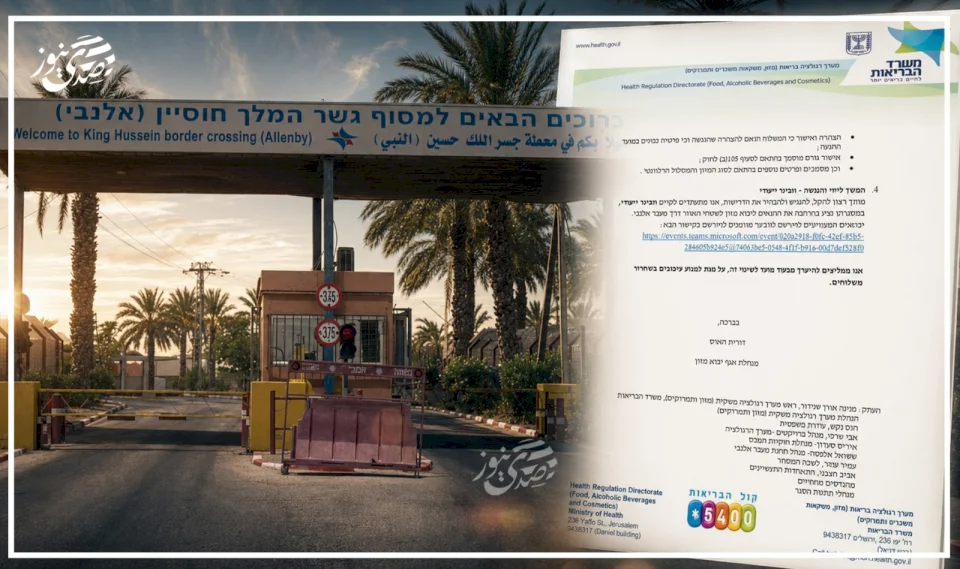
A Severe Blow to the Economy of the West Bank.. New Israeli Measures at the Karama Commercial Crossing Beginning Next Month
Exclusive to "SadaNews" - Palestinian importers have received a message from the Israeli Ministry of Health stating that new measures will be applied to the import of foodstuffs through the Karama commercial crossing starting from the beginning of next August.
SadaNews obtained the text of the message which indicates the approval of a new Israeli policy that includes measures not previously applied regarding food products imported to the West Bank through the crossing.
Informed sources tell SadaNews that the Karama crossing is considered, according to the Paris economic protocol, as a crossing exclusively for Palestinian territories, as Palestinian police used to be present at the crossing until the year 2000 when the Al-Aqsa Intifada broke out, after which the procedures changed.
The sources stated, "The goods that enter through this crossing are only designated for Palestinian territories," noting that the new circular from the Israeli Ministry of Health includes opening an office at the crossing to inspect the food products that will pass through it.
The sources pointed out that these measures are currently only applied at Israeli crossings, which means that the crossing will now be subject to Israeli health inspections to comply with Israeli specifications, similar to the other crossings and ports in Israel. This is considered a direct intervention in the nature of the food products that will be allowed to enter the West Bank.
According to the sources, Palestinian importers were, prior to the events of October 7, 2023, bringing in 150-200 trucks daily through the crossing, before the occupying authorities imposed obstacles following the outbreak of war on the Gaza Strip and the West Bank after those events, and after carrying out two operations at the crossing that resulted in the deaths of Israelis.
The sources stated, "The Karama crossing used to handle about 70% of Palestinian imports from abroad, but currently this percentage does not exceed 3-5% as only 15-20 trucks pass daily. The Israeli procedures and complications have imposed additional costs due to delays in bringing in goods, leading many importers to consider completing their import operations through Israeli ports.
Sources expect that the goal of these procedures is direct Israeli intervention to inspect food products for fear that settlers might buy them from the West Bank, in addition to the political dimension of removing the Palestinian identity from the crossing.
The sources confirmed that this decision will inevitably drive importers to reconsider importing many food items, as the inspection process will take a long time, leading to spoilage of those goods, or increasing the cost of importation since sampling these goods may take up to two weeks, which means that the goods will remain at the crossing and force traders to pay for ground rent, increasing costs further, and some materials will suffer spoilage.
The sources indicated that the new procedures will prevent the importation of specific items such as ice cream, juices, and tomato juices, as they require special storage conditions that are not available at the crossing.
They added, "This means that these goods will be transported to Ashdod port to await inspection results, which implies an increase of no less than 20,000 shekels per shipment," noting that this procedure will inevitably discourage importers from thinking about importing food items through this crossing, which means depriving Palestinian imports of sources coming from the east, specifically from Jordan and Gulf countries, at reasonable prices and distinctive quality.
Sources confirmed that the procedures at the Karama crossing have recently seen unprecedented tightening, banning goods exempt from customs duties according to the Paris Protocol, but the occupying authorities have not allowed them to pass exemption, as part of their pressure policy on the Palestinian economy.
The message received by the importers stated, "Starting from August 1, 2026, it will no longer be possible to deliver foodstuff shipments at the Nabi crossing except after submitting an official request to obtain a delivery certificate according to Article 84 of the law. We note that this request will be submitted through the food service portal similar to food delivery requests submitted at the Allenby crossings," adding that the message required importers to present registered importer data, shipment details, transport means, and port of arrival, and to issue a release certificate for the shipment, importers must present a certificate from the accredited authority indicating that the previous shipment intended for import (if available) has been actually transferred to the territory of the area (West Bank) and is not allowed to be shipped to other areas (Israel).
 Follow the latest Sada News via Google News
Soaring Oil Prices Burn the Pockets of the Palestinian Citizen "The Poor"

Millions of Dollars in Losses.. "SadaNews" Reveals Shocking Figures for Traders from Pales...

The Problem of Shekel Overcrowding Worsens.. Fuel Station Owners Threatened with Closure o...

The Palestinian Economy at a Crossroads: 4 Files Awaiting Resolution

A Severe Blow to the Economy of the West Bank.. New Israeli Measures at the Karama Commerc...

Exchange Rates of Currencies Against the Shekel (24 July)

The United States Imposes New Sanctions on Network Linked to the Muslim Brotherhood and Ha...
