

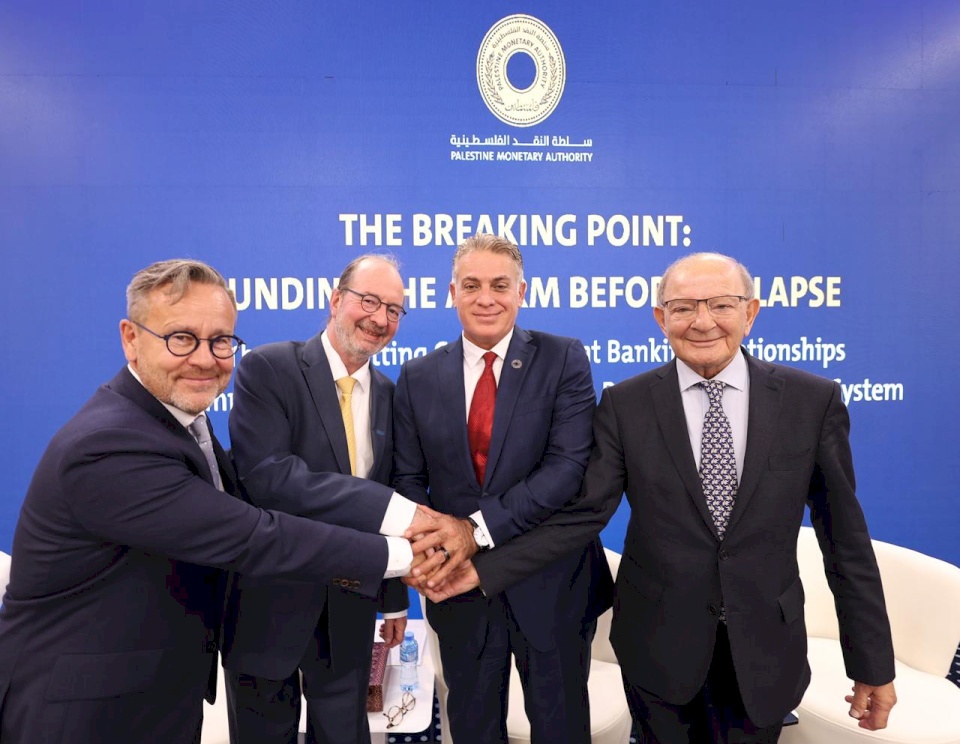
The Monetary Authority Mobilizes the International Community to Act Before the Point of No Return: Cutting Correspondent Banking Relations Threatens the Economy and Life
SadaNews Economy - Palestinian Monetary Authority Governor Yahya Shanar warned during a high-level international meeting held by the Monetary Authority at its headquarters in Ramallah and Al-Bireh, with the participation of several ambassadors and representatives of international financial and banking institutions and organizations, about the serious repercussions of severing correspondent banking relations, emphasizing that the continuation of Israeli measures undermines the Palestinian economy and threatens food security, leading to the collapse of essential services. He called for urgent, coordinated international action before reaching a point of no return.
The Monetary Authority held the session under the title "Point of Collapse: Aimed to Sound the Alarm Before the Complete Collapse of the Economy, which Threatens Stability in the Region." Among the speakers were Jordan's Central Bank Governor Dr. Adel Sharkas, the Director General and Chairman of the Arab Monetary Fund Dr. Fahd Mohammed Al-Turki via video conferencing, the resident representative of the International Monetary Fund in the West Bank and Gaza Tobias Roy, the senior advisor to the UN Special Coordinator for the Middle East Peace Process (UNSCO) in Jerusalem Hansjürgen Sturmier, and the Chairman of the Association of Banks in Palestine Maher Al-Masri, while the session witnessed a wide attendance of ambassadors and representatives of international financial and banking institutions.
Shanar called on the international community and international financial institutions to take urgent action before it's too late, stressing the necessity of international intervention to maintain correspondent banking relations with Israeli banks, considering it the only way to access goods and services globally under the Paris Economic Agreement. He pointed out that reaching reliable and sustainable banking arrangements ensures the smooth flow of trade and goods to and from Israel and the world, which brings stability and calm.
The governor stressed that any disruption or termination of correspondent banking relations will have impacts beyond the financial sector and could rapidly develop into a widespread economic and humanitarian crisis. He explained that supply chain disruptions could lead to shortages of fuel, energy, and essential food products, alongside rising prices, a sharp slowdown in economic activity, and an unprecedented rise in unemployment and poverty levels. This comes alongside the worsening of the public financial crisis faced by the government due to Israel's continued withholding of clearance revenues, which increases the difficulty of meeting financial obligations and providing essential services.
Shanar clarified that 90% of Palestinian exports are directed to Israel, while 100% of Palestinian imports come from Israel or through it, with about 60% coming directly from Israel, including vital sectors such as energy, fuel, water, medicine, and food. He added that correspondent banking handled transactions worth about 51 billion shekels in 2025, reflecting the significant reliance on banking payment channels for maintaining economic activity and the flow of goods and services.
The governor noted that the crisis may push economic activity towards unofficial channels based on cash transactions, weakening and leading efforts to combat money laundering, increasing risks of isolation from cross-border payment networks, and raising transaction costs. He emphasized that Palestine is among the advanced countries in adhering to international standards and procedures for combating money laundering and terrorist financing, reiterating the commitment of the Palestinian banking sector to the highest compliance and transparency standards in line with relevant international requirements, reflecting the State of Palestine's keenness to maintain the integrity and robustness of its financial system and enhance confidence at both the regional and international levels.
Shanar added that the accumulation of cash liquidity in shekels poses an additional challenge for the Palestinian banking sector, with accumulated cash liquidity in bank vaults reaching about 18 billion shekels, approximately 6 billion dollars, which limits the banking sector's ability to perform its role in trade financing on one hand and providing financing for economic projects and small and medium enterprises on the other hand.
For their part, representatives of international financial institutions and participating international organizations warned that any disruption in correspondent banking relations will have wide-ranging implications for the Palestinian economy, including trade movement, supply chains, food security, and essential services. They affirmed that the margin of time available for action is narrowing and that avoiding a disruption scenario requires urgent, coordinated international action, working to ensure stable and sustainable arrangements that prevent isolating the Palestinian banking sector from the global financial system and mitigate the risk of the crisis spreading to the economy and society.
 Follow the latest Sada News via Google News
Soaring Oil Prices Burn the Pockets of the Palestinian Citizen "The Poor"

Millions of Dollars in Losses.. "SadaNews" Reveals Shocking Figures for Traders from Pales...

The Problem of Shekel Overcrowding Worsens.. Fuel Station Owners Threatened with Closure o...

The Palestinian Economy at a Crossroads: 4 Files Awaiting Resolution

The Monetary Authority Mobilizes the International Community to Act Before the Point of No...

Palestine.. Trade Balance Deficit Increases by 15% During May Last Year

The Monetary Authority Keeps the Discount Rate at 25% of Public Sector Employees' Salaries...
