

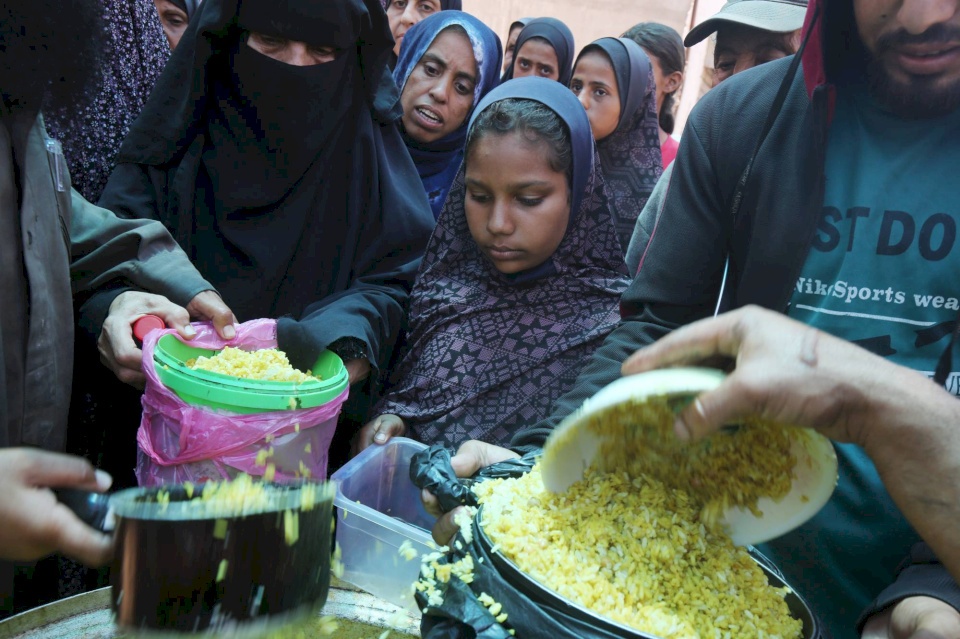
Observatory: Two-thirds of Gaza's population may face severe hunger by the end of the year
SadaNews - A global observatory concerned with monitoring hunger stated on Thursday evening that more than two-thirds of Gaza's population may face severe hunger by the end of the year as humanitarian aid agencies cut back on aid flows due to funding shortages.
The latest assessment by the Integrated Phase Classification for Food Security showed that levels of acute malnutrition, especially among children, had significantly decreased after an increase in food supplies and nutrition services following the ceasefire between Israel and the Palestinian Islamic Resistance Movement (Hamas) in October 2025. However, the observatory highlighted in its report that this improvement in conditions is at risk of reversal.
The report indicated that food consumption remains inadequate for most families, with some resorting to begging and searching for food in garbage bins.
Furthermore, more than 1.2 million people, or about 59% of Gaza's population, experienced severe hunger, defined as crisis levels or worse, during the period from mid-April to the end of June.
Among this number, approximately 212,000 people were in emergency conditions. This figure is expected to rise to over 1.4 million people, or 67% of the population of the sector, by December. The majority of Gaza's population relies on aid supplies after the war that erupted in 2023 amidst repeated displacement and the strict restrictions imposed by Israel on the delivery of aid. However, the Israeli Foreign Ministry stated that Israel does not impose restrictions on food entering Gaza and has facilitated the entry of over 1.8 million tons of foodstuffs into the sector since October 2025.
Fragile Situation
The Integrated Phase Classification for Food Security in December noted that parts of the Gaza Strip no longer suffer from famine conditions, a reversal from its conclusion in August. It now warns that this progress is threatened as the amount of aid begins to decline.
Complementary nutrition programs targeted at pregnant and lactating women have halved the number of beneficiaries to six thousand women between January and May of this year.
Further cuts in aid are likely due to funding shortages and uncertainty regarding the operations of relief organizations in the sector.
Israel rejected the findings of the Integrated Phase Classification for Food Security in August, consistently denying accusations that it is pursuing a starvation policy in Gaza despite acknowledging food shortages at that time.
Israel previously stated that it allowed sufficient aid into the sector during the war. The Israeli government's Coordinator of Activities in the Territories, the Israeli military body responsible for overseeing the flow of aid to Gaza, dismissed the classification report as biased.
They stated that large quantities of food, water, and medical supplies have entered Gaza since the ceasefire, accusing Hamas of diverting and looting aid supplies.
Relief organizations warned that Gaza faces an unprecedented collapse of water and sewage networks.
The war erupted when fighters led by Hamas attacked southern Israel, which claims that the assault resulted in the deaths of 1,200 people, most of them civilians, and the capture of 251 hostages.
Gaza health officials report that the subsequent Israeli attack resulted in the deaths of more than 73,000 Palestinians, most of them civilians.
 Follow the latest Sada News via Google News
Observatory: Two-thirds of Gaza's population may face severe hunger by the end of the year

US Court Rejects Trump's Administration Request to Re-detain Pro-Palestinian Researcher

Casualties and Injuries in Extensive American Attacks in Iran as the Country Strikes Gulf...

Injuries.. Occupation Destroys 4 Homes and a Workshop in Israeli Shelling on Gaza (Video)

Injury in Jerusalem.. Extensive Arrest Campaign in the West Bank

Expansionist Colonial Scheme to Seize Thousands of Dunams Southeast of Bethlehem

Katz Threatens Iran and Israel Awaits Trump's Green Light
