

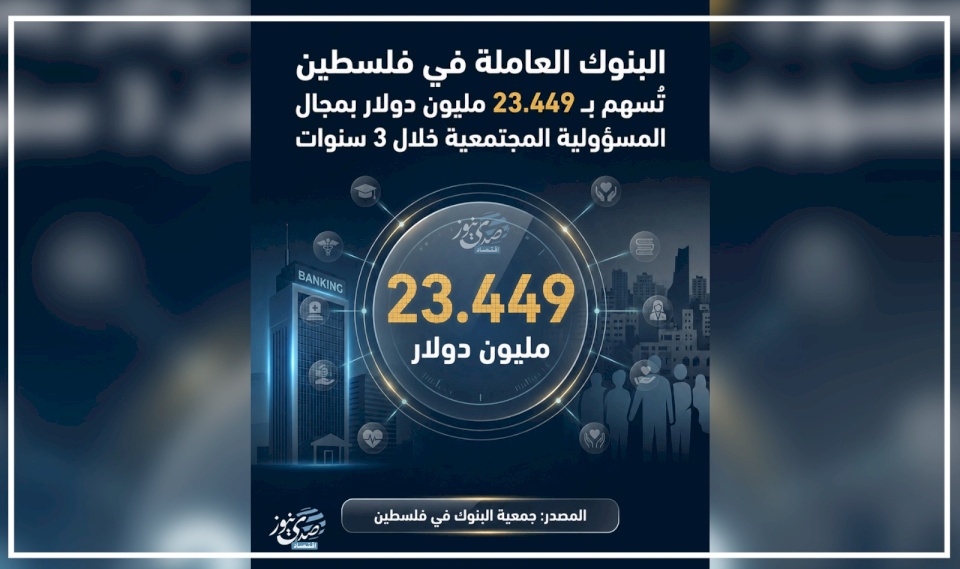
Contributions of Banks Operating in Palestine to Social Responsibility Exceed 23 Million Dollars Over 3 Years
SadaNews Economic - Recent data issued by the Banks Association in Palestine revealed that banks contributed $23.449 million in the field of social responsibility during the period (2023-2025), with an average annual spending of about $7.816 million.
The value of spending in the field of social responsibility during 2023 was about $8.55 million, while in 2024 it reached approximately $7.55 million, and in 2025 about $7.34 million.
Relief and health sectors account for 57% of support
The figures released by the association show that the relief and humanitarian aid sector received the lion's share of the banks' support, obtaining approximately $7.07 million, or 30%, followed by health and environment support which amounted to about $6.43 million, or 27%, then the education sector with support of about $3.15 million, or 13%, followed by the youth creativity sector at approximately $3.09 million, or 13%, and community development at about $1.84 million, or 8%. The remainder of the support was distributed to other sectors including: culture and arts, sports, childhood, people with disabilities, and women's empowerment.
Social responsibility responds to challenges
Researcher and academic Dr. Ibrahim Raba'iah stated: "Social responsibility for banks is very important in the Palestinian context, whether in the Gaza Strip or the West Bank," pointing out that this importance has doubled due to the decline in available resources for vital sectors such as health and education or for social protection provided by the National Authority. He added, "What has happened during the past period, especially during the war, was connected to responding to these challenges," explaining that the Palestinian economy, including banks, experienced a shock due to the decline in resources and the disruption of business.
He noted that during the war, banks' social responsibility focused on two main sectors: first, education and higher education, through partnerships some banks established with the Ministry of Education and some universities, which contributed to funding higher education, especially for students in the Gaza Strip; and second, the field of relief to provide social protection, with significant contributions in this direction by supporting civil society organizations to deal with the shocks resulting from the genocidal war, or at the social level.
Dr. Raba'iah indicates that the social responsibility of banks gains significant importance, and has a considerable humanitarian and developmental impact; however, there remains a need to institutionalize the relationship between banks and community institutions through various channels such as student lending funds, in addition to organizing aid and its distribution in humanitarian work to avoid overlapping with other assistance provided by international or local parties, ensuring that the base of benefit and spread is fair and effective, and that the mechanism is organized to prevent duplication, as well as the necessity of framing social protection policies within participatory regulations between the public and private sectors that address priorities responding to national policies.
Dr. Raba'iah pointed out the need to enhance banks' contributions in social responsibility due to the extent of community needs, emphasizing the importance of transforming these contributions into a form of permanent commitment so that the distribution is linked to needs, in addition to measuring the impact as it helps redesign these programs, whether at the level of banking institutions or partner institutions. He called for the need to enhance attention to the less fortunate at the geographical distribution level due to service shortages or their exposure to immense shocks as a result of the war, as well as enhancing attention at the social level, such as for people with disabilities, women, or children.
Contributing to addressing community issues
For his part, Dr. Amin Abu Aisha, an expert in economic policies, believes that social responsibility is not confined to a singular concept, but rather is a social network implemented by banks in various fields—economic, ethical, legal, and charitable—through its financial inclusion and conceptualization of sectors: education, health, relief, creativity, arts, and others, expanding to encompass the core interests of Palestinian society amidst the financial crisis facing the public sector, which fails to provide care for these sectors. He noted that these interventions prevent harm and also provide a positive view of the role of these banking institutions, as they work to address community issues through the $23 million, launching and providing a number of initiatives and activities sustainably across all sectors, especially in intangible areas like training, development, and awareness.
Dr. Abu Aisha emphasized the necessity of incorporating social responsibility into the operational plans of banking sectors, with the need for coordination among them, and avoiding selectivity and impulsive unstudied actions within an economic and social environment, aiming for sustainable development, through a single body that studies in depth how to optimally invest in social responsibility, by setting plans and priorities that align with the community's economic, developmental, educational, and health objectives, etc.
Tangible commitment to social responsibility
For his part, economic expert Dr. Said Sabri stated that the data shows that banks operating in Palestine maintained a tangible commitment to social responsibility during the three years from 2023 to 2025, totaling $23.449 million, while the announcement of annual figures indicates about $23.42 million, a slight difference likely resulting from rounding. This means that annual spending averages around $7.8 million, a level that reflects a stable institutional presence of banks in the social field despite the highly fragile economic environment.
Sabri points out that from a temporal perspective, the figures indicate a decline from $8.55 million in 2023 to $7.55 million in 2024, a decrease of approximately 11.7%, and then to $7.32 million in 2025, with an additional decline of about 3.0%. This movement suggests that banks did not withdraw from their community role but rather adjusted spending to align with rising risks, declining business margins, and the need for a more conservative liquidity and capital management approach. In economic terms, we face a continuation of commitment with a rational expansion.
As for the distribution of 2025 spending, Sabri sees it as carrying important implications; relief and humanitarian assistance accounted for 27%, nearly $1.98 million, followed by education at 24%, translating to about $1.79 million. Furthermore, youth creativity and health and environment each received 16%, approximately $1.17 million per sector, while 5% went to community development, with the remainder allocated to areas such as culture, arts, women's empowerment, childhood, people with special needs, and sports.
Economically, this distribution implies that banks directed their interventions toward mitigating short-term social shocks through relief, while maintaining a long-term investment in human capital through education and youth. This is a crucial point, as the most effective social spending is not merely that which meets immediate needs but also enhances the community's ability to recover and produce in the future. Additionally, support for health and environment strengthens social stability and mitigates future costs for families and the local economy.
Dr. Sabri believes that while banks' contributions are important, they should be viewed as a supportive lever and not as a substitute for public policies or large-scale developmental investment. However, in the Palestinian context, where uncertainty levels are high, maintaining an annual social expenditure close to $7-8 million is an indicator that the banking sector continues to play a role that transcends financial intermediation to contribute to social and economic resilience. The most significant impact here is not merely in the monetary value, but in directing resources to priorities that impact stability, dignity, and human capital.
 Follow the latest Sada News via Google News
Soaring Oil Prices Burn the Pockets of the Palestinian Citizen "The Poor"

Millions of Dollars in Losses.. "SadaNews" Reveals Shocking Figures for Traders from Pales...

The Problem of Shekel Overcrowding Worsens.. Fuel Station Owners Threatened with Closure o...

The Palestinian Economy at a Crossroads: 4 Files Awaiting Resolution

Contributions of Banks Operating in Palestine to Social Responsibility Exceed 23 Million D...

New Legal Amendments to Value Added Tax Provisions in Palestine

Increase in the Index of Building Costs for Residential Buildings
