

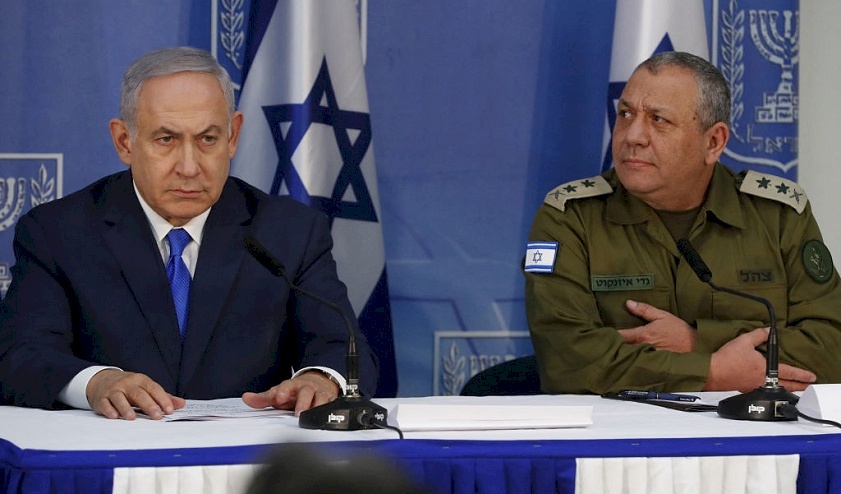
Two Surveys: Eizenkot Strengthens His Position as Netanyahu's Main Rival While Bennett Continues to Decline
SadaNews - Two public opinion surveys in Israel show continued rise of the "Yashar" party led by Gadi Eizenkot, establishing his position as the primary competitor to Prime Minister Benjamin Netanyahu, while the coalition of Naftali Bennett and Yair Lapid continues to decline, amidst a majority of Israelis opposing the deal being formulated between Netanyahu and the ultra-Orthodox parties regarding the timing of the upcoming elections.
According to the survey conducted by the Israeli Public Broadcasting Corporation ("Kan 11") and published its results on Wednesday evening, the Likud party rises to 24 seats compared to 23 in the previous survey, while the "Yashar" party led by Eizenkot gains 22 seats, up from 21 in the last survey, while Bennett's list declines from 17 to 16 seats.
According to the survey, the "Yisrael Beiteinu" party receives 10 seats, while the "Democrats" and "Otzma Yehudit" get 9 seats each. Shas received 8 seats and Degel HaTorah obtained 7 seats.
The Joint List and the Arab List for Change coalition receives 6 seats, and the Religious Zionism party gets 5 seats, while the United List surpassed the electoral threshold by securing four seats; meanwhile, both the "Blue and White" party led by Benny Gantz failed to pass the threshold.
In the distribution of seats by blocs, Netanyahu's coalition receives 53 seats, compared to 57 for the opposing Zionist parties, while the Arab parties obtain 10 seats.
In a scenario examined by the "Kan" survey, if Bennett and Lapid run in two separate lists, Bennett would receive 14 seats against only 4 for Lapid, which would not fundamentally change the balance of power between the blocs.
The survey showed that a potential list including Gantz, Yoaz Hendel who leads a party targeting reserve soldiers, and reserve General Dadi Samhi would gain 7 seats, potentially giving it an influential position in the negotiations to form the upcoming government.
In this scenario, Netanyahu's bloc gets 51 seats, compared to 52 for the opposing Zionist parties, while the Arab parties get 10 seats, and the potential list led by Gantz receives 7 seats, noting that Gantz does not rule out joining any coalition led by Netanyahu or his opponents.
Another indicator showed that the "Kan" survey found a majority of respondents opposing the deal being formulated between Netanyahu and the ultra-Orthodox parties regarding a mutually agreed date for the elections in exchange for passing legislation serving the interests of the ultra-Orthodox parties; 52% of survey participants opposed it, while 23% supported it.
Furthermore, 40% of respondents believed Eizenkot is the most suitable figure to lead the opposition bloc in the upcoming elections, while only 16% believed Bennett is the more qualified candidate for this task, and 27% stated that neither of them is suitable to lead the opposition bloc.
The survey's authors noted that the increasing criticisms directed at Netanyahu by U.S. President Donald Trump contributed to a portion of right-wing voters rallying around him, stemming from a growing feeling within this camp that Israel is experiencing increasing external pressures.
Channel 13: Eizenkot Surpasses Netanyahu and Expands the Gap with Bennett
According to the Channel 13 survey, Likud would get 23 seats if elections were held today, followed by the "Yashar" party led by Eizenkot with 20 seats, while the Bennett-Lapid coalition continues to decline, receiving 15 seats.
The survey also grants the "Yisrael Beiteinu" party led by Avigdor Lieberman 12 seats, and the Democrats led by Yair Golan 10 seats, while the "Otzma Yehudit" party receives 9 seats.
Shas and Degel HaTorah each get 8 seats, while the Joint List and the Arab List for Change receive 6 seats, and the Religious Zionism party gets 5 seats, while the United List gets 4 seats.
The map of political blocs shows that the ruling coalition parties collectively receive 53 seats, compared to 57 for the opposing Zionist parties, while the Arab parties receive 10 seats.
In a scenario examining the formation of a unified political framework led by Eizenkot, his party jumps to 37 seats, while the Likud remains at 23 seats. In this case, the strength of the Zionist opposition parties rises to 58 seats, compared to 52 seats for the ruling coalition parties.
The survey also showed that unifying the Arab parties in a common list raises their representation to 12 seats and reduces the strength of the coalition parties to 50 seats, while the Zionist opposition parties maintain 58 seats.
According to the survey, about 51% of Arab citizens intend to participate in the upcoming elections, while 49% said they do not intend to vote.
Regarding the suitability of candidates for the premiership, Eizenkot surpasses Netanyahu with 43% to 39%, while Netanyahu leads Bennett by 44% to 41%.
When asked about the preference between Eizenkot and Bennett, 42% said they prefer Eizenkot for the premiership, compared to only 21% who preferred Bennett.
In light of the recent U.S.-Iran agreement, the survey showed a decline in Trump's positive perception in Israel; 42% of respondents viewed him as "bad for Israel," compared to 21% who thought he was "good for Israel," while 37% said they do not know.
The results also indicated a drop in the level of trust in Trump compared to previous months; whereas 72% around six months ago considered him "the most supportive president for Israel ever," this percentage has now decreased to 54%.
Regarding Lebanon, 48% of survey participants believed Israel should not commit to a ceasefire, while 37% said it should commit to it, whereas 15% answered that they do not know.
 Follow the latest Sada News via Google News
Abu Rdeina: Bennett's Statements are Condemnable, Rejected, and Contrary to International...

Two Surveys: Eizenkot Strengthens His Position as Netanyahu's Main Rival While Bennett Con...

Israeli Channel: Israel Prepares to Resume Fighting on the Yemen Front

Abdel Aati Receives Maladinov to Discuss Developments in Gaza

Mustafa: Providing dignified housing for displaced families is a priority alongside health...

Netanyahu: We Still Have Work in Gaza, Lebanon, and Iran

Settlers Assault an Employee of the Jerusalem District Water Authority
