
Mas Institute in partnership with the Bank of Palestine holds a roundtable discussion titled "The Energy Sector in Palestine: Between Rising Prices and Possible Solutions"
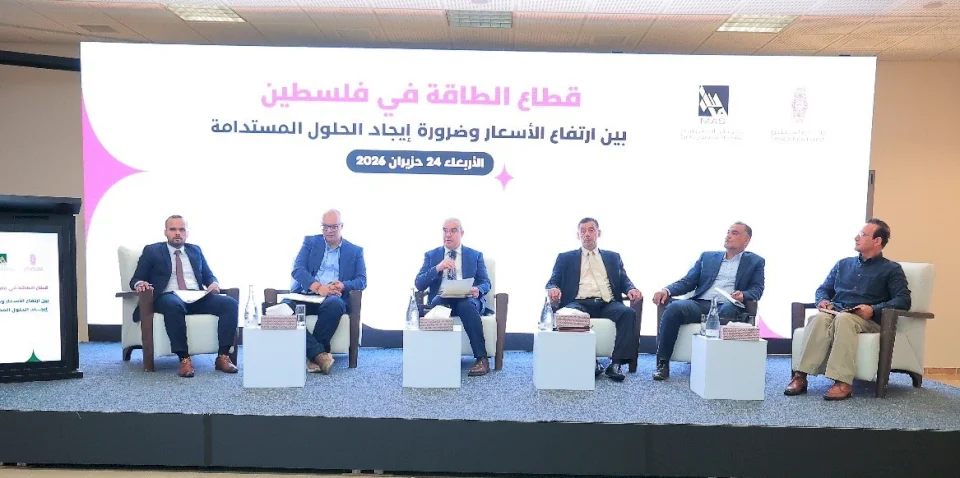
SadaNews - The Palestinian Economic Policy Research Institute (MAS), in partnership with the Bank of Palestine, held the third roundtable meeting for 2026 to discuss "The Energy Sector in Palestine: Between Rising Prices and the Necessity of Finding Possible Solutions," held at the institute's headquarters and via Zoom.
The meeting was chaired by Dr. Samah Hallak, the research coordinator at MAS, with the background paper prepared by researcher Sabri Ya’aqob. Contributing their inputs and comments on the paper were Omar Qabha, Director of the Communication and Information Department at the Ministry of National Economy, Engineer Nidal Abu Rub, Acting General Director of the Palestinian Energy and Environment Research Center at the Palestinian Energy and Natural Resources Authority, and Khaled Sarahana, Secretary of the Fuel Dealers Union.
At the outset of the meeting, Dr. Firas Malhim, General Director of MAS, welcomed the participants from various sectors, emphasizing the importance of discussing the challenges related to the energy sector in light of the current economic conditions and the additional pressures they impose on the Palestinian economy. He noted that this session is part of the institute's efforts to provide a platform for dialogue that brings together decision-makers, experts, and private sector representatives, contributing to the formulation of practical policies and recommendations that enhance energy security and increase the national economy's capacity to withstand shocks. Malhim also thanked the Bank of Palestine, the sponsor of this session, for its support of this event, confirming its role in supporting the Palestinian economy and its belief in the importance of enhancing energy security and the gradual transition to alternative energy sources, in line with modern developmental trends.
For its part, the Bank of Palestine confirmed that its support for the roundtable organized by MAS comes from its belief in the importance of enhancing vital economic and developmental issues, primarily the energy sector and its sustainability, as a fundamental pillar to strengthen the resilience of the national economy and enhance its ability to face challenges and crises. It pointed out that investing in knowledge and exchanging experiences between decision-makers, experts, and the private sector contributes to formulating practical solutions and effective policies that support the gradual transition to alternative energy sources and achieve more sustainable economic development.
In his presentation, researcher Ya’aqob explained that the paper aims to analyze the structural and circumstantial reasons behind the rising prices of fuel in the Palestinian market, understand the mechanisms by which the increase transfers to the local economy, and assess its economic and social implications on households, economic sectors, and society as a whole, contributing to formulating more effective responses to the current conditions. He noted that the paper is based on the premise that the continued high reliance on imported traditional energy sources keeps the Palestinian economy continuously vulnerable to external economic and geopolitical fluctuations, accompanied by price shocks that directly affect the costs of living, production, and transport. Ya’aqob indicated that the impact of this vulnerability is exacerbated by dependence on importing approximately 86% of electrical needs from the Israeli side, alongside almost complete reliance on importing fuels through the Israeli market, which makes the Palestinian economy highly susceptible to fluctuations in global oil and energy prices, and enhances the importance of gradually expanding the use of alternative energy sources to support energy security and reduce the Palestinian economy's vulnerability to external shocks.
The researcher revealed that the reliance rate on imported energy in Palestine reached about 84.3% in 2024, indicating the limited local energy production capacity, which increases the Palestinian economy's sensitivity to price fluctuations and geopolitical disturbances related to external supply chains. He clarified that the transport sector was the largest consumer of fuels in 2024, while the household sector consumes the highest percentage of electricity and gas, emphasizing the importance of expanding investment in renewable energy systems as one of the most prominent strategic interventions required to enhance the contribution of local sources to the Palestinian energy mix and reduce reliance on imported energy, especially in light of rising fuel prices and the increasing risks of transferring price shocks to the electricity sector.
The researcher reviewed the repercussions of rising fuel prices on the Palestinian economy, stating that the almost complete reliance on importing fuel from the Israeli side makes the local market highly affected by global oil price fluctuations. He noted that the recent increases in fuel prices have directly reflected on transport and production costs and price levels, at a time when the government's ability to provide support declines due to the financial crisis and withholding of clearance funds.
The researcher concluded his presentation by outlining a series of interventions that could help mitigate the effects of the accelerating rise in fuel prices and alleviate their economic and social repercussions. The suggested short-term interventions include enhancing market regulation, directing support toward the most affected productive sectors, and ensuring supply chain security. In the medium term, the paper proposes seeking to levy the fuel tax (excise) locally by pressuring the Israeli side, with international support and advocacy, to implement the agreements reached in 2019 between the Palestinian and Israeli Ministries of Finance regarding the Palestinian National Authority purchasing fuel at its original price without paying the excise tax. Alongside the necessity to expand storage capacities and establish a strategic fuel reserve, and to enhance reliance on solar energy systems and electric vehicles.
In the long term, the paper called for adopting more sustainable policies to enhance energy security by exploring the possibility of diversifying fuel import sources and reducing exclusive reliance on the Israeli market, through an examination of the technical, political, and legal requirements necessary to open alternative import channels from foreign markets in the future.
In his comments on the paper, Qabha asserted that the energy issue has become an essential part of the national economic security system, given its wide-ranging impacts on various economic sectors, not just the energy sector. He pointed out that the challenge is not limited to explaining the reasons for price increases but lies in building a more resilient Palestinian economy capable of facing shocks. He added that the Ministry of National Economy continues to develop the legislative and regulatory frameworks governing markets to enhance their efficiency and resilience to crises, within a strategic vision aimed at strengthening the resilience of the national economy and achieving greater energy security.
Abu Rub indicated that Palestine possesses multiple energy resources, especially those in Rantis, as well as shale oil present in the southern area, but the restrictions and Israeli occupation prevent Palestinians from benefiting from them. He recalled that fluctuations in energy markets are not new, recalling the sharp rise in oil prices in 2007 when the price per barrel exceeded $140, justifying the need to adopt policies that enhance investment in energy sources and support Palestinian energy security.
For his part, Sarahana clarified that fuel stations in Palestine operate under licenses and supply procedures organized by the Petroleum Authority, which also purchases fuel from the Israeli side in the absence of a Palestinian strategic stock. He pointed out that fuel prices are influenced by global markets and international developments, stating that supply shortages pose a continuous challenge that requires governmental solutions, emphasizing the need to address existing challenges to enhance the stability and efficiency of the sector.
In their contributions, participants emphasized the importance of regulating the fuel sector and providing stable government policies that enhance investor confidence and stimulate investment in it. They stressed the necessity of combating smuggling and addressing challenges facing the sector. They also called for activating the role of the banking sector in supporting projects related to energy and fuels and strengthening cooperation between the public and private sectors as essential pillars for developing the sector and improving its efficiency.
 Follow the latest Sada News via Google News
The Banks Association in Palestine Issues Issue (102) of the Magazine 'Banks in Palestine'

Mas Institute in partnership with the Bank of Palestine holds a roundtable discussion titl...

The Business Incubator "Intersect" Celebrates Promising Palestinian Startups at the Gradua...

Palestinian Islamic Bank and Roots Foundation Implement Project to Equip 5 Health Centers...

The General Assembly of the Insurance Union Holds Its Annual Meeting

"Gargour Trading" Company Revolutionizes the Palestinian Car Market with Fully Electric "s...

Bank of Palestine Strengthens Its Development Role with $4.1 Million for Social Responsibi...
