

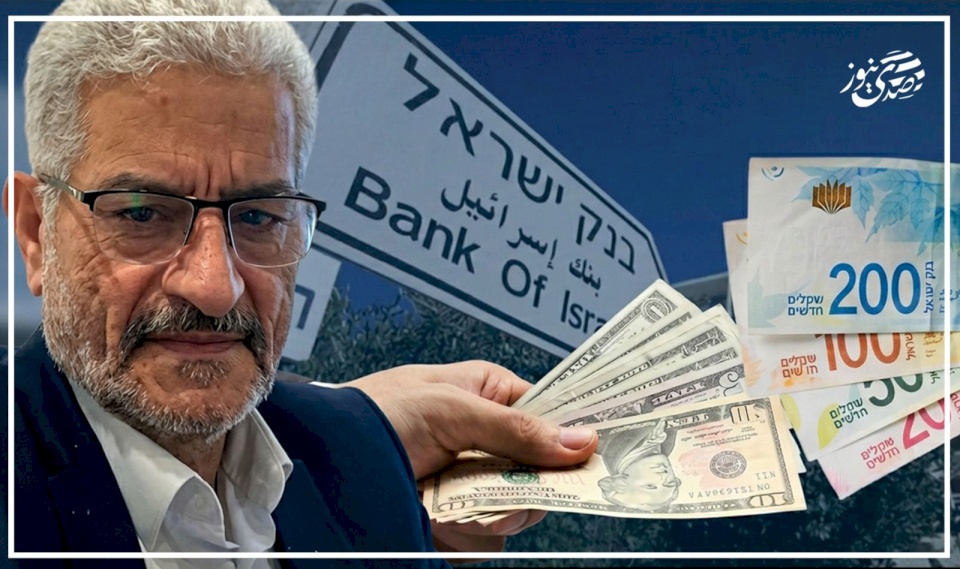
Indicators on the Horizon May Lead to a Devaluation of the Shekel Against the Dollar Soon
Exclusive to SadaNews: A financial and banking expert confirmed that indicators are emerging that may soon lead to steps to lower the value of the shekel against the dollar, pointing out that maintaining the current exchange levels below 3 shekels harms economic sectors in "Israel", which may drive the Israeli central bank to intervene soon by lowering interest rates on the shekel currency.
Recently, the dollar recorded levels against the shekel that are the lowest in about 30 years, reaching an exchange rate of 2.94 shekels.
The financial and banking expert Mohammed Salama told "SadaNews" that some indicators have started to show that the Israeli economy cannot cope with a dollar exchange rate at these low levels, specifically below the 3 shekel mark. He noted that it is natural for Israeli exporters to be harmed due to these exchange levels, and additionally, foreign investment managers have started to complain that their profits in global markets fade away when they return and convert their balances from dollars or foreign currencies to shekels due to the rising value of the Israeli currency.
He adds: "There are leaks from the governor of the Israeli central bank stating that interest rates on the shekel might be lowered soon," pointing out that some predictions have gone so far as to suggest a rate cut of up to half a percentage point.
He continued: "If this happens, it would mean significant intervention in the market, as inflation levels are stable at about 2%, which is within the target range. He clarified that there are fears that the strength of the shekel could lead to an economic recession in "Israel", and in this case, as with Japan, inflation helps stimulate demand and create economic growth. He said: "If a recession occurs, it poses a bigger problem than the exchange rate of the dollar against the shekel, meaning the strength of the shekel could have negative effects, especially on Israeli exports or on foreign investment."
The Only Option for the Israeli Central Bank
Salama noted that there is an imbalance in liquidity in "Israel" so much so that the monetary policy run by the Israeli central bank is drifting away from the positions of the economy. There is a gap that must be filled through intervention via a rate cut. He pointed out that the Israeli central bank cannot directly intervene in the markets by buying dollars and selling shekels, because there is a liquidity imbalance, as there is a surplus of shekels in the markets against a deficit in dollars. Therefore, it cannot currently withdraw dollars from the markets to raise its exchange rate, as this would increase the exposure to dollars, exacerbating the surplus liquidity issue in that currency, rendering it unusable. As stocks have risen significantly and the bonds' returns are unsuitable, the only solution currently available to the Israeli central bank remains the reduction of interest rates.
Salama explained that there are stability factors keeping the shekel strong at present, noting that the dollar may rebound against the shekel in a corrective movement either because the situation cannot sustain the shekel's strength at current exchange levels, or because the reasons for the shekel's strength have been exhausted. He mentioned that regardless of the reasons, we may see a return of the dollar rising against the shekel above the 3 shekel ceiling, which would be a natural rebound within market movements, fluctuating between rises and falls.
No Indicators on Interest Rate Cuts on the Dollar
As for the dollar, Salama clarified that in the last meeting of the U.S. Federal Reserve, there was a clear difference in views among the 12 Federal members. He noted that one member who will soon end his term called for lowering the interest rates in line with what President Donald Trump says, and he was the only one taking this stance, while three "hawkish" members of the Fed called for raising the interest rates, not lowering them, while the consensus of eight members was to keep the interest rates unchanged.
He adds: "Such a decision signals that the members of the Federal Open Market Committee do not agree on significantly lowering interest rates, which has reduced the likelihood of interest rate cuts this year and led to the belief that there may be an interest rate hike by early 2027 if current conditions continue to fuel inflation dynamics in the U.S. economy, particularly rising energy and fuel prices, which may extend its effects to other goods, potentially pushing inflation above 2%, thus making the idea of raising interest rates plausible."
He continued: "The decision to stabilize interest rates eased pressures on the U.S. dollar. The new Federal Reserve governor reported to Congress that he is about to make significant changes in interest rates and measure inflation, indicating that he is undertaking a reform movement, but did not give any indication regarding interest rate cuts."
Salama clarified that the Fed remains an independent institution, often not subject to political logic, saying: "But since the new governor is a nominee of President Donald Trump, it is not surprising to see any unexpected move, but markets do not expect him to lower interest rates immediately; rather, there will be much debate and discussion before any decision is made regarding interest rates, whether to raise or lower them."
 Follow the latest Sada News via Google News
Soaring Oil Prices Burn the Pockets of the Palestinian Citizen "The Poor"

Millions of Dollars in Losses.. "SadaNews" Reveals Shocking Figures for Traders from Pales...

The Problem of Shekel Overcrowding Worsens.. Fuel Station Owners Threatened with Closure o...

The Palestinian Economy at a Crossroads: 4 Files Awaiting Resolution

Inflation Expectations in Israel Stabilize at 1.5%

Ministry of Economy Announces the Opening of Import Application Submissions for Commodity...

Relative Stability of the Dollar Near 3.04 Shekels and Predictions of Returning Inflationa...
