

The European Union Conducts a Tour to Review a Series of Funded Projects Supporting Farmers' Resilience in Tiassir and Atoof
SadaNews - Today, Tuesday, the European Union conducted a field tour to review a series of projects that were funded and implemented through the EU in collaboration with the Ministry of Agriculture. These projects aim to compensate Palestinian farmers for the assaults by the Israeli occupation army and its settler mobs and to support their resilience against these attacks by providing job opportunities and sources of income through which farmers can sustain themselves and continue their agricultural activities, which are their primary source of livelihood in these agricultural regions. The total number of supported projects being implemented in phases is more than 350 projects across various areas of the West Bank, including 48 projects in Tubas benefiting 48 farmers.
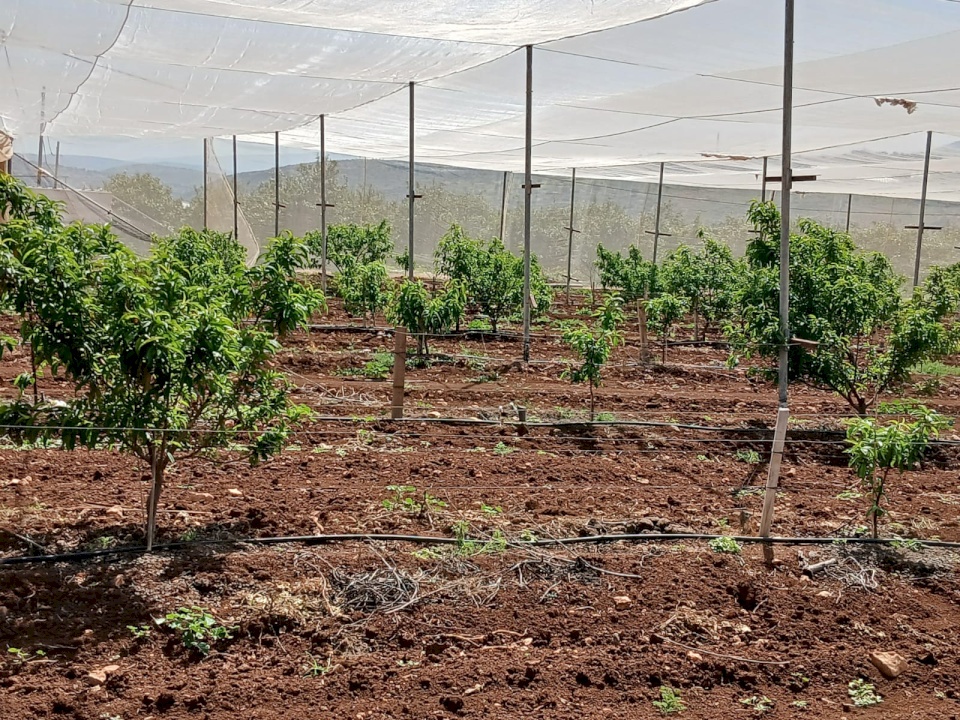
At the beginning of the field tour, the delegation headed to the Aqbat Tiassir area to visit a project for plant production inputs by providing water lines, irrigation networks, fertilizers, and pesticides valued at about 20,000 euros for 20 dunums for farmer Ghassan Daraghmeh. This project was implemented as compensation for the Israeli army's assault on his agricultural crops covering an area of 120 dunums in 2019. This funding has provided Ghassan a new starting point to venture into new crops such as protected vegetables and grapes and to employ modern agricultural methods that helped achieve competitive production in terms of quality and quantity while also providing more than 20 job opportunities from which one can earn a living.
The next stop was in Salhab to review the protected agriculture project through a greenhouse valued at about 10,000 euros for farmer Nasser Jamil Sawafteh. This project was implemented as compensation for the seizure of the farmer's land by the occupation army. Farmer Sawafteh indicated that their area suffers from the absence of job opportunities alongside the repeated assaults by the occupation army and its settler mobs on farmers' lands and properties, making it difficult to sustain existence on their land. This project has provided a valuable opportunity to continue and start anew with an agricultural project that serves as a source of livelihood for his family.
In Atoof, a visit was made to farmer Murshid Rashid Bani Odeh, whose land was completely seized by the occupation army to construct a settlement road through their area. In compensation for the damages and losses he incurred, he received support from the EU in coordination with the Ministry of Agriculture, where he was provided with a livestock project valued at about 17,500 euros. This support enhanced his small home project, allowing him to benefit optimally due to his expertise in this domain, which lacked funding to start a project at a commercial level rather than just a family one. This was achieved after this support, providing him with a new source of income to meet his family and children's educational needs.
In Flamia, the last stop was at a livestock breeding project for farmer Abdel Nabi Abu Dhahir valued at around 17,000 euros funded by the EU with technical support from the Ministry of Agriculture as compensation for the farmer's land, which was seized behind the apartheid wall in 2013. This project supported agricultural investment through recycling livestock waste and using it as fertilizers for avocado and fig trees, alongside the economic return of the project itself.
It is worth noting that these projects, which were funded and implemented, were part of previous stages of documentation and assessment of the damages resulting from assaults by the occupation army and their settler mobs. They were approved after meeting all the conditions and requirements for the documentation, assessment, and registration process required by the EU, which happened through communication between farmers and the Ministry of Agriculture teams, providing the necessary documents, registration, and follow-up until the support and spending triggers were available.
 Follow the latest Sada News via Google News
Soaring Oil Prices Burn the Pockets of the Palestinian Citizen "The Poor"

Millions of Dollars in Losses.. "SadaNews" Reveals Shocking Figures for Traders from Pales...

The Problem of Shekel Overcrowding Worsens.. Fuel Station Owners Threatened with Closure o...

The Palestinian Economy at a Crossroads: 4 Files Awaiting Resolution

بنك إسرائيل يخفض توقعات النمو ويحذر من ارتفاع العجز

Exchange Rates of Currencies Against the Shekel on Tuesday (July 21)

Inflation Expectations in Israel Stabilize at 1.5%
