

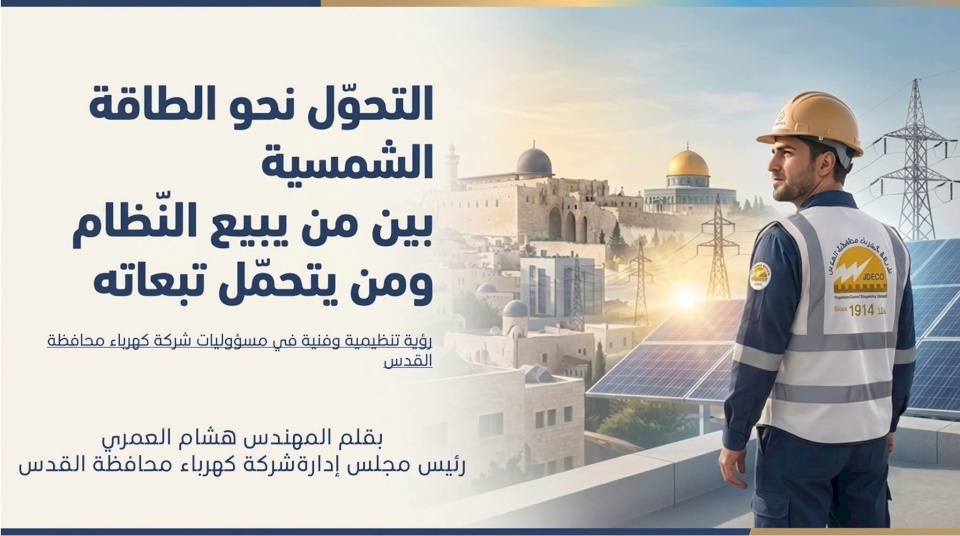
The Shift Towards Solar Energy... Between Those Who Sell the System and Those Who Bear Its Consequences: A Regulatory and Technical Perspective on the Responsibilities of the Jerusalem District Electricity Company
The energy sector in Palestine and the region is witnessing a rapid shift towards solar energy systems and electrical storage, in line with global trends to enhance sustainability and reduce dependence on conventional energy sources. This is a strategic transition whose necessity and importance are undisputed.
However, the success of this transition cannot be achieved through slogans, media pressure, or uncontrolled expansion, but through precise technical and regulatory management that balances encouraging investment, ensuring the stability of the electricity grid, and achieving fairness among all subscribers.
In this context, the Jerusalem District Electricity Company confirms its initial support for the organized expansion of solar energy projects, considering itself a key partner in implementing national energy policies. However, this support cannot be separated from the operational and legal responsibilities incumbent upon distribution companies, which require a realistic approach to the actual technical capacities of existing networks.
First: A Necessary Alert to the Public and Decision-Makers
It is important to clearly distinguish between the commercial success of a solar energy system developer and the operational sustainability of the public electricity system.
The system developer sells and installs a project, and their role practically ends at the initial operational phase, whereas the distribution company bears the responsibility for balance, quality, safety of the network, and continuity of service for all subscribers at any time, for many years to come.
Any confusion between these two roles or assigning distribution companies responsibilities arising from unstudied expansion is a dangerous mix that threatens the entire electricity system and undermines trust in the transition to renewable energy.
Second: The Nature of Existing Electrical Networks Design
Historically, existing electrical networks have been designed according to a one-way energy flow principle: generation, transmission, distribution, consumer.
All components of the network – from transformers, feeders, protection systems, and control – have been built on this basis.
The wide and unstudied expansion of distributed generation, which involves exporting energy from consumption sites to the grid in the opposite direction to its traditional flow, changes the operational philosophy fundamentally, and may entail, in the absence of technical control, real risks that include:
• Imbalance in voltage levels,
• Uneven load on transformers,
• Conflicts in protection systems,
• Risks to the safety of the teams during maintenance work,
• Continuing to feed parts of the network despite disconnecting the main source.
These are not theoretical concerns, but real operational challenges that distribution companies bear the consequences of alone.
Third: Daytime Surplus and Load Decrease
Solar energy systems peak in production during afternoon hours, which is, in many areas – especially residential – a period of relative decrease in demand. When local production exceeds actual consumption, a surplus is injected back into the grid.
This unmanaged surplus may lead to:
• Voltage levels exceeding permitted limits,
• Frequent disconnections by protection systems,
• Strain on equipment and reduced operational lifespan,
• Deterioration of power quality for subscribers.
In advanced cases, distribution companies may be forced to make emergency and costly investments to address imbalances that were not planned.
Fourth: Capacity to Absorb Varies from Area to Area
The capacity to absorb solar energy is not uniform across all areas, but rather affected by several factors, including:
• Nature of the loads (residential, commercial, industrial),
• Transformers and feeders' capacities,
• Lengths and sections of the networks,
• Daily consumption patterns,
• Urban density.
Industrial areas with high daytime demand may accommodate larger solar capacities, while a low-load residential area may reach its technical limits quickly during noon.
Hence, there arises a need for technical studies for each feeder and each area separately, rather than generalizing uniform decisions that ignore the varying technical realities.
Fifth: Net Billing and Fairness in Energy Calculation
Net billing mechanisms are among the most sensitive issues in the public discussion, and it is important to clarify the following:
• The price of purchasing energy from the subscriber does not necessarily equal the price of selling it back to them,
• The electrical grid is not just a wire, but a comprehensive system that provides transport, balance, and standby services,
• Utilizing this public system incurs continuous operating, maintenance, and investment costs.
Any sustainable model should balance encouraging renewable energy, not burdening other subscribers with indirect costs, and maintaining the financial sustainability of distribution companies.
Sixth: Electrical Storage and Load Management
Storage systems represent a real opportunity for managing daytime surplus and improving the efficiency of solar energy usage, if integrated within a solid regulatory and technical framework.
However, their introduction without clear regulations may create additional challenges, especially during simultaneous charging or discharging on a large scale.
Seventh: Public Safety:
Main oversight on the technical control of equipment and components of solar energy and storage systems and their certification by national standards organizations is the first step to ensure the quality and compliance of these systems with the required specifications. Alongside this, installation and inspection processes of these systems are essential steps to protect lives and property, whether belonging to the subscriber's facility or the distribution company. Based on this, any connection made to the electrical grid without meeting these requirements leads to many problems, the most important of which are:
• Lack of necessary protections to disconnect the system in case of any malfunction, leading to equipment damage and burning, and exposing subscribers to danger.
• Occurrences of electric shocks due to unintended and uninspected equipment.
• Negative impacts on neighboring subscribers of these systems, leading to unexpected damage in electrical devices or burning or unjustified interruptions in the grid.
• Difficulty in controlling any fires resulting from damage to these systems by civil defense entities.
Eighth: Off-Grid Systems
The Jerusalem District Electricity Company does not oppose the establishment of independent solar systems that are not connected to the grid, as long as they do not inject energy into it or rely on it as a backup source.
However, if there is a real or potential connection to the grid, the company becomes legally and technically obligated to protect the stability of the overall system.
Ninth: Who Bears Responsibility?
The Developer vs. The Distribution Company
The lack of a clear distinction between the role of a solar energy system developer and that of distribution companies represents one of the most dangerous forms of misinformation in the current debate.
The developer is not the operator of the network and does not bear long-term commitments, whereas the distribution company bears the responsibility for:
• The stability of the network,
• Absorbing exported energy,
• Providing an immediate alternative in the absence of generation,
• Bearing legal responsibility for any malfunction.
Accordingly, evaluating the expansion of solar energy cannot be based solely on the number of installed systems or the volume of investments, but rather on the actual technical capacity of the networks and their ongoing operational commitments.
Conclusion
The shift towards solar energy is an irreversible strategic choice, and the Jerusalem District Electricity Company is a key partner in its success.
However, existing networks were not designed for wide uncontrolled backflows, and technical regulation is not an obstacle to renewable energy, but the real guarantor of its sustainability, the safety of the network, and service fairness.
Those who sell the system are not the ones who bear its consequences.
The energy transition is not a media race but a long-term engineering, economic, and national responsibility.
 Follow the latest Sada News via Google News
Between Pragmatism and Survival Management: Where Does Hamas Go After the Election of Khal...

Khalil Al-Hayya as President of Hamas.. Continuation of the Founders' Approach

The Annihilation of Sportsmanship

Until When Will the Palestinian Citizen Pay the Price of an Endless Phase?

7-10 Billion Shekels.. The Bill for the Absent Worker from Brussels

Why Does Marwan Barghouti Remain the Key to Unity and Settlement?

The Joy That Passes Through Barriers
