

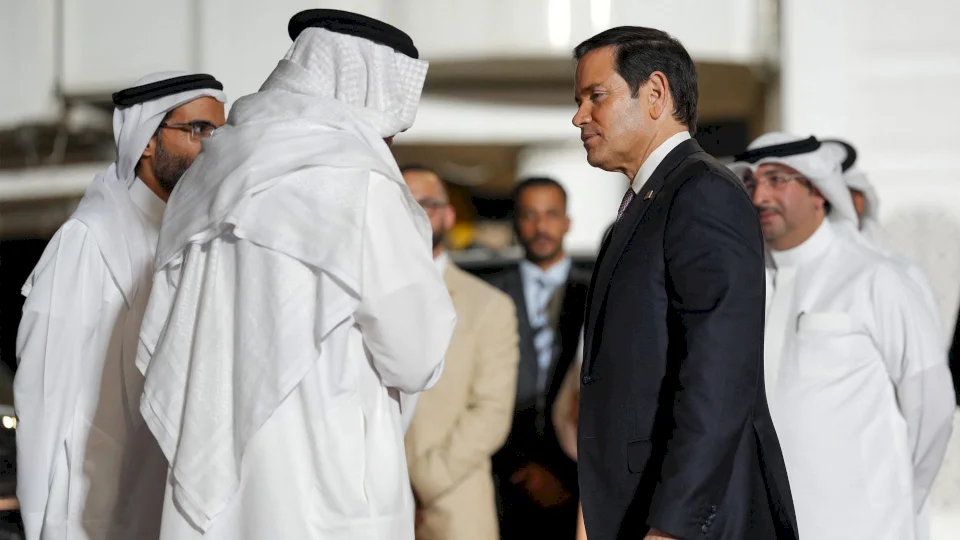
Rubio in Bahrain: No Agreement with Iran at the Expense of Gulf Security and No Fees on Hormuz
SadaNews: U.S. Secretary of State Marco Rubio is concluding his Gulf tour in Bahrain, attempting to reassure Washington's allies that negotiations with Iran will not occur at the expense of their security, amid rising disputes over the future of navigation in the Strait of Hormuz.
The United States remains steadfast in its refusal to accept any fees for passage through the strait, while Tehran continues to push for new post-war arrangements, the latest being a warning from the Revolutionary Guard that ships must not cross without Iranian permission.
In Manama, Rubio participated in a meeting with the Gulf Cooperation Council countries and is scheduled to meet with Bahraini King Hamad bin Isa Al Khalifa, following stops in the UAE and Kuwait that addressed Gulf security, the future of the Strait of Hormuz, and post-war arrangements.
Washington seeks to assure its allies that negotiating with Tehran will not mean overlooking their security interests, especially following missile attacks and drone strikes faced by Gulf countries during the war that erupted after the U.S.-Israeli attack on Iran on February 28.
Rubio stated during his visit that Washington wants to ensure that "any decision within this agreement" takes the allies' interests into consideration.
He added that the United States aims to make the negotiation process successful but "wants an agreement with Iran, not an agreement at any cost," emphasizing that Washington, despite its commitment to negotiations, will not accept any arrangements that undermine the interests of its allies and partners.
Rubio had previously pledged, during a stop in Abu Dhabi, to uphold U.S. commitment to ensuring the security of the UAE, reinforcing the reassurance messages he carried during his Gulf tour.
The arrangements for navigation in the Strait of Hormuz remain among the main points of contention between Washington and Tehran, following the signing of a memorandum of understanding last week that, according to the U.S. narrative, stipulates no fees on ships during a negotiation period of 60 days, which is extendable.
The disruption of traffic in the strait during the war caused upheaval in global energy markets and a sharp rise in oil prices, before navigation began to gradually return after the memorandum was signed.
Tehran asserts that navigation arrangements in the strait will not return to what they were before the war, speaking of the possibility of imposing what it calls the cost of "services" related to managing traffic in Hormuz, not "transit fees."
However, Rubio rejected this distinction, stating that calling it fees or charges does not change the essence of the matter. He added that Washington will not accept that the Strait of Hormuz becomes subject to any state, warning that accepting fees there could extend "like contagion" to other waterways around the world.
The Strait of Hormuz is a vital route for energy supplies, through which about one-fifth of the world's oil and liquefied natural gas supplies usually pass. The narrowest point of the strait is only about 34 kilometers wide.
Warning from the Revolutionary Guard
Rubio's statements come while the Iranian Revolutionary Guard has raised its warning tone regarding crossing arrangements in the strait, cautioning on Thursday against any ships crossing without obtaining permission from Tehran.
The Revolutionary Guard stated in a statement that the only authorized route for crossing is the one declared by the Islamic Republic, considering any crossing outside of it to be "extremely dangerous and prohibited," and asserting that "violators will be dealt with."
The Iranian warning followed the announcement by Oman of temporary routes to facilitate ships' exit from the area, which it stated had been coordinated with the International Maritime Organization, a United Nations agency concerned with maritime safety.
Iran and Oman began talks on Tuesday regarding the future management of navigation and maritime services in the strait, at a time when Washington maintains its refusal of any fees or charges on passage through this vital corridor.
Technical talks between the United States and Iran are expected to resume on June 29 or 30 in Switzerland, according to Rubio, amid ongoing disputes over several issues, including the Iranian nuclear program, navigation arrangements in the Strait of Hormuz, and the limits of Tehran's regional role.
The Trump administration faces domestic pressures regarding the war and the costs of its continuation, as well as criticism of provisions in the initial agreement that critics believe could grant Iran significant gains. The administration requested additional funding of about $88 billion from Congress on Wednesday, a large portion of which will cover war costs.
In Tehran, the Speaker of Parliament, Mohammad Baqer Qalibaf, described the memorandum of understanding as having become an "announcement of America's defeat," while simultaneously calling for lessons learned from the war and the establishment of a "new regional system" based on the capabilities of the countries in the region.
With concerns about supply shortages receding after improved navigation through Hormuz, oil prices continued to decline. Brent crude fell to its lowest levels since before the war, indicating market bets on the continued flow of supplies, despite the final arrangements for the strait remaining unresolved.
While Washington presents the memorandum of understanding as a gateway to broader calm, Rubio's Gulf tour seeks to convince allies that any final agreement with Iran will not come at the expense of their security or at the cost of freedom of navigation in one of the world's most important maritime passages.
 Follow the latest Sada News via Google News
Rubio in Bahrain: No Agreement with Iran at the Expense of Gulf Security and No Fees on Ho...

After US Confirmation.. Israel Denies Withdrawal from Part of Southern Lebanon

Female judges at the International Criminal Court pursue legal action against the Trump ad...

Israeli Soldier Killed and Another Injured in Military Vehicle Flip in Southern Lebanon

Trump Administration Requests Additional Funding of $87.6 Billion for War on Iran

They executed him inside his home.. A martyr shot by the occupation in the village of Sart...

Strong Earthquakes Strike Venezuela: Dozens Dead, Buildings Collapse, and Warning of After...
