

Hubble Telescope Discovers Early Galaxy That Changed Its Cosmic Environment 12 Billion Years Ago
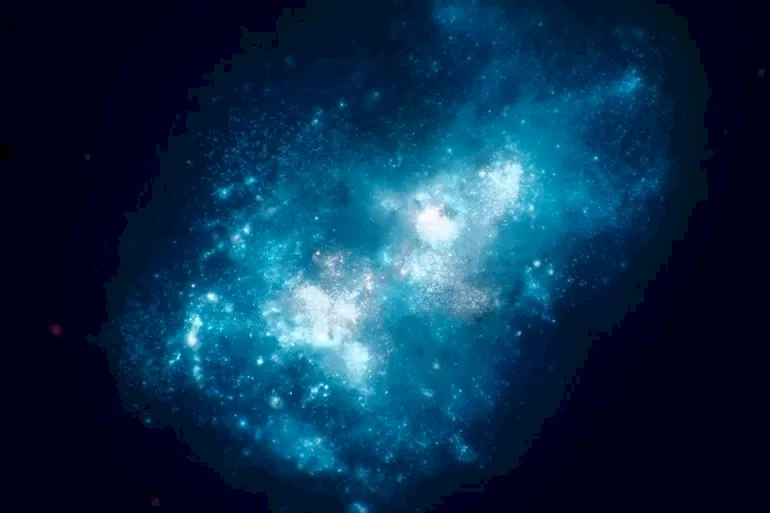
SadaNews - In a discovery described by scientists as previously deemed impossible just a few years ago, the Hubble Space Telescope has detected ultraviolet light emitted by a very distant galaxy known as "MXDFz4.4", which appeared about 1.4 billion years after the Big Bang.
This observation provides astronomers with the first almost direct evidence of how the early galaxies contributed to clearing the cosmic fog that filled the early universe.
The results of the study were published on June 23, 2026, in the "The Astronomical Journal" led by researcher "Elias Govarts" from the Space Telescope Science Institute in Baltimore, USA, with the participation of researchers from several international institutions, relying on data from the Hubble Telescope, the James Webb Telescope, and the Very Large Telescope.
The End of the Cosmic Fog Era
During the first billion years of the universe's existence, the distances between stars and galaxies were filled with neutral hydrogen gas that absorbed most of the ultraviolet radiation, making the universe resemble a dense fog obscuring visibility.
Scientists refer to the subsequent phase as the "Era of Reionization", the period during which the matter between galaxies gradually transitioned from a dark state to a transparent one.
The galaxy "MXDFz4.4" lived at the end of that critical transitional phase, and Hubble demonstrated that the ionizing light emitted from its young stars was able to penetrate the gas surrounding it, allowing researchers to observe signals that were not expected to be detected in such an early time of the universe's history.
Lead researcher Elias Govarts stated in an official press release: "It was believed that observing such a galaxy was impossible, as the early hydrogen fog was supposed to completely obscure this type of light."
Powerful Young Stars
Data revealed that the galaxy contains very dense clusters of young, hot, and massive stars, formed just a few million years before the time we observe it today.
Interestingly, this galaxy is about 100 times smaller than the Milky Way in area, but it produces stars at a rate approximately ten times that of our galaxy currently. Researchers believe that this massive concentration of young stars enabled it to produce large amounts of ionizing radiation capable of penetrating the surrounding gas.
The scientific team estimates that between 50% and 100% of this high-energy light successfully escaped into outer space. Govarts states: "The presence of a large number of young and hot stars in a small space makes them more capable of piercing through the dense gas."
Additionally, the giant stellar explosions resulting from the death of some of these stars contributed to opening large gaps within the gas clouds, allowing more radiation to escape.
Collaboration of Hubble, Webb, and the European Telescope
Hubble was not alone in this scientific achievement; the team also utilized data from the James Webb Telescope in the near-infrared range, as well as data from the Very Large Telescope (VLT) operated by the European Southern Observatory.
Webb's observations helped measure the mass of the galaxy and study its older stars and star formation history, while data from the Very Large Telescope accurately determined its cosmic age, confirming it existed only 1.4 billion years after the Big Bang.
Mark Rafelski, Deputy Science Coordinator for the Hubble mission at the Space Telescope Science Institute and a co-author of the study, explained that astronomers have found many galaxies from this era, but we have not previously observed ionizing photons from any of them, making "MXDFz4.4" a unique case.
The comparison between the data from Hubble and Webb also showed that star formation within the galaxy occurred in bursts, rather than continuously.
A New Step in Understanding the Origin of the Universe
In 2023, James Webb's observations indicated that early stars were producing enough energy to heat and ionize the surrounding gas. However, the most critical question remained unanswered: How did that light manage to escape from inside the galaxies?
Today, the galaxy "MXDFz4.4" provides the first direct evidence of the potential mechanism of this process. Scientists believe that discovering more similar galaxies may help paint a clearer picture of how the cosmic fog dissipated and how the universe was revealed as we see it today.
Researcher Alexander Piquet from the astrophysics laboratory in Marseille, France, states that the combination of the capabilities of Hubble and Webb along with the Very Large Telescope and advanced analysis software has enabled scientists to study this exceptional galaxy with unprecedented accuracy.
This discovery reveals that the greatest cosmic transformations may have begun inside small, hidden galaxies barely visible. By tracing photons that traveled over 12 billion years ago, humanity takes another step closer to understanding its early chapters in this vast universe.
It serves as a reminder that scientific research does not just answer questions but opens new doors of wonder, giving us a renewed ability to explore the roots of our existence and our place in the grand story of the universe.
Source: Al Jazeera + Agencies
 Follow the latest Sada News via Google News
Hubble Telescope Discovers Early Galaxy That Changed Its Cosmic Environment 12 Billion Yea...

The 10 Strongest Earthquakes That Shook the World in Modern Times

How Did the Trade Balance Deficit of Palestine Move at the Beginning of 2026?

6 Prime Ministers Overthrown by Crises in Britain in One Decade

By the Numbers: How is Parliamentary Representation Distributed in Palestine, Jordan, and...

Saudi Arabia Ranks First.. The Largest Arab Country in Tourism Revenues for 2025

From 155 to 227 million.. Growth of the leasing sector in Palestine (2021–2025)
