

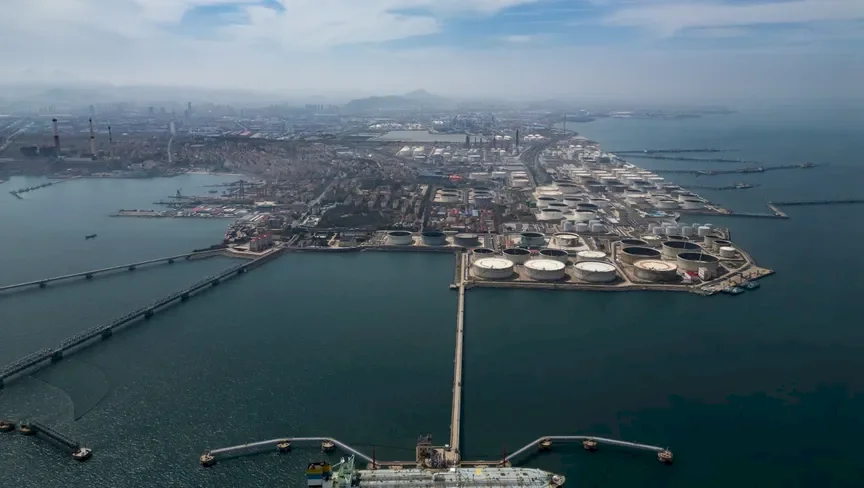
China Withdraws from Its Oil Reserves to Contain the Impacts of Gulf Shock
SadaNews - China has begun withdrawing from its commercial oil reserves to contain the supply shock caused by the war in Iran, although the world's largest oil importer continues to prioritize reducing refinery operating rates and imposing restrictions on fuel exports to deal with the crisis's repercussions.
It is expected that the average withdrawal from reserves will reach about one million barrels per day over the coming months, according to estimates from "Vortexa," "Kpler," and "Energy Aspects."
This represents about a third of the crude oil quantities that China no longer receives since the conflict led to the near-total closure of the Strait of Hormuz, yet it remains minimal compared to the approximately 1.2 billion barrels held by the country in its commercial and strategic reserves.
The Largest Shock in Oil Market History
The price reaction to what the International Energy Agency described as the largest shock in oil market history was relatively limited; China refrained from entering global markets to compensate for the lost quantities.
Brent crude, the global benchmark for oil prices, has risen by less than a third since the outbreak of the conflict, while analysts estimate that China's imports may remain weak over the coming months, contributing to alleviating the pressures on prices.
China raised its oil reserves to unprecedented levels last year. It began withdrawing from those reserves in May, consuming nearly 25 million barrels during the month ending June 7, according to "Energy Aspects," based on data from its satellite tracking unit "Kairous."
Despite the enormity of this figure—compared to the global consumption of 100 million barrels per day—the decline in demand in the refining sector had the most significant impact.
Chinese Refinery Measures
State-owned refineries reduced refining rates to historic lows, imposing restrictions on fuel exports amid wartime conditions to ensure domestic supply, as the pace of the shift towards electric vehicles accelerates.
Emma Li, Chief Analyst for the Chinese market at "Vortexa," stated: "China's transport system has become structurally more flexible compared to previous oil shock periods."
She added that the rapid expansion in the use of electric vehicles has contributed to reducing fuel demand by about one million barrels per day during the current quarter. Some observers believe that the current decline in demand may not be permanent.
US Assessment of China's Withdrawals
US Energy Secretary Chris Wright said in Washington on Tuesday: "China was building a strategic reserve of oil, but it has now stopped increasing these stocks and started to withdraw from them. It has also reduced its refinery operating rates, leading to a decline in the production of petroleum products." He added: "This is a measure in response to a crisis, and it does not reflect a permanent structural shift."
China's strategic reserves are shrouded in a high degree of secrecy; the existence of long-term targets and heavy reliance on underground storage hinders the formation of a clear picture of their actual size. Therefore, market traders rely on satellite images and estimates from independent parties to fill the information gap.
While Beijing continued to bolster its strategic oil reserves during the war, refineries increasingly relied on commercial stocks instead of new imports, according to the analytics firm "Kpler." The exact volume of crude oil withdrawn from government reserves remains obscure due to the lack of transparency.
Possibility of China Using Part of the Strategic Reserve
Sumit Ritulya, Senior Analyst for Refinery Supply and Modeling at "Kpler," stated: "The use of part of the strategic oil reserve cannot be completely ruled out," adding that some of the reserves located in hard-to-monitor underground storage facilities may have been used to refill the more visibly stored facilities that supplied oil to the market.
Jianan Sun, an analyst at "Energy Aspects" based in London, noted that Chinese state refineries are expected to resume purchasing from global markets once they "withdraw significantly from reserves."
He added: "Resuming large-scale purchases is contingent upon government approval, which depends on Beijing's reading of developments in the Strait of Hormuz."
 Follow the latest Sada News via Google News
Does Ending the Iran War Give Kevin Warsh an Opportunity to Avoid Raising Interest Rates T...

Shipowners Await Clarity on Hormuz Agreement as 600 Tankers Prepare to Depart

Gold and Silver Prices Witness Slight Increase After Agreement Between Iran and America

Oil Prices Fall After Agreement Between America and Iran and Opening of Hormuz

Jordan's Central Bank: Total remittances to the Kingdom increased by 13.3% during the firs...
Gold prices hit near $4,219 an ounce

100 Days After the Iran War: The Federal Reserve and Bank of England Balance Between Infla...
