
Gulf Investors Make a Difference in the Largest IPO in 'Wall Street' History
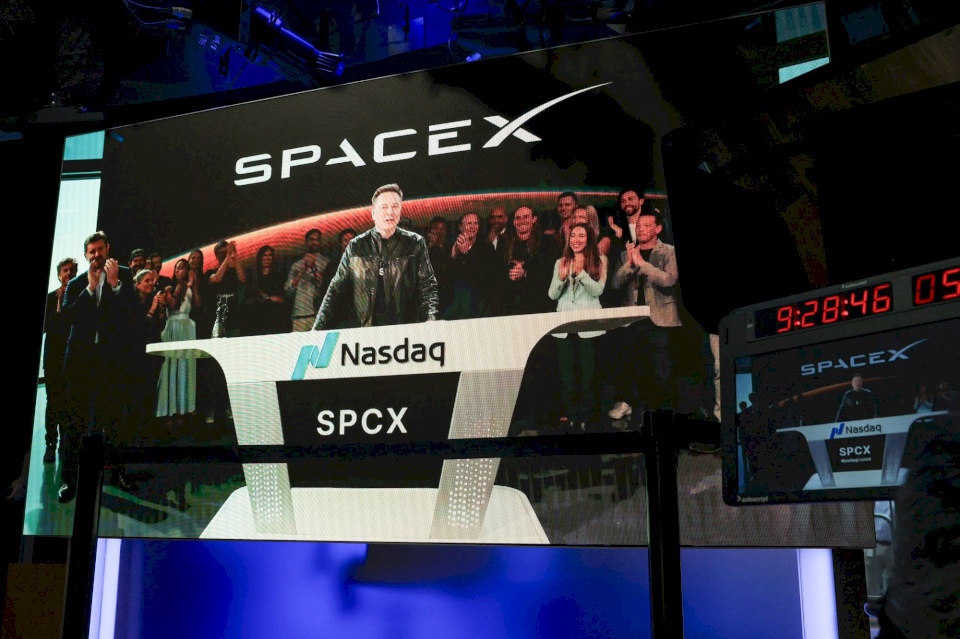
SadaNews Economy - With the official trading of "SpaceX" shares on the Nasdaq, achieving a market capitalization of $1.78 trillion, the discussion about the role of Gulf funds is no longer mere speculation or media leaks. Last-minute disclosures and the public offering prospectus unveiled a crucial economic reality: sovereign wealth funds and investors from the Gulf Cooperation Council (GCC) countries were not just transient participants crossing continents but formed the backbone and primary engine of the largest fundraising operation in financial market history ($75 billion), turning the Gulf into a historic partner in shaping the future of space and artificial intelligence.
While global hedge funds experienced sharp reductions in their bids due to record demand surpassing $250 billion, the British newspaper "Financial Times" revealed, citing sources familiar with the offering records, that priority was given to sovereign funds and family offices, placing Gulf funds at the forefront of strategic investors for "SpaceX".
According to the newspaper, the official Gulf distribution topped the list of major subscribers; the Saudi Public Investment Fund, the Qatar Investment Authority, and the Kuwait Investment Authority each obtained shares valued at more than $1 billion as a final allocation, with numbers approaching the demand size of the American asset management giant "BlackRock", which requested a $5 billion stake.
This rush was also fueled by the "fast-track" rules established by global index providers like "Nasdaq" and "FTSE Russell", which allow the stock to be added to their major indices (such as Nasdaq 100) within just 5 to 15 trading days, turning the acquisition of shares from the initial offering into a preemptive battle for the funds.
The Story of the Rise of the Kingdom's Stake
The case of Prince Alwaleed bin Talal and "Kingdom Holding Company" exemplifies how Gulf investors have reaped historic paper profits due to their longstanding strategic relationship with Elon Musk, embodying Musk's commitment in 2024 when he stated on his platform: "Loyalty deserves loyalty", promising to prioritize his long-standing investors.
This journey began in 2011 when Prince Alwaleed invested $300 million in the "Twitter" platform (now X). When Musk acquired the platform in 2022, "Kingdom Holding" and its Chairman, Prince Alwaleed bin Talal, made a pivotal decision to roll over the stake instead of liquidating it. Subsequently, with Musk's rapid developments merging the "X" platform with his AI startup, "X.AI", and then fully integrating the entity under "SpaceX", that historical contribution officially transformed into direct ownership shares in the space and communications rocket company, according to documents from the public offering.
As a result of this smart investment engineering, "Kingdom Holding" disclosed in a separate official disclosure to the Saudi financial market that the estimated value of its joint stake with Prince Alwaleed bin Talal has surged to over $10.6 billion based on the final offering price of $135 per share. The impact of this valuation was not limited to the company's books but was immediately reflected in reality; it triggered a price surge that led the "Kingdom Holding" stock in the Saudi financial market (Tadawul) to soar to its highest level in a full decade.
The AI Equation
Alongside these direct gains, published operational data and the ongoing transactions of "SpaceX" show that Gulf investors have succeeded in changing the rules of traditional investment games. Capital coming from the region is no longer merely "silent" financing that waits for dividends; it has transformed into a strategic player imposing clear conditions for localizing high technology and building infrastructure for computing and artificial intelligence on Arab soil, thus ensuring the transfer of knowledge and digital sovereignty instead of leaving operational returns solely to "Silicon Valley".
Humain in the Picture
This new strategy is clearly embodied in the movements of the Saudi company "Humain", fully owned by the Public Investment Fund, which is dedicated to providing comprehensive AI capabilities globally. According to the official statement issued by the company, "Humain" injected a massive strategic investment of $3 billion in the Series E funding round for "X.AI", an investment made at a historical turning point just before the larger acquisition and merger executed by "SpaceX" in early February, leading to the complete transformation of "Humain's" stake into direct and publicly recognized shares in the parent entity (SpaceX) as a significant minority shareholder.
The press statement reveals that this investment partnership was not spontaneous; rather, it resulted from a broad partnership agreement signed in November 2025 during the "U.S.-Saudi Investment Forum". Under this agreement, "Humain" and "X.AI" committed to joint development of infrastructure and data centers for the next generation of AI with computing power exceeding 500 megawatts, in addition to localizing and deploying advanced "Grok" models within Saudi Arabia. At that time, the CEO of "Humain", Tarek Amin, stated that this investment represents a practical translation of the company's ability to inject substantial capital behind exceptional technological platforms that combine technical excellence and long-term vision, noting that the merger between "X.AI" and the massive infrastructure of "SpaceX" creates a unique platform for accelerated growth and the construction of long-term investment value across four key areas: next-generation technology centers, hyper cloud, advanced models, and transformative solutions for AI.
Similarly, the UAE shaped its technological alliance; Abu Dhabi secured a strategic seat through its specialized technological arm (MGX) in collaboration with "G42" in the integrated entities under Musk, while moving forward with the construction of a massive data center complex in Abu Dhabi, based on parallel strategic partnerships, including an investment commitment from "Microsoft" worth $15.2 billion for the "Khazna" subsidiary of the group.
Financial Engineering and Betting on Space
Official data reported by the "Financial Times" unravel the precise spending plan for the offering funds; immediately, $20 billion will be deducted from the total proceeds to repay a bridge loan that the group had drawn in March to cover debts resulting from merging Elon Musk's AI and social media operations (X.AI and X) under the financial umbrella of "SpaceX".
The remaining liquidity, significantly contributed by Gulf cash flows and billions, which place them at the top of the subscriber list, will be directed toward financing the next growth leap. At the forefront of these aspirations is Musk's revolutionary project, the details of which he revealed to the CEO of "J.P. Morgan" during the IPO promotional tour, as reported by the British newspaper, which involves establishing "AI data centers in outer space" through the deployment of gigantic satellites measuring 70 meters in wingspan, serving as a strategic and innovative solution to overcome the constraints and limitations of electricity resources on planet Earth.
Steel Confidence
What makes this Gulf positioning particularly intriguing to financial circles on "Wall Street" is that the current calculations and digital data of "SpaceX" entail exceptional investment equations under conventional market rules; the company was offered to go public with a financial commitment that included repaying a $20 billion loan before the offering to cover the obligations of the merged companies (X.AI and X) under the unified umbrella of "SpaceX".
What is even more distinctive in the offering scene is the company's valuation, which equates to 92 times its annual revenue of $19 billion; to simplify this figure, prevailing financial norms typically categorize large companies based on instantaneous valuations linked to direct revenues, placing "SpaceX's" market value in a uniquely advanced position among the largest technology conglomerates in the world compared to the scale of its current operations.
Despite these conventional book calculations, banking circles described the approach of Gulf sovereign funds and family offices as a strategic vision that transcends the typical market fears; investment managers revealed to the "Financial Times" that they offered their Gulf clients "financial hedging" options as a typical precautionary measure at the start of trading, yet everyone completely rejected the idea of hedging.
This stance reflects a mature shift in the investment mentality of the region, which has moved beyond relying solely on immediate readings and indicators; it has now anchored its approach on "seizing monopolistic opportunities for the future", based on the predictions of "Goldman Sachs" (the lead underwriter) which anticipated a 100-fold leap in the company’s AI returns to reach $322 billion by 2030, dominating a global target market valued at $28.5 trillion.
In conclusion, "SpaceX's" historic IPO has proven that the region's funds have become a strategic partner capable of imposing operational terms, localizing future technology, and shaping a new geopolitical financial landscape whose impacts extend from the depths of the deserts of the Middle East to outer space.
 Follow the latest Sada News via Google News
Does Ending the Iran War Give Kevin Warsh an Opportunity to Avoid Raising Interest Rates T...

Shipowners Await Clarity on Hormuz Agreement as 600 Tankers Prepare to Depart

Gold and Silver Prices Witness Slight Increase After Agreement Between Iran and America

Oil Prices Fall After Agreement Between America and Iran and Opening of Hormuz

Jordan's Central Bank: Total remittances to the Kingdom increased by 13.3% during the firs...
Gold prices hit near $4,219 an ounce

100 Days After the Iran War: The Federal Reserve and Bank of England Balance Between Infla...
