

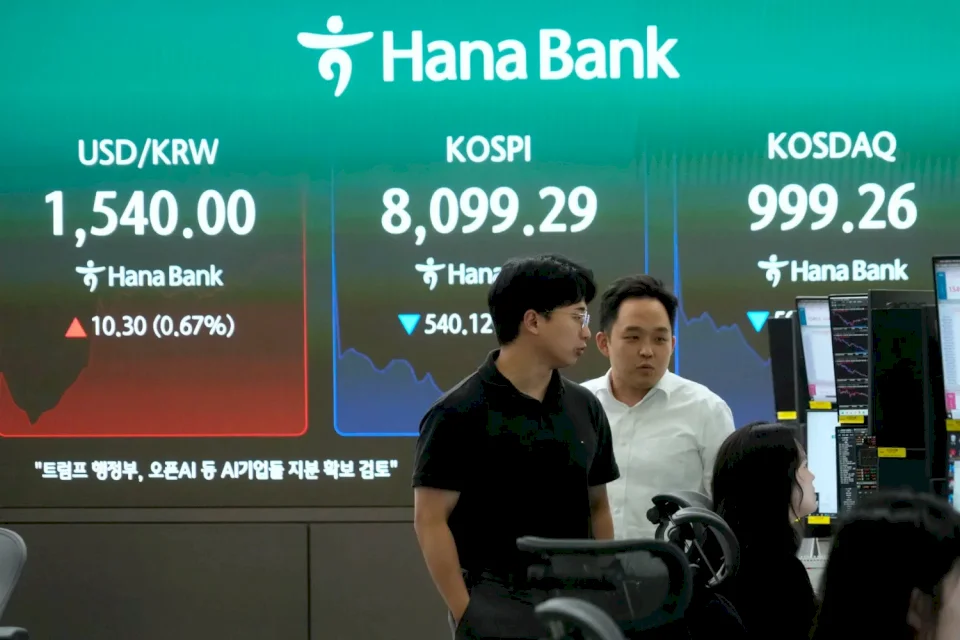
Fears of Artificial Intelligence Hit Asian Markets as KOSPI Loses Over 5%
SadaNews Economy - Asian stocks fell on Friday, led by sharp losses in South Korea, where the main index dropped by more than 5%, affected by a broad sell-off of technology and artificial intelligence stocks following strong declines on Wall Street.
U.S. stock futures also recorded a decline, after big companies linked to artificial intelligence faced significant selling pressure during Thursday's trading. Shares of chip maker “Broadcom” fell by 12.6% after its future forecasts fell short of investors' expectations, raising new concerns about the prospects for the artificial intelligence and technology sector in general, according to the “Associated Press”.
Pressure extended to other companies, with shares of memory chip manufacturer “Micron Technology” down by 7.7%, while “CrowdStrike Holdings”, specializing in cybersecurity, saw a decrease of 3.8%.
Despite these declines, key U.S. indexes managed to finish Thursday's session with mixed performance, as the “Standard & Poor's 500” index rose by 0.4%, while the “Dow Jones Industrial Average” increased by 1.7% to reach a new record high, while the technology-heavy “Nasdaq Composite” index slipped slightly by 0.1%.
In Asia, investors abandoned shares of major technology companies linked to artificial intelligence, with shares of South Korea's “SK Hynix” falling by 8.4%, while “Samsung Electronics” lost 5.4% of its value.
The South Korean “KOSPI” index fell by 5.1% by mid-session to reach 8185.62 points, having almost doubled last year, supported by significant gains in technology companies.
In Japan, the “Nikkei 225” index declined by 1.4% to 66532.35 points, with technology stocks leading the list of losers, despite official data showing a rise in real wages for the fourth consecutive month. Shares of “Tokyo Electron”, a manufacturer of chip-making equipment, fell by 7.2%.
The “Hang Seng” index in Hong Kong dropped by 0.8% to 25047.83 points, while the “Shanghai Composite” index diverged from the general trend and rose by 0.4% to 4075.31 points.
In Australia, the “S&P/ASX 200” index fell by 0.5% to 8639.50 points, while the Taiwanese “TAIEX” index decreased by 1.5%, and the Indian “Sensex” index rose by 0.2%.
On the energy front, oil prices stabilized relatively after their decline in Thursday's session. Brent crude, the global benchmark, rose by 0.4% to $95.42 per barrel, after falling to nearly $95.03 in the previous session. It is worth noting that crude prices were around $70 per barrel before the outbreak of war in late February.
West Texas Intermediate crude increased by 0.1% to $93.15 per barrel.
Global markets continue to receive support from strong corporate earnings and momentum related to investments in artificial intelligence, which has helped many stock indices reach new record levels. However, these gains face increasing challenges due to geopolitical disruptions and the ongoing war in the region.
Oil prices remain under the influence of concerns related to the ongoing de facto closure of the Strait of Hormuz, one of the world's most important maritime routes for transporting oil and natural gas, at a time when the energy shock caused by the war threatens to slow global economic growth and push inflation rates to higher levels in many economies.
U.S. and Iranian negotiators reached a preliminary agreement last week to extend the ceasefire; however, the agreement has not yet received final approval, while recent developments in Lebanon have cast doubt on the chances of reaching a permanent settlement of the conflict.
In this context, Lebanese “Hezbollah” rejected the recent ceasefire agreement between the Lebanese and Israeli governments, increasing uncertainty in the markets.
Warren Patterson and Eva Manthy, commodity strategists at “ING Bank”, stated in a research note: “In light of the absence of clear indicators of progress in U.S.-Iran talks, the oil market continues to trade based on expectations of a potential agreement that would restore oil flow through the Strait of Hormuz.”
They added that the prevailing optimism regarding the chances of success in U.S.-Iran negotiations may be “exaggerated”.
In currency markets, the U.S. dollar fell to 159.97 Japanese yen compared to 160.03 yen in the previous session, while the euro slightly increased to 1.1614 dollars compared to 1.1610 dollars.
 Follow the latest Sada News via Google News
Due to "Hazardous and Counterfeit Products".. Europe Fines "AliExpress" $627 Million

Gasoline Prices Exceed $4 Again in America Amid Resumed War

What was the financial reward for Spain after winning the World Cup?

Gold Stabilizes Amid US Interest Rate Outlook

Oil Prices Climb 2% Amid Escalating Attacks Between the US and Iran in the Middle East

Israel Increases Gas Supplies to Egypt by 26% to Reach 1.2 Billion Cubic Feet Per Day

Expectations of a Delay in European Interest Rate Hike Amid War Risk Preparedness
