

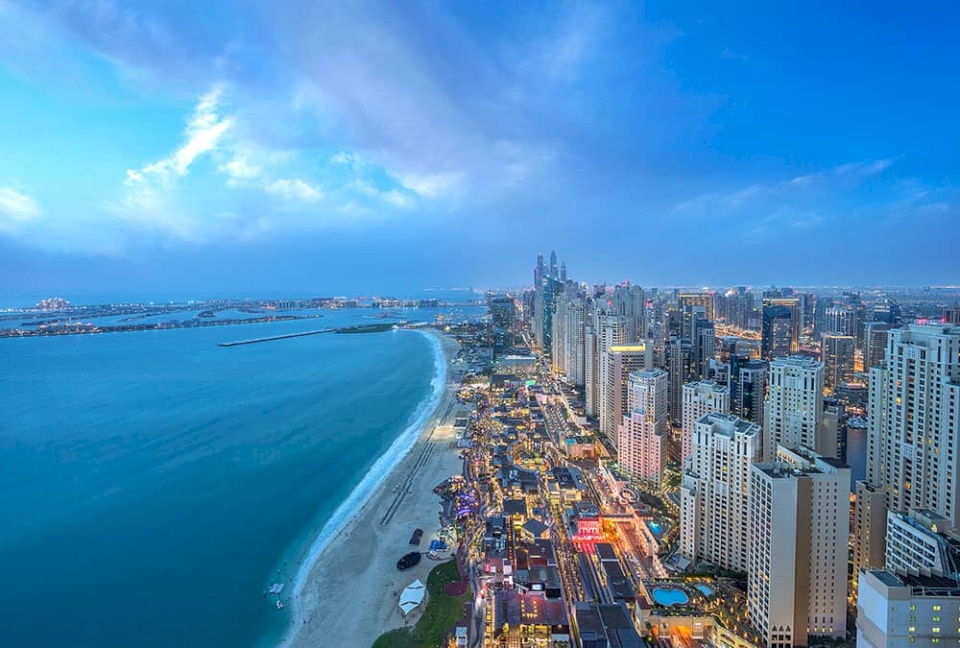
Bloomberg: Dubai Recovers Businessmen and Tycoons Displaced by the Iran War
SadaNews - Signs of normal life are gradually returning to Dubai, with the crowds back at the luxurious "Arts Club" restaurants in the financial center and traffic picks up again in the area, coinciding with the influx of bankers, traders, and executives returning to their offices following their temporary evacuation from the UAE after it was targeted by Iranian missiles.
After the announcement by the United States and Iran of a ceasefire at the beginning of April, it seemed that Dubai was beginning to adapt to a new reality. However, last Monday evening, residents of Dubai and neighboring Emirates received emergency warning messages on their mobile phones asking them to shelter indoors for the first time in weeks.
Delicate Balance
Schools, which had recently resumed in-person classes, reinstated remote learning systems, while some financial institutions reverted to working remotely. Additionally, traffic near the Dubai International Financial Centre (DIFC), which had recovered to around 70% of pre-war levels in the weeks following the ceasefire, fell to about 60% after the warning messages last Monday, according to xMap, a company specializing in mobility analytics.
Although the recent attacks targeting a port and ships off the coast of the UAE did not seem sufficient to fundamentally undermine confidence, they highlighted the precariousness of the situation once again. Most of the projectiles fired toward the country continued to be intercepted by air defenses, while it appeared that many residents and businesses were determined to continue their operations despite the fluctuations.
However, this temporary disruption reflects the delicate balance facing the Gulf trading hub as it tries to regain confidence while simultaneously preparing for the possibility of renewed military escalation at any moment.
Edwin Lawrence, CEO of Nettlestone Capital Advisors based in Dubai, considered that the recent attacks were a "reminder that the broader situation is still ongoing and that uncertainty remains, even if everyone here is very eager to return to normal life."
The media office of the Dubai government did not immediately respond to a request for comment.
A spokesperson for Citigroup stated on May 4 that "all employees are now welcome back to the offices, and branches have returned to regular operating hours." Standard Chartered Bank mentioned that its operations in the UAE and employee presence in offices have returned to normal levels and that "business is continuing as usual."
These policies are still in effect.
The Region's Importance to Wall Street Banks
This resilience reflects the increasing importance of the Middle East for global financial institutions. The massive liquidity in the region has been a major source of financing for years, as many executives have declared their full support for the Gulf during the height of the Iran war.
Some companies continue to invest despite the conditions. Brookfield Asset Management is working to establish a real estate project in Dubai, reflecting a bold bet on the city’s real estate market. Jad Alwan, the managing partner and regional president for Brookfield in the Middle East, confirmed: "We understand the risks and advantages in the region better than others, which is why we seek to inject capital."
These moves also reflect Dubai's success in transforming into a city less dependent on temporary residency. Although expatriates still make up over 80% of the population, "Golden Visa" long-term residency programs have encouraged more foreigners to buy homes and establish businesses.
Low taxes and security levels continue to attract wealthy professionals and global companies, many of which are hiring again "albeit at a slower pace," according to Zahra Clark, head of the Middle East and North Africa at Tiger Recruitment, a recruitment firm specializing with financial institutions. She added: "We've seen about 20% of our job requests on hold."
Despite the ongoing conflict, hedge funds including Citadel, operated by Ken Griffin, which manages $67 billion in assets, are preparing to launch operations in the emirate. Dubai has also eased some regulatory compliance requirements to help businesses continue operations during the conflict.
Confidence in Dubai
In an additional sign of continued confidence in the financial sector, 258 companies established a regional presence in the Dubai International Financial Centre in March, up 59% compared to the same period last year, according to a representative of the center. Overall, 775 new companies were established in the center during the first quarter.
Greg Agius, CEO of Swiss recruitment firm Agius & Partners, noted that many bankers and wealthy individuals were impressed with the UAE's handling of the crisis.
He added: "Dubai offers a lot for families and business owners. Switzerland is beautiful, but it’s slower-paced and has higher taxes."
However, even with the return of bankers to their offices, uncertainty surrounding deals in the region increases. Some planned initial public offerings in the first half of the year are expected to be postponed or canceled, while merger and acquisition activity may slow as companies delay their investments, according to informed sources.
Impacts on Travel and Tourism
Outside the financial sector, the repercussions of the ongoing disruptions have extended to the wider economy.
Although Emirates Airline has recovered faster than regional airlines, it is still operating at about 75% of its operational capacity compared to before the Iran war. Hotel occupancy rates have dropped to around 33% compared to more than 80% before the conflict, according to research firm CoStar Group.
Informed executives said they expect activity to begin recovering in the coming months with the end of the traditionally quiet summer period. Many hotels in Dubai are using this time to undertake renovation and maintenance work.
Mohammed Alabbar, founder of Emaar Properties, stated: "Please remember that we have seen years when occupancy rates in our hotels reached around 85% with great prices. We made a lot of money. We are taking a break for a few months, and that’s acceptable. We have time for maintenance and renovation of our hotels."
Rentals Unaffected
Meanwhile, residential rents, which have risen sharply in recent years, have remained relatively resilient against the Iran war. They have decreased citywide by just over 2% on average since the end of February, according to Pratyusha Goraboo, head of research at Cushman & Wakefield Core.
Goraboo explained: "Lease renewals are being signed at nearly the same rates as before because many tenants prefer to avoid the costs of moving."
Private schools, which have benefited from the increasing number of expatriates in Dubai in recent years, have had to deal with periods of online education. Before the attacks last Monday, most students had returned to classrooms across the UAE, although attendance rates have continued to vary.
Meanwhile, consumer spending patterns have begun to change.
Scott Boatwright, CEO of Chipotle Mexican Grill, stated in an interview that the company has seen a relatively swift recovery in Kuwait and Qatar, but the rebound has been slower in the UAE, which is more dependent on tourism compared to the other two countries.
He added: "Most local consumers are returning to their normal behavior. But the biggest challenge for the region right now is the decline in tourism compared to last year."
Sales in traditional stores among supermarket chains and hypermarkets in the UAE fell by about 7% between March 30 and April 19 compared to the same period last year, according to NielsenIQ. Although electronic sales for those companies and other digital platforms increased by 15%, this rate remains below the 34% recorded before the conflict.
Emirates Airline
Despite the uncertainty, some executives remain optimistic. Emirates Airline reported profits, though they were lower than previous expectations.
Tim Clark, the company’s president, mentioned that the giant carrier "hopes this crisis will be resolved soon and that conditions will return to what they were in February of this year."
The president of what may be the most famous brand in the country expressed a clear spirit of determination last month. Clark said: "I don’t believe anything will change in our way of operating the airline or our business strategy. We will not retreat."
 Follow the latest Sada News via Google News
Gold Stays Above $4,000 Amid Tensions in the Strait of Hormuz

The AI Frenzy Drives Hong Kong Stock Sales to Highest Level in 5 Years

Bank of America: The Global Economy has Partially Overcome the Shock of War, but Damage ha...
Gold prices hover around $4,089 per ounce

IMF Chief Economist: The World Faces Significant Risks and Globalization is Not Dead

Oil Falls 2% Amid Resumption of Shipments from the Strait of Hormuz

Gold Rises Globally as Dollar Weakens
