

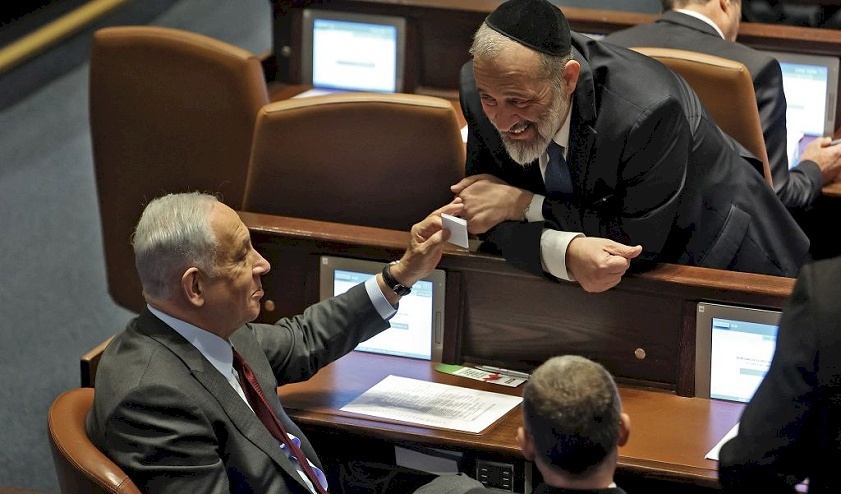
Report: Netanyahu Considers Delaying Elections to Finalize Agreements with Haredim
SadaNews - Circles surrounding Israeli Prime Minister Benjamin Netanyahu are considering the possibility of conducting the elections on their original date, October 27, instead of advancing them to October 20. This is an attempt to provide time for the coalition to complete the implementation of agreements with the Haredi parties, related to pushing a package of laws that regulate the status of students in Torah institutes and stopping the arrest of those evading military service.
In parallel with Netanyahu's attempts to finalize agreements with the Haredi parties before setting the election date, internal disputes within Likud regarding the party's primary elections and their mechanism persist. According to Israeli reports, the primary elections are expected to take place at the beginning of August, while Netanyahu is demanding to secure 11 guaranteed spots in the Likud list up to the fortieth rank, which is rejected by David Bitan and Haim Katz.
Israeli Channel 12 reported today, Sunday, that the push to delay the elections is part of an effort to "complete the deal with the Haredim" by approving a series of legislations they demand before dissolving the Knesset or going to elections, foremost among them being the freezing of criminal proceedings against students of Torah institutes who do not enlist in military service, in addition to promoting what is known as "Basic Law: Study of Torah."
In this context, Israeli Security Minister Israel Katz sent a message to the Chairman of the Knesset Foreign Affairs and Defense Committee, Boaz Bismuth, urging him to hold an "urgent discussion" in the committee regarding the issuance of a temporary order to freeze criminal prosecutions against Haredim evading service. Bismuth responded by announcing that he would hold a committee meeting during the current week.
Katz wrote in his letter that the temporary order should include provisions that define who qualifies as a student of a Torah institute who "makes Torah his profession," and what conditions are required to benefit from the freezing of the enforcement of criminal law, in addition to a list of institutes and mechanisms for "effective supervision and enforcement" on the students. He claimed that, in return, "criminal enforcement should continue against Haredi draft evaders who are not studying in the institutes."
Katz's move coincides with a message sent by Government Secretary Yossi Fox to Bismuth on Saturday evening, in which he called for a temporary halt to arrests of Haredim for three months, that is, during the election period, fulfilling a pledge Netanyahu made to the Haredi parties. However, the details on who will be classified as a student of a Torah institute remain unclear.
These steps come after statements made by Netanyahu at a press conference on Saturday evening, in which he claimed that the police arrest Torah students inside religious institutes, a narrative that the channel said is not true. Netanyahu called for an end to the arrest policy, asserting that the arrest of institute students leads to a decline in recruitment, yet he simultaneously stated that those not studying Torah should face penalties and "the full weight of the law."
Concurrently, the Knesset Committee held a session on "Basic Law: Study of Torah," while Knesset member Yoav Ben-Tzur from the "Shas" party visited detainees in Military Prison No. 10. During the presentation of the law, "Degel HaTorah" leader Moshe Gafni said that "the study of Torah is what has preserved us throughout the history of the Jewish people," adding that it is time for it to receive its "proper status" in Israel, considering it a "Jewish state," and to be recognized as a "supreme value."
However, the discussion also revealed objections within Likud itself. Knesset member Dan Elhuz said during the session that "the coalition I am part of is spitting in the face of the public we are supposed to represent," adding that the aim of the law is to continue granting privileges to those who do not enlist under the pretext of studying Torah, considering it a use of religion to achieve political and material gains.
Elhuz called for the establishment of a "right-wing national liberal government" after the elections, based on a Zionist coalition that works on integrating Haredim. He stated that the recruitment law could have contributed to increasing recruitment if substantial amendments were made to it, but it has turned, as he put it, into a "fake law" after the Haredi parties refused to introduce changes that would make it an effective law.
Conversely, Ben-Tzur announced that he visited detainees studying Torah in military prison "due to studying Torah," as he put it, and said he updated them on efforts to release them and on the parliamentary paths led by Shas leader Arye Deri to stop the arrests temporarily and organize the status of Torah students in law.
These developments come despite the fact that the Israeli army has not published official data on the numbers of Haredim who have failed to appear for recruitment offices. However, a military representative said in a previous session of the Foreign Affairs and Defense Committee that Haredi recruitment has risen since the beginning of the war; from an average of 700 recruits before the war, the number rose to about 2,200 in the first year, then to about 2,800, with 1,860 recruits recorded in the first half of the current recruitment year.
In contrast, he pointed out that there are about 32,000 draft evaders, and more than 50,000 have received initial orders, estimating that the number may soon reach 90,000 draft evaders. He also stated that sanctions have an impact in increasing the number of recruits, as some of them reach the army in order to regularize their status, or after being detained and realizing that "they have no choice" but to enlist.
 Follow the latest Sada News via Google News
Report: Netanyahu Considers Delaying Elections to Finalize Agreements with Haredim

Martyr and Injuries Due to Shelling from an Israeli Drone West of Khan Younis

Israel Provokes Turkey and Acknowledges the 'Genocide of the Armenians'

Report: Lebanon Agreement Allows Israel to Enter "Experimental Areas" Under the Pretext of...

Iran responds to U.S. strikes and warns: "Violations in Hormuz will escalate regional tens...

Israeli Army Announces Killing of Militants in Southern Syria

Israeli Occupation Army: Officer Killed and Soldier Injured in Battles South of Lebanon
