

From a Seat of Power to Ruins.. This is How the National Museum in Taiz Turned into 'Stolen Memory'
SadaNews - In the city of Taiz, long known as Yemen's cultural capital, the National Museum today stands as a body burdened with history and open to the possibilities of forgetting.
This silent archaeological museum is a space where layers of power, memory, and war intersect in a country that has not ceased to rewrite its history through both softness and strength.
The place, which today is undergoing modest restoration works, was not originally built to be a museum, but was constructed as a military hospital in the late 19th century, specifically in 1890, as part of the healthcare infrastructure associated with the Ottoman military presence in Taiz, before later undergoing a series of functional transformations with the changing local authorities.
UNESCO's reports indicate that cultural sites in Yemen represent a living record of a long and complex history, warning that their destruction during conflicts means the loss of parts of the cultural identity that cannot be compensated.
A Seat of Power Designed for Control
The building's design was not random; rather, it reflected the nature of the authority it embraced. During the era of the Imamate, the palace was not a residence, but a complete security system.
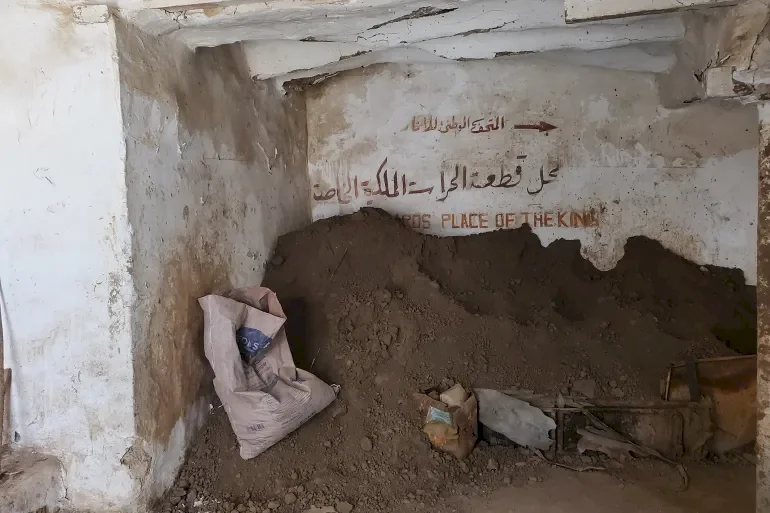
Abdullah Omar, an employee of the Antiquities Authority in Taiz for over 30 years, tells Al Jazeera Net that the building was an actual seat of governance, containing tunnels and guard rooms, in addition to elevated positions used to monitor large parts of the city of Taiz, indicating the relationship between architecture and control in that era.
Yemeni archaeological researcher Abdullah Mohsen argues that many historical buildings in Yemen were not built solely as civilian structures, but were instruments for political and military control, which explains these sites' later transformations into cultural symbols bearing a complex legacy.
When Place Becomes Memory
After the revolution of 1962, the building was transformed into a national museum in 1967, in the context of reshaping the national identity of republican Yemen, where the palace no longer merely symbolized a past authority but transformed into a space for preserving and displaying history.
Mahboub Al-Geradi, director of the General Authority for Antiquities and Museums in Taiz, tells Al Jazeera Net that the museum represented the memory of the city, containing rare artifacts documenting various stages of Yemeni history, noting that its role was not limited to display but also to preserving cultural identity.
In this context, archaeologist Zahi Hawass asserts that museums are not places for displaying artifacts; they are institutions that preserve the memory of peoples and connect the past with the present, which makes their loss or destruction a loss that transcends the material aspect.
War: The Collapse of Meaning Before Walls
With the outbreak of war in Yemen in 2015, the National Museum in Taiz entered a phase of sharp decline, as it ceased to be a site of preservation and became itself in need of preservation.
In the same context, Al-Geradi tells Al Jazeera Net that museums in Taiz suffered near-total destruction during the years of war due to bombing, neglect, and the absence of protection, confirming that the damage affected both the architectural structure and the contents.
Similarly, Salam Mahmoud, who is interested in history and heritage, states in an interview with Al Jazeera Net that the war in Yemen did not merely destroy archaeological buildings, but extended to dismantle the material memory of the country due to looting, lack of documentation, and the declining role of cultural institutions during years of conflict.
He adds that the removal of artifacts from their original context within museums and historical sites deprives them of an essential part of their scientific value because understanding an artifact can only be completed within its historical and spatial environment.
He believes that what happened to the National Museum in Taiz falls within this broader context, where it is not merely a material loss but a gradual erosion of the cultural memory that these institutions represent, making their restoration later a complex process that goes beyond mere physical restoration.
Looting: When Memory is Stolen
The losses did not stop at the bounds of bombing or destruction but extended to widespread looting of the museum's collections, especially those related to the Imamate era.
Abdullah Omar tells Al Jazeera Net that most of the Imam's possessions, including swords, watches, and personal belongings, were looted during the war, considering that what was lost represents an important part of history that is difficult to recover.
Abdullah Mohsen views that the looting of antiquities in Yemen during the war was not just individual acts but part of an illicit economy that flourished in the midst of chaos, leading to many pieces being removed from their historical context.
UNESCO confirms through its programs to combat cultural property trafficking that armed conflicts significantly increase the rate of illicit trade in antiquities.
In this context, Zahi Hawass emphasizes that stolen artifacts lose their scientific value when they are removed from their original environment, which makes their recovery, even if it occurs, insufficient to compensate for the loss.
Attempts to Save Under Complex Conditions
Despite this reality, attempts have begun in recent years to rehabilitate the National Museum within the framework of limited local efforts aimed at halting the decline.
Mahboub Al-Geradi tells Al Jazeera Net that work is currently underway to restore and rehabilitate the building, alongside efforts to recover some artifacts and restore damaged documents, noting that these efforts face significant challenges.
UNESCO confirms that protecting heritage in Yemen requires urgent interventions in light of what it describes as unprecedented threats to cultural sites.
Challenges Beyond Capacities
However, the restoration process does not only involve repairing the physical structure, but extends to attempts to rebuild a complete system for protecting historical memory in an environment burdened by conflict and institutional weakness.
Abdullah Mohsen points out that the absence of accurate documentation for some artifacts makes their recovery nearly impossible, especially with the disruption and fragmentation of cultural institutions during the years of war. He adds that the problem is not limited to the museum alone but extends to a complete heritage system that has lost both its administrative and knowledge tools at once, making the protection of antiquities more complex than mere restoration efforts. Furthermore, lack of funding, ongoing security tensions, and the absence of specialized personnel are additional factors that increase the difficulty of any serious intervention, placing the future of the museum within an uncertain framework.
Abdullah Omar argues that what is happening today goes beyond neglect or direct damage; he sees that the museum reflects the condition of an entire city that has lost the ability to protect its memory.
He emphasizes that what remains of the collections and documents represents the last witnesses of a long history, and their loss means severing the connection of future generations with the roots of the place. In his reading of the situation, Omar links what happened to the museum with the fate of Yemeni heritage in general, considering that the real danger lies not only in the extent of the destruction but also in the continued gradual erosion of memory without a comprehensive national project to restore and preserve it from disappearing.
Source: Al Jazeera
 Follow the latest Sada News via Google News
Casualties in Explosion in Damascus

The General Secretariat of the Organization of Islamic Cooperation Affirms the Role of UNR...

Paul's Initiative in Libya: A Real Settlement or a New Division of Influence and Resources...

The Ghost of El Fasher Haunts El Obeid.. A Funding Gap Threatens the Lives of 20 Million H...

Dozens Dead and Injured in Russian Missile and Drone Attack on Kyiv

8 Dead and Injured.. Russia Launches Deadly Attacks on Kyiv

Aoun calls on those opposed to the "framework agreement" to present an alternative
