

A Mechanical Computer Running on Physical Memory without Electricity and Electronic Chips
SadaNews - In a world obsessed with smaller chips and faster charging, a team of scientists has taken a completely opposite path by building a computer from springs.
Springs are mechanical pieces often shaped like coiled metal wire, and they are characterized by compressing or extending when pushed or pulled, then returning to their original shape once the force is removed.
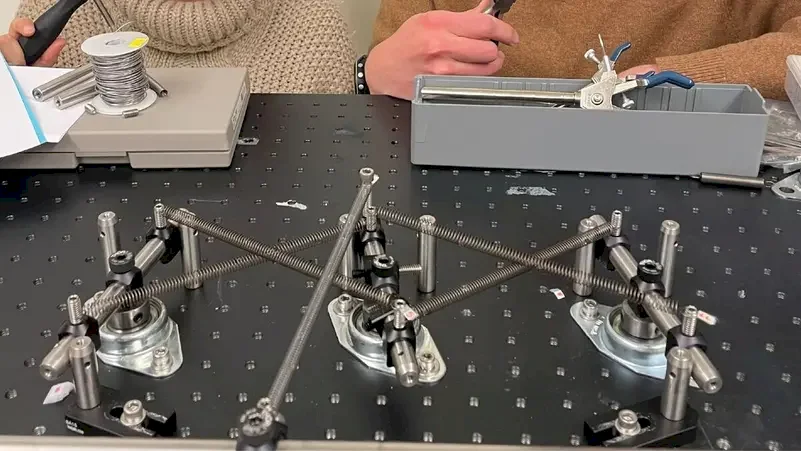
Researchers from St. Olaf College and Syracuse University in the United States have developed a mechanical computing system that does not require an external power source. This system derives its intelligence from the tensile strength of springs and the movement of steel.
These devices, which do not require batteries, perform logic and memory tasks using physical components, and they may serve as an alternative to electronic processors, according to a report from "Interesting Engineering".
Compared to traditional electronics, these devices rely on the "memory" inherent in physical materials (such as rubber, which retains its shape after being stretched).
A Pull-Operated Computer
This project emerged from a simple observation about the physical world. Joey Paulsen, an associate professor of physics at St. Olaf College, stated: "We typically think of memory as something located in a computer’s hard drive or inside our brains."
Paulsen added, "But many everyday materials retain a kind of memory regarding their past — for instance, rubber can "remember" how much pressure or stretching it has previously undergone. The research team wanted to see if we could use everyday materials not just to remember movement, but also to process information — in other words, to perform calculations."
Based on the concept of physical memory, the team designed three mechanical systems made from steel rods and springs.
These devices carry out specific computational tasks: one acts as a counter for physical pull operations, the second functions as a logic gate to differentiate between odd and even inputs, while the third serves as a gauge that retains memory of the applied force.
Together, these systems demonstrate that complex information processing can occur through structural movement instead of electrical signals.
Paulsen said, "We now have a systematic way to build these machines that can perform simple calculations without needing a computer chip or power source."
A Long Road Ahead
It may seem like a step backward, but its implications are futuristic. Silicon chips are fragile; they melt under extreme heat, malfunction in high radiation, and corrode in harsh chemical environments.
In contrast, these mechanical computers are designed to be more robust, operating in environments that might destroy other electronic systems.
For example, there could be a prosthetic limb in the future that senses pressure and reacts without the need for a battery, or a sensor inside an airplane engine that monitors wear using only the engine's vibrations.
Paulsen remarked, "Our results represent a step toward designing materials that can sense their environment, make decisions, and then respond. These materials are often referred to as smart materials, and what we learned could help improve people's lives through more responsive prosthetics or sensory interactive rooms."
To further develop this technology, Paulsen is currently focusing on the scalability and limitations of these mechanical systems.
At this time, students at St. Olaf College are studying how multiple rotors interact with each other and their mutual effects, which may lead to the creation of more complex networks.
These ongoing researches aim to transform these individual components into more advanced and multi-part machines.
 Follow the latest Sada News via Google News
No Miracle in Tokyo.. A Book Returns Japan to the Laws of Urbanization

Al-Swehli Crowned Champion of the Libyan League for the First Time in Its History

Egypt's Public Prosecution Reveals Details of the Investigation with Sabry Nakhnokh

Closure of a Fake Doctor's Clinic Famous for Saying 'We Cleaned and Wiped the Intestines,...

Foods Rich in Water That Help Hydrate the Body, Including Cucumber

Expert Confirms: Artificial Intelligence is Eroding our "Virtue of Patience"

Report Warns of the Expanding Scope of Cyber Attacks Surrounding the 2026 World Cup
