

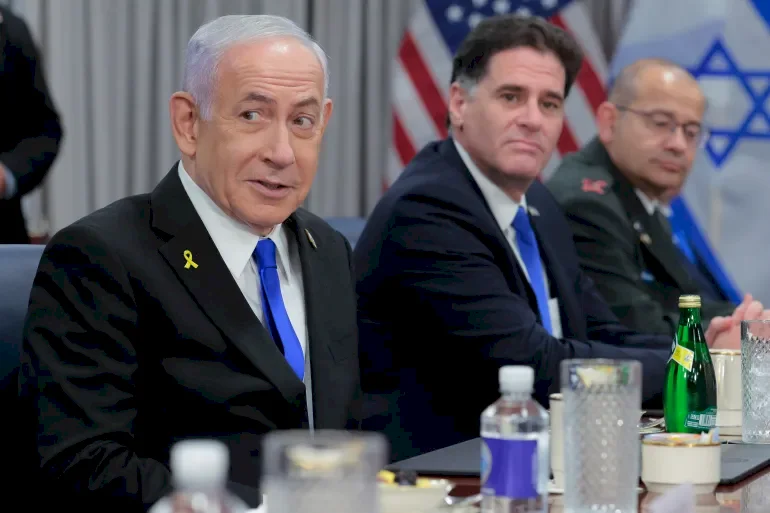
2026 "Madar" Strategic Report: The "New" Israel Closes the Path for a Two-State Solution
SadaNews - The "Madar" strategic report for the year 2026 concluded that the right-wing government led by Benjamin Netanyahu expanded in 2025 and early this year with a strategy of transforming war into an opportunity to build the "new" Israel as a superpower, free from constraints and capable of imposing facts; with a focus on liquidating the Palestinian issue, reshaping the region according to the Israeli balance of power, and taming the internal political system by undermining what remains of liberal controls. However, the approach that began after the attacks of October 7, 2023, and was cemented by the regional expansion of the war, ended in a deadlock that revealed the fragility of the "super Sparta" model heralded by Netanyahu, which was represented by the inability to translate "excess power" into stable political accomplishments.
The report warned that the "new" Israel, in practical terms, was not new in a historical sense, but rather a more explicit intensification and adaptation of its logic and tools, pushing them to the maximum extent.
According to the report, Israel's success in opening paths in the West Bank and Gaza that surpass Oslo realities and close the door on a two-state solution does not end the conflict; rather, it reproduces it within a single political space between the river and the sea, amid a growing erosion of Israel's international legitimacy that has extended in an unprecedented manner into the American political arena across all of its components.
The "Madar" report was released this year under the title: "The 'New' Israel: The Fragile Super Sparta," slightly delayed this year, "out of the center’s desire to explore the implications of the war on Iran and Lebanon and to attempt to include its preliminary implications in the analysis, allowing for a more accurate and comprehensive reading of the ongoing transformations, instead of limiting the reading of 2025 without considering its regional peak that became apparent in early 2026."
The War on Iran: The Limits of the "New" Israel's Power
The report dedicates space to analyze the dynamics of the latest war, which showed that the Israeli strategic thinking pattern remains captive to closed perceptions, despite the discussion sparked by the October 7 attacks in this area, whether in reading the adversary or estimating self-imposed power limits, leading to an exaggeration of the ability to decisively act and a minimization of the complexities of reality.
The report states in this context that Netanyahu's government estimated that it emerged from the years of war (2024-2025) with a surplus of power and achievements, with a clear preferential shift in the geopolitical balance of power in its favor, and that it now possesses enough assets and capabilities to invest in the "Trumpian moment" and transition to a new phase based on consolidating the "new" Israel as a dominant regional power and reshaping the Middle East.
From this perspective, the war on Iran on February 28, 2026, came as the peak of this vision: an attempt to translate surplus power into regional resolution.
The report adds that instead of the war representing the peak of consolidating the "new" Israel, it revealed its limits, as it showed a clear gap between the goals set for the war and the estimates built on its scenarios, and between its actual dynamics and the course of its evolution. It also showed that the gap between the ability to cause widespread destruction and the ability to impose stable political outcomes remains the core crisis of Israeli strategy.
Aligning Behind Netanyahu's Agenda
Regarding the internal Israeli political scene, the report indicated that it has not produced a real alternative to Netanyahu's approach; rather, the opposition itself operates within the same framework based on the centrality of power and war, meaning that the crisis within Israel is a problem within the system itself, not a conflict between distinct political alternatives.
The report considered that the Israeli rally around the war and the idea of resolution by force, along with the normalization of genocidal practices in Gaza and the rampant violence in the West Bank, does not only reflect Netanyahu's government mood but also a prevailing popular sentiment convinced that if they do not crush their enemies, their enemies will crush them.
This mood is reflected in the political field through the complete alignment of the opposition around the war and its objectives, although this does not necessarily mean aligning behind Netanyahu. Ironically, the alignment behind Netanyahu's agenda serves as a political and strategic rationale based on the principle of maximizing force.
The "Lever" of the High-Tech Economy
The report focused on the economic structure, especially the high-tech sector, and its pivotal role in absorbing shocks and preventing the war from turning into a comprehensive economic crisis, noting that high-tech accounted for about 57% of Israeli exports in the first half of 2025, with software and digital services remaining the most significant drivers of surplus in the service balance.
On another front, Israel translated its military superiority into global "market value": its defense exports reached a record level of nearly $15 billion in 2024 (a 13% increase). In a parallel trend, the intertwining of hard power and the "oligarchy" of global technology deepened through partnerships and digital infrastructure — from extensive government cloud computing contracts with Google and Amazon to partnerships in data analysis and artificial intelligence, culminating in an increasing reliance on artificial intelligence and big data systems in targeting and managing operations.
Playing the "Trump Card"
The report concludes by indicating that the international and regional environments, especially under Donald Trump's administration, provided Israel with a wide margin to maneuver through undermining international control systems, warning of the potential counter-repercussions surrounding the Trump-Netanyahu alliance. What seems, in the short term, to be an alliance that multiplies the capacity for destruction might transform, in the medium term, into an additional factor in deepening the American-Israeli gap and accelerating the processes of delegitimization of Israel, cementing its image as a pariah and rogue state, as general sentiment in the United States is increasingly perceiving that Israel pushed the United States towards a war that does not necessarily align with its immediate priorities, which might deepen, with a change in the current administration, the tendency to redefine Israel from a strategic ally into a political, security, and moral burden.
This potential becomes even more crucial in light of the accumulated decline in American public support for Israel.
It is worth noting that the annual "Madar" report, edited by Dr. Hanida Ghanem and involving a select group of specialists on Israeli affairs, includes seven main axes, along with its executive summary, which begins with: the axis of Israel and the Palestinian issue, the internal political/party axis, the external relations axis, the security/military axis, the economic axis, the social axis, and finally, the axis of Palestinians in Israel.
Contributors to the report's sections this year included (in chapter order): Walid Habas, Antoine Shalhat, Khalid Anabtawi, Fadi Nohas, As Atras, Lina Dalasha, Raef Zreik.
 Follow the latest Sada News via Google News
High-level sources reveal to SadaNews: Washington seeks to hold a Gaza Reconstruction Conf...

Iraqji Reveals Details of the Attack on the Iranian Supreme Leader's Headquarters

صراع على إرث خامنئي وسط غياب مجتبى.. والمتشددون يتهمون قادة إيران بـ«الانقلاب»

The European Union Reiterates Its Call for Israel to Refrain from Expanding Settlements in...

"Mamdani Berlin".. The German Left Bets on a Politician of Turkish Descent to Lead the Cap...

Hebrew Channel: Kushner Pushing to Enhance Communication Between the United States and the...

SadaNews Report: Israeli Elections with a Settlement Flavor!
