

How Can Straits Be Closed and What Does Maritime Law Say About It?
SadaNews - Straits are the lifeblood of global trade and industry, through which energy shipments and supply chains nourish various sectors of industry. They are essential for various forms of trade across continents.
They are also vital passages for major naval powers that rely on operations far from their shores, as controlling them or denying an opponent their use influences the maritime balance of power. Therefore, the security of straits is often linked to national defense strategies and international agreements aimed at ensuring freedom of passage and preventing the use of maritime closure as a means of political or military pressure.
Due to the extreme strategic importance of these waterways, they have become influential geopolitical pressure tools in the hands of the states bordering them, which exploit them during crises or conflicts to gain political, military, and economic advantages. They typically become contentious issues during international crises.
The closure of straits can take various forms that go beyond the traditional concept of military blockade, including both hard and soft forms, whether legal or illegal. The repercussions of strait closures can affect the global economy as a whole, due to increased shipping costs and inflation rates, as well as delays in delivery times and disruptions to production cycles.
How Do Countries Close Their Straits?
The methods a country may adopt to close a strait can range from military and physical approaches, to legal and regulatory, and economic methods, including soft or gray strategies.
A. Physical Military Means
Naval Mines: Planting contact mines, magnetic or acoustic mines in the strait to destroy ships or create prohibited areas without the need for heavy naval presence or direct engagement. The United States applied this method in the port of Hai Phong in northern Vietnam in 1972 as part of Operation Pocket Money, which led to significant disruption at the port and subjected shipping movements to negotiation considerations.
Naval Blockades and Coastal Fortifications: Deploying naval fleets, submarines, coastal artillery, and missile platforms on either side of the strait to encircle the passage and prevent enemy ships from crossing or subject them to inspection. The Dardanelles Strait witnessed an early example of deploying coastal artillery and mines against Allied fleets attempting to breach Ottoman defenses in 1915 during World War I.
Anti-Ship Missiles and Drones: Anti-ship cruise and ballistic missiles, along with combat drones and unmanned explosive boats, are used to create exclusion zones near the straits. An example is the targeting of passing ships in the Red Sea by the Ansar Allah group since late 2023, known as the Red Sea crisis.
Seizure and Detention of Ships: Some countries intercept foreign ships, board them, detain them, or redirect them to their ports. For example, Iran seized the British oil tanker Stena Impero in the Strait of Hormuz in 2019.
B. Legal and Regulatory Means
Closure Based on International Treaties: Some countries rely on specific agreements that grant them the authority to restrict the passage of warships during times of war or imminent danger.
In this context, the Montreux Convention of 1936, which regulated traffic in the Turkish straits (Bosphorus and Dardanelles), allowed Turkey in 2022 to restrict the passage of Russian and Ukrainian warships during the ongoing war in Ukraine.
Domestic Legislation and Claiming Internal Waters: Other countries enact domestic laws reclassifying some international straits as internal waters or impose pre-licensing regulations on passage, contrary to the transit regime established in the United Nations Convention on the Law of the Sea.
Russia sought through bilateral agreements and regulations to tighten its control over the Kerch Strait from 2003 to 2018, linking the passage of ships to special licensing and guidance procedures.
Declaring the Strait a Military Zone: Countries can impose effective closure or create navigational hazards by announcing military maneuvers and dangerous areas in crowded waters.
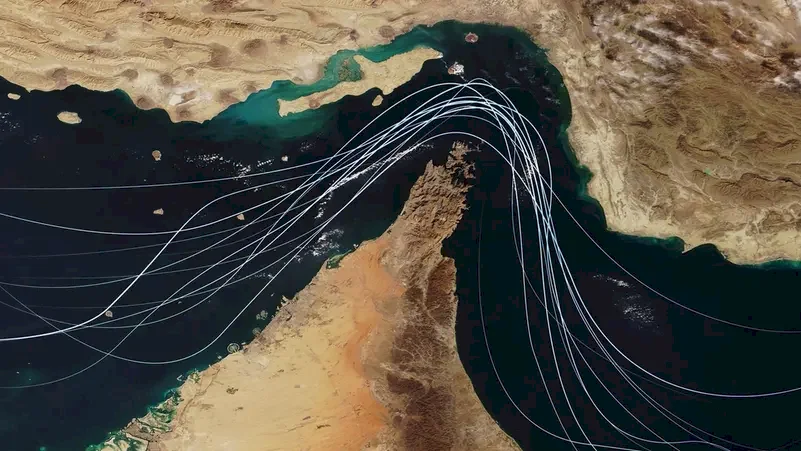
The Iranian Revolutionary Guard announced in March 2026 that the Strait of Hormuz was effectively closed and unsafe for navigation following U.S. and Israeli military strikes.
Interpretation of Laws: Some countries exploit ambiguities in maritime law, claiming that the strait is subject to innocent passage rules rather than unrestricted transit.
This interpretation allows coastal states to suspend passage or impose additional conditions if they believe a vessel's activities threaten their security. Iran, for instance, insists that the regime of innocent passage is not customary law and demands that vessels from non-party states to the Convention, like the United States, comply with innocent passage rules in the Strait of Hormuz.
C. Economic Means
Withdrawal of Insurance Coverage and Increased Risk Premiums: Effective "closure" of the strait can occur if risk levels rise to the point that insurance companies withdraw war risk coverage or increase premiums to exorbitant levels (such as 1% of the ship's value or more), resulting in shipowners and shipping companies avoiding that passage.
The Strait of Hormuz saw a collapse in transit rates in early 2026 after several protection and indemnity clubs withdrew war risk coverage following mutual military strikes between Israel and the U.S. on one side and Iran on the other, leading to a decline in shipping traffic by over 80% compared to usual levels.
D. Soft and Gray Means
Selective Targeting: Some countries use non-state armed groups to target ships belonging to specific nations, resembling the imposition of selective "maritime sanctions" while maintaining plausible deniability. Houthi attacks in the Red Sea and Bab el-Mandeb since 2023 have focused on ships linked to Israel, the U.S., and the U.K., while allowing passage of vessels from other states.
Jamming Navigation Systems (Electronic Warfare): This includes jamming Global Positioning Systems and spoofing Automatic Identification System data, creating confusion over ship locations and identities, increasing navigational risks in narrow passages, and facilitating the concealment of attack sources. In recent years, patterns of jamming and manipulation of navigation signals have been observed in the Gulf, the Strait of Hormuz, and the Sea of Oman, accompanied by the detention and targeting of commercial vessels.
Maritime Militias and Soft Blockades: Some countries rely on coast guard forces, paramilitary units, and "fishing militias" to create a maritime reality by harassing ships and imposing restrictions on their operations, dragging them forcibly to certain ports without declaring a state of war or an official blockade. China has been accused of using this method in the South China Sea by deploying armed coast guard and fishing vessels to assert its maritime claims and push ships from other countries to alter their routes or reduce activity in contested areas.
Countries rarely rely on a single tool; they often integrate direct military threats from missiles and drones with electronic jamming, rising insurance premiums or withdrawal of coverage, and legal and regulatory measures to create a multidimensional effective closure.
The events in the Strait of Hormuz in March 2026 exemplify this pattern, where missile strikes, official warnings, and navigation jamming converged, while insurance companies withdrew, reducing transit activity to its lowest levels without declaring a traditional blockade.
Straits in Maritime Law
International law stipulates that a country's authority extends to 12 nautical miles from its shores, meaning any strait less than 24 nautical miles wide is subject to the complete territorial sovereignty of the surrounding states, granting some straits special legal provisions, such as a state's right to close it for security reasons under certain conditions according to international law.
The United Nations Convention on the Law of the Sea, ratified in 1982, established the transit regime in straits, and among its key provisions is:
Defining the principle of "transit passage" which facilitates rapid navigation in straits connecting areas of high seas and exclusive economic zones (EEZ), allowing naval ships—including submarines—to pass through these areas in their normal operating conditions without requiring them to navigate on the surface.
In contrast, the principle of "innocent passage" applies to waters under state sovereignty, where vessels must transit on the surface, and submarines must raise their flags, while aircraft cannot fly over them.
Passage is considered innocent as long as it does not harm the peace, security, or public order of the coastal state, which has the right to suspend it in its territorial waters for security reasons. However, the International Court of Justice ruled in the Corfu Channel case in 1949 that innocent passage in international straits cannot be suspended in peacetime.
Consequences of Closing Straits and How Countries Respond
Decisions to close straits or paralyze traffic within them have immediate and significant repercussions affecting most global supply chains, forcing ships to alter their routes, which often leads to increased transportation costs, insurance premiums, and extended travel times, along with additional risks and costs.
For instance, rerouting a maritime journey from the Red Sea to the Cape of Good Hope can extend the duration by up to 10-15 days, leading to significantly greater fuel consumption, coupled with increased insurance costs, raising overall maritime transport costs by up to 130% during the Red Sea crisis.
This disruption also affects manufacturing processes based on the continuous flow of components, leading to a breakdown of global trade networks, along with implications for inflation rates and the potential for a global economic recession, with impacts extending to sensitive aspects such as the depletion of states' strategic reserves.
Therefore, countries are always keen to preserve freedom of navigation in sensitive straits through various means, such as demining operations, which take significantly longer than laying mines, and become even more complicated when there is targeting or a blockade of the strait.
At times, countries are compelled to send naval fleets to escort commercial ships, as indicated by U.S. President Donald Trump regarding the possibility of this occurring amid the Israeli-American-Iranian war in March 2026. The U.S. Navy previously undertook this in 1987 and 1988 during what was known as the Tanker War.
Countries also form multinational naval alliances to protect shipping routes, such as the multinational "Guardian of Prosperity" alliance established at the end of 2023 at the initiative of the United States, aimed at safeguarding commercial vessels in the Red Sea, intercepting drones and missiles, and even sometimes carrying out preemptive air strikes.
Source: Al Jazeera
 Follow the latest Sada News via Google News
Bezhkian: Directives from the Leader to End the State of No War, No Peace

Saudi Arabia condemns the Houthi threats to navigation and pledges to protect its ships

Global Warning to Americans Due to Rising Tensions in the Middle East

Houthi Movement Announces Ban on Maritime Navigation Against Saudi Arabia

Earthquake of 5.5 Magnitude Hits Western Iran

To Enhance His Support for "Increasing Children"... Vance Announces the Birth of His Fourt...

Death of a Mosque Imam in Armed Attack in Southeastern Iran
