

Islamabad Negotiations Begin Amid Doubts and Mutual Conditions
SadaNews - High-level U.S. and Iranian leaders began a track of negotiations on Saturday in Islamabad, Pakistan, aimed at ending the war that erupted between the two sides six weeks ago. However, Tehran cast shadows of doubt on the possibility of formal talks beginning, stating that these cannot commence without commitments regarding Lebanon and sanctions.
The indirect talks are considered high-risk as they aim to end the war in the Middle East; nevertheless, the ceasefire mediated by Pakistan still faces obstacles, with ongoing exchanges of fire between the Israeli army and Hezbollah fighters along the southern Lebanese border, as Iran insists on preconditions before negotiations can start.
Pakistani Prime Minister Shehbaz Sharif noted that the conflict has entered a "difficult stage" as parties attempt to move from a temporary cessation of hostilities to a more durable settlement, adding that they find themselves at a "critical moment."
The White House announced that Vice President J.D. Vance held a bilateral meeting with the Pakistani Prime Minister on Saturday. The U.S. delegation also includes Steve Witkoff and Jared Kushner, while the Pakistani side includes Interior Minister Mohsin Naqvi and Foreign Minister Ishaq Dar.
Starting Stalemate
The U.S. delegation arrived on two U.S. Air Force planes at an airbase in Islamabad Saturday morning. The Pakistani Foreign Office stated that the Foreign Minister and Interior Minister, along with the Army Chief, received the U.S. delegation led by Vance on Saturday.
It added, in a statement, that Dar praised the United States’ commitment to achieving lasting peace and stability both regionally and globally, expressing hope that all parties would engage constructively, reiterating Pakistan's desire to continue facilitating efforts aimed at reaching a permanent and sustainable solution to the conflict.
Dar expressed hopes for constructive U.S. and Iranian participation in peace talks. A statement from the Pakistani Foreign Office mentioned that Dar reiterated Islamabad’s desire to continue working towards bringing both sides closer to a "lasting and solid resolution to the conflict."
Before leaving for Pakistan, Vance warned Iran against "manipulating" the United States. Hours later, U.S. President Donald Trump expressed his wishes for Vance's success, adding, "We’ll find out what’s happening. They have been defeated militarily."
In response, the Iranian delegation arrived early Saturday morning in Islamabad, headed by Speaker of Parliament Mohammad Baqer Qalibaf, who stated on the platform "X" that discussions would only take place if a ceasefire is achieved from the Israeli side in Lebanon and if frozen Iranian assets are released.
The Iranian delegation arrived late Friday night. It includes the nuclear negotiating team led by Foreign Minister Abbas Araghchi, alongside Central Bank Governor Abdolnaser Hemmati, Deputy Secretary of the Supreme National Security Council for International Affairs Ali Bagheri Kani, High Defense Committee Secretary Ali Akbar Ahmadian, as well as several members of parliament.
These negotiations will be the highest level discussions between the U.S. and Iran since the 1979 revolution, and the first formal direct talks between the two sides since 2015, when they reached an agreement regarding the Iranian nuclear program. Trump withdrew the U.S. from the agreement in 2018 during his first term, while the late Supreme Leader Ali Khamenei, killed at the beginning of the war six weeks ago, banned any further direct talks between U.S. and Iranian officials.
Iranian Messages
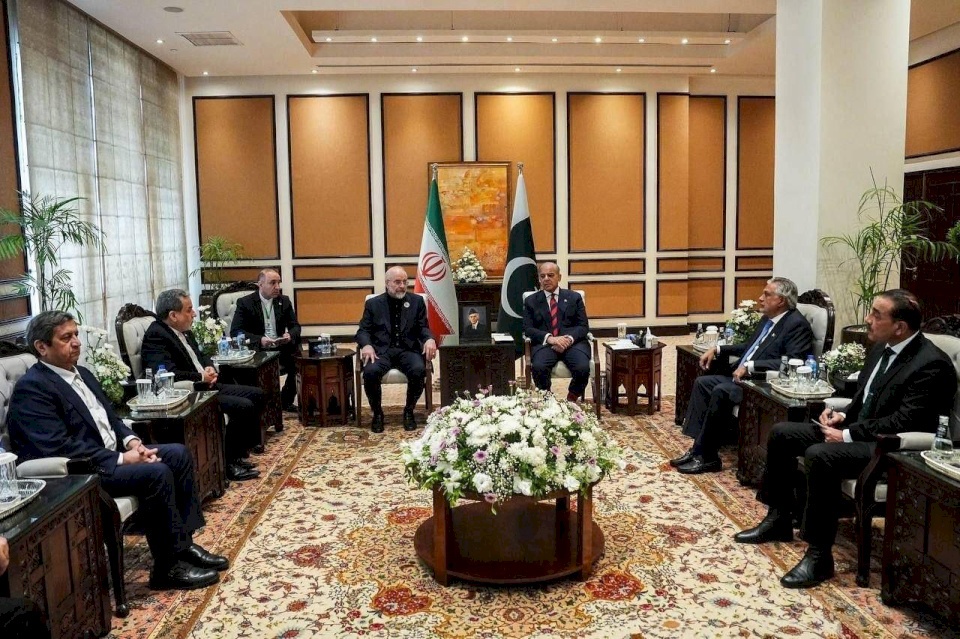
Iranian media reported that the Iranian delegation held a meeting on Saturday morning to discuss the course of negotiations. Hours earlier, Iranian state television announced that the Iranian negotiating team, headed by Qalibaf, met with the Pakistani Prime Minister to discuss the timing and manner of the "potential negotiations."
No comment has been made by the Iranian delegation or the Prime Minister's Office regarding the meeting held in Islamabad.
In the same context, the "Fars" and "Tasnim" agencies affiliated with the "Revolutionary Guard" reported that the Iranian delegation, led by Qalibaf, met with the Chief of the Pakistani Army following its arrival in the Pakistani capital.
The agencies stated that the Iranian delegation expressed during the meeting its protest against what it described as the U.S. failure to uphold its commitments at this stage of the negotiations.
They added that Tehran had set conditions for beginning talks following a U.S. request for a ceasefire, which included releasing frozen Iranian assets and implementing a ceasefire in Lebanon; noting that the Pakistani mediator informed Iran of Washington's consent to these conditions, yet they have not been implemented thus far.
According to reports from the agencies, Iran has maintained, in response, its restrictions on the passage of oil tankers through the Strait of Hormuz unchanged.
Preconditions
At the same time, a senior Iranian source stated that the United States agreed to release frozen Iranian assets in Qatar and other foreign banks, but an American official quickly denied this.
The Iranian source described this step as an indicator of "seriousness" in seeking to reach an agreement during the Islamabad talks, indicating that the release of the assets was one of the demands communicated by Tehran to the U.S. side in exchanged messages and that Iran had received U.S. approval in this regard.
The source, who requested anonymity due to the sensitivity of the file, stated that lifting the freeze on these assets is "directly linked to ensuring safe passage through the Strait of Hormuz," referring to one of the most prominent issues on the agenda.
The source did not reveal the total value of the assets that he claimed Washington agreed to release, but a second Iranian source stated that the United States agreed to release six billion dollars of frozen Iranian funds in Qatar.
The Qatari Foreign Ministry did not immediately comment on this information.
These funds, originally frozen since 2018, belong to revenues from Iranian oil sales to South Korea, which had been seized in South Korean banks after the re-imposition of U.S. sanctions on Iran during Trump's first term, following Washington's withdrawal from the nuclear agreement.
The six billion dollars were meant to be released in 2023 as part of a prisoner exchange deal between the U.S. and Iran, but the Biden administration froze the funds again after the October 7, 2023, attacks on Israel.
U.S. officials at that time stated that Iran would not be able to access these funds in the near future, affirming Washington's right to freeze the account entirely.
Under the prisoner exchange deal mediated by Qatar in September 2023, the funds were transferred to bank accounts in Qatar. The deal included the release of five American citizens who were held in Iran in exchange for the release of the funds and the release of five Iranians who were held in the United States.
U.S. officials at that time stated that the funds were designated for humanitarian uses only, and that they would be channeled through approved entities to procure food, medicine, medical equipment, and agricultural products sent to Iran, under the supervision of the U.S. Treasury Department.
In parallel, Fars agency reported that Tehran is not accepting what it described as an "attempt to separate Israel from the United States" in the ongoing negotiations mediated by Pakistan, warning of a scenario that holds Israel responsible while exonerating Washington.
It quoted an informed source as saying that some parties are trying to present Israel as an independent and disruptive party, allowing the U.S. administration to absolve itself of responsibility, but the Islamic Republic "completely rejects this separation and this duality," holding the United States responsible for the failure to reach results in these talks.
Fars also reported, quoting a knowledgeable Iranian source, that intensive diplomatic consultations have been ongoing since last night to push the United States to fulfill its commitments, while some parties have spoken about progress in this regard.
The source stated that Tehran does not accept what it described as an "attempt to separate Israel from the United States" in the ongoing negotiations mediated by Pakistan, warning of a scenario that shifts the blame to Israel, allowing the U.S. government to evade its responsibility.
He added that Tehran "completely rejects this separation and this duality," stating: "It is said that Israel is obstructing, but we do not see it as a player separate from Washington's decisions, and we hold the United States responsible for the failure to reach results in these negotiations."
For its part, Tasnim reported that the Iranian delegation led by Qalibaf arrived in Islamabad, comprising security, political, military, economic, and legal committees, and that Araghchi, Ahmadian, Hemmati, along with various members of parliament, are participating in the visit.
It added that talks with the U.S. side will commence if the opposite party accepts the preconditions set by Iran.
Washington Raises the Bar
Qalibaf stated on the X platform that Washington has pre-approved lifting the sanctions on Iranian assets and establishing a ceasefire in Lebanon, where Israeli attacks on Hezbollah fighters have resulted in nearly two thousand deaths since the fighting began in March, adding that negotiations will not begin until these commitments are honored.
Araghchi stated that his country enters negotiations on Saturday with the U.S. while holding a "deep distrust," as the Islamic Republic has faced two attacks during negotiations regarding its nuclear program.
Araghchi warned that his country would respond if attacked, according to a statement published by his office on "Telegram." He also called, during his Friday conversation with his German counterpart Johann Wadephul, for a cessation of Israeli attacks on Lebanon.
Israel and the United States have stated that the campaign in Lebanon is not part of a ceasefire between Iran and the United States, while Tehran insists that it is.
State-run Iranian media reported that Qalibaf stated in a separate statement that Iran is ready to reach an agreement if Washington offers what he describes as a real agreement and recognizes its country’s rights.
The White House has not yet commented on Iran's demands, but Trump noted on social media that the only reason the Iranians are alive is to negotiate an agreement.
He stated: "It seems the Iranians do not realize they have no winning cards, except for extorting the world in the short term by using international waterways. The only reason they are alive today is to negotiate!"
Vance stated, while heading to Pakistan, that he expects a positive outcome, but added: "If they try to manipulate us, they will find that the negotiating team is not so responsive."
Sources in Islamabad stated that Pakistani officials held preliminary discussions, each separately, with preparatory teams from both sides.
The Iranian semi-official "Tasnim" agency reported that these teams included 70 members from Tehran, including technical specialists in economic, security, and political fields, in addition to media personnel and support staff. A Pakistani government source indicated that about 100 members of the U.S. preparatory team were in the city.
Another Pakistani source close to the discussions stated: "We are very optimistic." In response to a question about whether the talks would conclude on Saturday, he stated: "It is too early to determine that. They are instructed to reach an agreement or withdraw. So they are not in a hurry. These talks are not time-bound."
Hormuz at the Heart of Negotiation
Islamabad is witnessing unprecedented lockdown measures ahead of the talks, with thousands of paramilitary forces and army personnel deployed in the streets.
Pakistan’s State Minister for Interior Talal Chaudhry said: "We have taken multiple-level security measures for this event based on coordination, intelligence information, and continuous monitoring to ensure that there are no disturbances and total control."
Trump announced on Tuesday a two-week ceasefire in the war, leading to the suspension of U.S. and Israeli airstrikes on Iran.
However, that did not end the Iranian closure of the Strait of Hormuz, which has caused the largest disruption ever in global energy supplies, nor did it ease the pace of the parallel war between Israel and Hezbollah.
Tehran's agenda in the Islamabad talks also includes demands for significant new concessions, including an end to sanctions that have crippled its economy for years and recognition of its authority over the Strait of Hormuz, where it aims to collect tolls and control access, which would represent a significant shift in the regional balance of power.
Iranian ships were sailing through the strait without obstruction on Friday, while ships from other nations remained trapped inside.
The disruption of energy supplies has exacerbated inflation and slowed the global economy, and this impact is expected to last for several months even if negotiators succeed in reopening the strait.
Shadow of Heavy War
The hardline stance taken by Iranian leaders before negotiations follows a message from the new leader Mojtaba Khamenei on Thursday.
Khamenei, who has not appeared in public since taking office after his father was killed on the first day of the war, stated that Iran will demand compensation for all damages incurred during the conflict, adding: "We will certainly not leave unpunished the criminal aggressors who attacked our country."
Despite Trump declaring victory and weakening Iran's military capabilities, the war has not achieved many of the initial objectives, such as depriving Iran of the ability to strike its neighbors, dismantling its nuclear program, and facilitating its people's overthrow of their government.
Iran still possesses missiles and drones capable of striking its neighbors, along with more than 400 kilograms of uranium enriched to levels close to those required for making a bomb. Its rulers, who faced a popular uprising just a few months ago, have stood firm against the attack with no sign of organized opposition.
Mohammad Reza Aref, Iran's first vice president, stated on Saturday that peace talks between the United States and Iran could yield an agreement if U.S. officials work in favor of their country in line with the principle of "America First" adhered to by President Donald Trump.
Aref noted in a social media post: "But if we face representatives of the 'Israel First' principle, there will be no agreement." He warned that "the world will face greater costs" if talks fail and the U.S. and Israel resume war against Iran.
Retired General and prominent defense analyst Tariq Rashid Khan stated on Saturday: "I believe there will be good news, big news this week as a result of these talks."
He added that the Chief of the Pakistani Army General Asim Munir played a crucial role in bringing both sides to the negotiating table, and that Pakistan offered to mediate as any further escalation could lead to a wider conflict.
The streets of the Pakistani capital, usually crowded, appeared deserted on Saturday, as security forces closed roads ahead of high-level talks between U.S. and Iranian officials to end their war, which has lasted nearly six weeks. Pakistani authorities urged Islamabad's residents to remain in their homes, making the city seem like it was under a curfew.
Pakistani Information Minister Attaullah Tarar stated that the government has established a modern and advanced media center to facilitate the work of Pakistani and foreign journalists covering the talks between the U.S. and Iran.
He added to reporters that the facility, located in the heart of the conference hall, provides high-speed internet service and a range of free services to support media coverage, as shuttle services have been arranged to transport journalists between the media center and a hotel located in the city’s main commercial area.
 Follow the latest Sada News via Google News
Axios: Trump Wants to End the War.. While Netanyahu Seeks to Resume It

Poll: Sharp Decline in Netanyahu's Popularity in Northern Israel Due to Lebanese War

Jerusalem Governorate: Integrating "Temple" Groups into the Occupation Police at Al-Aqsa i...

Prisoners' Club: The Israeli Supreme Court's Decision Regarding Red Cross Visits Is Ineffe...

Message from Mojtaba Khamenei to the Iranian Interior: What Did It Contain?

Israeli Division After Washington Publishes Details of Ceasefire Agreement in Lebanon

Ben Gvir: Ceasefire with Lebanon is a Grave Mistake
