

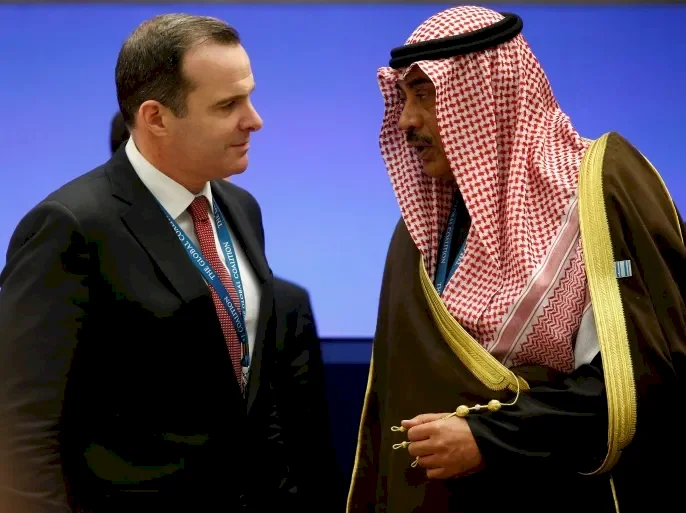
Adviser to Four Presidents.. The Man Who Shaped Washington's Vision for the Middle East
SadaNews - Former American diplomat Brett McGurk is considered one of the longest-serving figures in the White House and one of the most controversial due to his role in shaping and articulating U.S. policies toward the Middle East over the past two decades. Foreign Policy magazine dedicated an extensive profile to McGurk titled "The Man Who Shaped Washington's Vision for the Middle East," stating that he has advised four presidents from both the Democratic and Republican parties, making his career a revealing lens for understanding the evolution of American interaction with the region, its contradictions, and repercussions for almost a quarter of a century. Although McGurk (53 years old) is largely unknown outside decision-making circles, his influence has extended across four presidential administrations from George W. Bush (2001-2009) to Joe Biden (2021-2025), with a brief but significant interruption during Donald Trump's first term. According to Foreign Policy, McGurk's engagement with Middle Eastern issues began in the context of a major crisis, as he was serving as a law clerk to the Chief Justice during the September 11, 2001 attacks, which made him a close witness to the shock that redirected American foreign policy toward the Middle East. The Iraqi File In just two years, he traveled to Iraq and engaged in American efforts to rebuild the state following the overthrow of President Saddam Hussein's regime, where he began to adopt an ambitious vision for promoting democracy in the land of the two rivers, but soon shifted to a more pragmatic approach as sectarian violence escalated. During a later phase of American intervention in Iraq, McGurk contributed to shaping policies during one of the most critical phases of the war, including the decision to increase American troops in 2007. However, his experience in Iraq stirred some controversy due to his close relationship with Iraqi Prime Minister Nouri al-Maliki (2006-2014), as critics argued that Maliki's sectarian policies contributed to destabilization. Nonetheless, McGurk defended his dealings with him as a realistic necessity in a politically divided environment. Under Obama During President Barack Obama's tenure (2009-2017), McGurk's influence expanded further, playing a pivotal role in coordinating the international coalition against ISIS and dealing with a complex network of regional partners. Among the key decisions he made during that period was his support for Syrian Kurdish forces—especially the People's Protection Units (YPG)—as a primary ground force against ISIS, a strategy that was militarily effective according to Foreign Policy but led to significant tension with Turkey, which viewed those forces as an extension of designated terrorist organizations. McGurk's role also extended to high-stakes diplomacy, as he was one of the key participants in negotiating the release of Americans held in Iran, including journalist Jason Rezaian, showcasing his ability to operate in complex environments, but that also sparked political controversy regarding the financial aspects associated with the deals. However, McGurk's career in American decision-making circles came to a halt during Trump’s administration, specifically in 2018, when he resigned in protest over the decision to withdraw American troops from Syria, a decision that also prompted then-Defense Secretary James Mattis to resign. Under Biden McGurk quickly returned to power with President Biden's administration in 2021, assuming the position of Coordinator for Middle Eastern and North African Affairs at the National Security Council. In that role, McGurk sought to adopt a more cautious approach focused on scaling back grand ambitions and emphasizing "gradual progress" and aligning goals with means, learning from past lessons. Among his notable initiatives was recalibrating relations with Saudi Arabia, especially in light of the repercussions of the war in Ukraine on energy markets. He also worked on a broader project to normalize relations between Israel and Arab countries, focusing on reshaping regional balances. However, this approach faced criticism for what was seen as sidelining the Palestinian issue. These criticisms emerged strongly after the Al-Aqsa Flood operation on October 7, 2023, making McGurk a central figure in shaping the American response, strongly supporting Israel while also engaging in de-escalation efforts and facilitating the release of hostages. According to Foreign Policy, McGurk's handling of the Gaza War encapsulates the fundamental tension in his career between political realism and humanitarian considerations. While he contributed to achieving temporary ceasefires and facilitating the flow of aid, critics argue that his support for the Israeli war undermined Washington's credibility on human rights issues. Between Interests and Values Throughout his career, McGurk has consistently adopted an approach based on political realism, believing that human rights should remain a part of foreign policy without overshadowing other strategic interests. This position has placed him in confrontation with proponents of a values-based approach within the Democratic Party, as evaluated by the magazine. Therefore, the man's legacy in the White House remains deeply contested. While some see him as a brilliant strategist who contributed to tangible achievements such as defeating ISIS and strengthening alliances, others view him as a manifestation of U.S. failures in the Middle East, from the repercussions of the Iraq War to the tragedy in Gaza. Nevertheless, the magazine emphasizes that McGurk's influence is undeniable, as few have maintained such a sustained presence across successive administrations, participating in decision-making processes during both peace and war, reflecting his ability to maintain the trust of presidents alongside his political skill and flexibility. The magazine concludes that McGurk's career reflects in some ways the trajectory of American policy in the Middle East, encompassing wide interventionist ambitions, an awareness of the limits of power, and a shift toward pragmatism. Source: Foreign Policy
 Follow the latest Sada News via Google News
High-level sources reveal to SadaNews: Washington seeks to hold a Gaza Reconstruction Conf...

Iraqji Reveals Details of the Attack on the Iranian Supreme Leader's Headquarters

صراع على إرث خامنئي وسط غياب مجتبى.. والمتشددون يتهمون قادة إيران بـ«الانقلاب»

The European Union Reiterates Its Call for Israel to Refrain from Expanding Settlements in...

"Mamdani Berlin".. The German Left Bets on a Politician of Turkish Descent to Lead the Cap...

Hebrew Channel: Kushner Pushing to Enhance Communication Between the United States and the...

SadaNews Report: Israeli Elections with a Settlement Flavor!
