

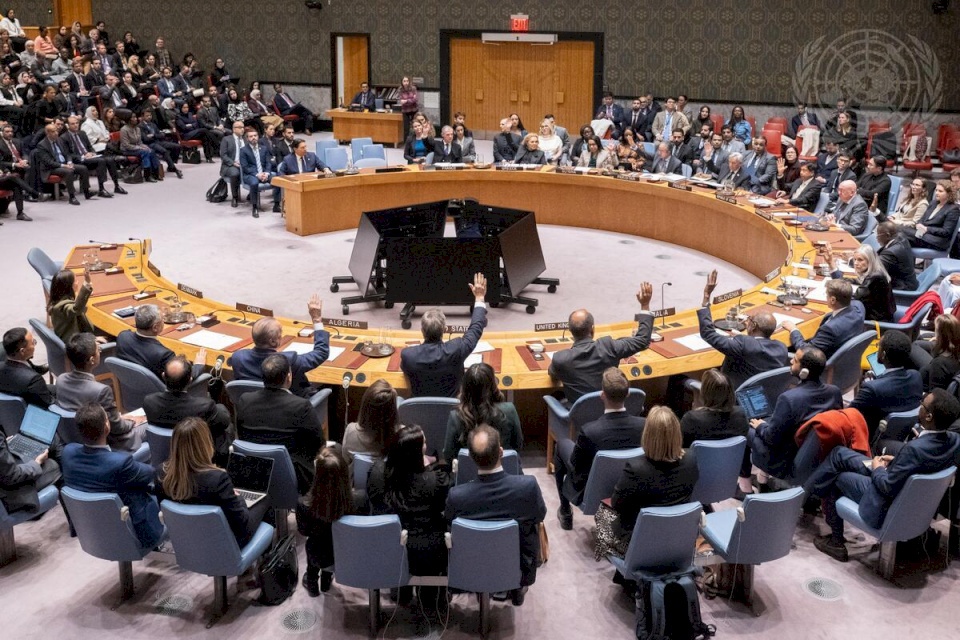
The Security Council Postpones Voting on a Text Authorizing the Use of Force to Protect the Strait of Hormuz
SadaNews - The United Nations Security Council has postponed the vote that was scheduled for Friday on a draft resolution presented by Bahrain that authorizes the use of "defensive" force to protect navigation in the Strait of Hormuz from Iranian attacks, according to the official schedule.
The 15-member council was supposed to vote on the draft resolution presented by Bahrain on Friday morning, but the schedule changed on Thursday night.
The stated reason is that the United Nations considers "Good Friday" a public holiday, according to diplomatic sources, despite the fact that this information was known when the voting date was announced.
No new date for the vote on the text has been set.
Meanwhile, diplomatic sources indicated that Russia, China, and France opposed this move, which led to its postponement.
Iran has imposed a blockade on the vital Strait of Hormuz in response to U.S.-Israeli strikes that ignited the fuse of Middle Eastern warfare, threatening fuel supplies and destabilizing the global economy.
The Permanent Representative of the Kingdom of Bahrain to the United Nations, Ambassador Jamal Al-Ruwaihi, warned this week about "the continuation of this situation, and the possibility of an economic strangulation and terrorism against our countries, and also against the world."
He stated that the text, which has undergone several amendments and is supported by the United States, "comes at a sensitive and important time."
U.S. President Donald Trump urged on Wednesday countries suffering from fuel shortages to "go get their oil" in the Strait of Hormuz, adding that U.S. forces would not assist them in that.
The sixth and final draft of the text allows member states, either unilaterally or "as voluntary multinational maritime partnerships," to use "all necessary and proportionate defensive means commensurate with the circumstances" to ensure the safety of vessels.
This applies to the strait and adjacent waters "to secure transit passage and deter attempts to close, obstruct, or interfere in any way with international navigation through the Strait of Hormuz."
This procedure is expected to last for at least six months.
However, the draft resolution does not enjoy consensus.
China has stated in the Security Council that "allowing member states under the current circumstances to use all necessary measures... could lead to further escalation," while Russia denounced the text as "biased."
For his part, French President Emmanuel Macron considered on Thursday that a military operation to "liberate" the strategic strait is "unrealistic" as it would take "too long and put anyone crossing the strait at risk."
Before its closure, about one-fifth of the world's oil and liquefied natural gas passed through the Strait of Hormuz.
Consequently, this impacts global supplies of vital commodities such as oil, liquefied natural gas, and fertilizers, leading to sharp increases in energy prices.
UN Security Council decisions that authorize member states to use force are relatively rare.
During the Second Gulf War, a vote in 1990 allowed a U.S.-led coalition to intervene in Iraq. In 2011, a similar vote permitted NATO intervention in Libya.
 Follow the latest Sada News via Google News
Jordanian Army Intercepts 4 Iranian Missiles and 4 Drones

Death of a Moroccan Man During His Arrest in Italy Sparks Calls for Investigation

Due to Trump's Sanctions.. Canada Cancels Joint Ceremony with the US for Bridge Opening

Trump: We will make great progress with Beirut.. Aoun: It is time for Lebanon to be stable

The Lebanese Army Deploys in the South and Comes Under Gunfire; Israel Clarifies

Bezhkian: Directives from the Leader to End the State of No War, No Peace

Meeting Between Aoun and Trump Expected Alongside 'Experimental Areas'
